
Automatically apply for jobs with Zippia
Upload your resume to get started.
Test operator skills for your resume and career

15 test operator skills for your resume and career
1. Test Equipment
Test equipment is a mechanical tool or a device which is used create signals and gather response from an electronic device under test. It helps in detecting any faults in the device and it also proves the proper operation of the electronic device.
- Performed Final Quality Control testing for both Manufacturing and Customer Service Field Returns using system level diagnostics and automated test equipment.
- Operated and performed troubleshooting and repair on integrated circuit test equipment leading greatly improved machine up time and production output numbers.
2. Hand Tools
- Assemble wire and cable, read blueprint, soldering through holes, surface mount, build harness, used hand tools.
- Perform minor repairs on rejected PC boards using soldering iron and hand tools and send back to test.
3. Test Procedures
Test procedure i defined as a tool for conducting an experiment to analyze or observe the specifications of a process or application.
- Set up and conduct routine repetitive test on final assemblies using electronic testing equipment following established test procedures.
- Tested a variety of electronic device using prescribed test procedures.
4. Test Results
- Qualified to accept or reject tubes based on specification requirements, recorded data and notify supervisor of any unusual test results.
- Recorded inspection and test results to compared results with specifications.
5. Safety Rules
Principles or regulations that ensure the protection of people, objects, or the environment are called safety rules. These rules can be governing actions, devices, or procedures that help in minimizing the risks of loss, injury, or damage.
- Maintain and follow up the importance of ISO, ESD, and Safety Rules.
- Follow safety rules, and PPE.
6. Circuit Boards
A circuit board refers to an electronic device used to offer mechanical support and connect components electrically using signal traces and conductive pathways.
- Recorded defective circuit boards and communicated with technicians to resolve any issues
- Performed manual assembly of electronic components into printed circuit boards.
Choose from 10+ customizable test operator resume templates
Build a professional test operator resume in minutes. Our AI resume writing assistant will guide you through every step of the process, and you can choose from 10+ resume templates to create your test operator resume.7. Math
- Solve math equations quickly and accurately without calculator.
- Achieved enhancement in shop math: trigonometry, compound angles, and geometry.
8. Windows
Windows is a chain of operating systems that controls a computer and is developed by Microsoft. Every version of Windows consists of GUI (graphical user interface), with a desktop that allows the user to open their files.
- Loaded different test programs on Windows, DOS and UNIX operating systems, setting up handlers for testing semiconductors.
- Utilized DOS, Windows, Unix, and Microsoft Office to log any failures found in a UUT.
9. Quality Standards
Quality standards are a specific level of standards of products that are set by the companies for the customers that have to be met and maintained throughout the process until the time of delivery. Quality standards are information that includes the customer's requirements, guidelines, and characteristics for the needed final product or service.
- Reviewed recorded information for accuracy and completion while ensuring on time delivery maintaining quality standards.
- Maintain a clean and sanitary shop that meets all OSHA quality standards and requirements.
10. Test Fixtures
- Use different test fixtures to test the gaming board, make sure the programs are running properly in any single unit.
- Operated standard test fixtures, power tools and equipment designed specifically for assembling and testing the company s products.
11. Frac
- Strap and calculate flow rate during drill out on frac tanks.
- Have maintained and operated frac manifolds for Edge since hiring on.
12. JSA
- Rejuvenated SafeStart program, wrote JSA's, held safety meetings and performed safety audits to enhance safety awareness.
- Initiate job safety analysis (JSA) procedures and hazard recognition practices prior to any job task.
13. Data Collection
Data collection means to analyze and collect all the necessary information. It helps in carrying out research and in storing important and necessary information. The most important goal of data collection is to gather the information that is rich and accurate for statistical analysis.
- Travel to remote field locations to interface with end user personnel in support of data collection during system integration assessments.
- Managed data collection, analysis, and data entry for printers from prototype phase through to production.
14. Functional Test
- Verified products met operating specifications by performing functional tests and configured products to customer orders.
- Programmed boards and performed functional testing using oscilloscopes on 7 boards simultaneously.
15. ICT
- Test operator ICT, Pre-ESS, Oven, Functional Machine Conducted hot/cold temperature tests for server circuit board.
- Performed different tests, such as ICT and FVT for different types of assemblies.
5 Test Operator resume examples
Build a professional test operator resume in minutes. Browse through our resume examples to identify the best way to word your resume. Then choose from 5+ resume templates to create your test operator resume.

What skills help Test Operators find jobs?
Tell us what job you are looking for, we’ll show you what skills employers want.
List of test operator skills to add to your resume
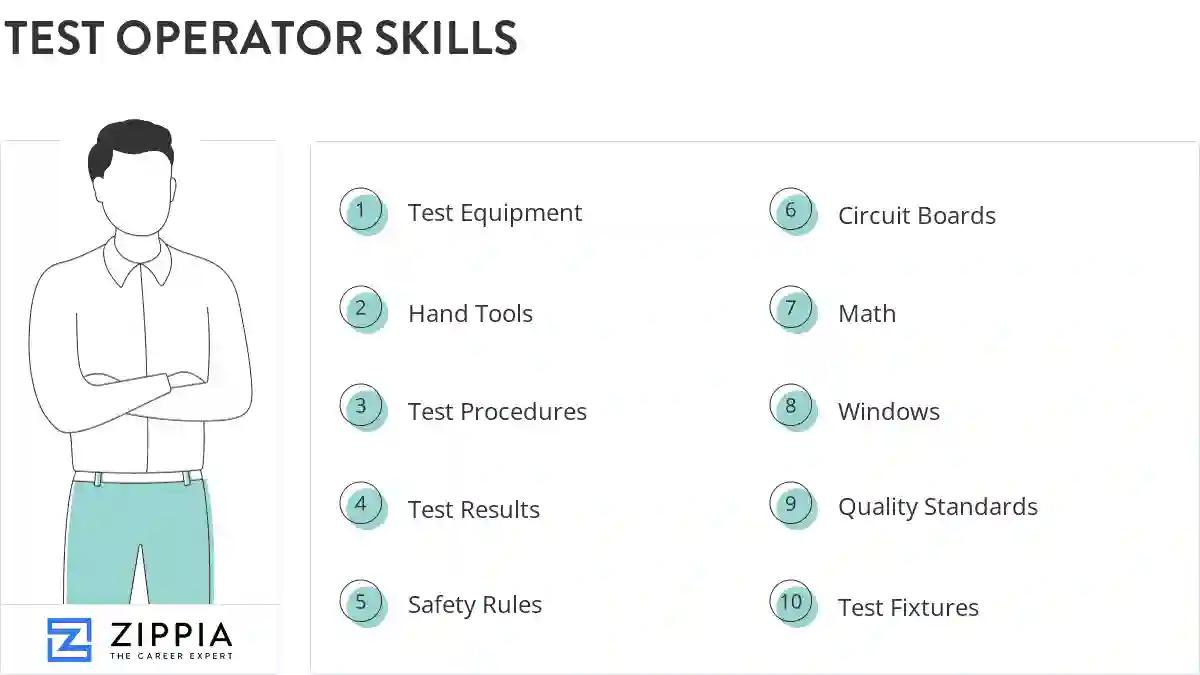
The most important skills for a test operator resume and required skills for a test operator to have include:
- Test Equipment
- Hand Tools
- Test Procedures
- Test Results
- Safety Rules
- Circuit Boards
- Math
- Windows
- Quality Standards
- Test Fixtures
- Frac
- JSA
- Data Collection
- Functional Test
- ICT
- Flowback
- Production Equipment
- PCB
- RF
- Safety Procedures
- PC
- Preventative Maintenance
- R
- Resistors
- Capacitors
- Linux
- ESD
- Various Testing
- Brazing
- Electronic Assemblies
- PPE
- ISO
- Clean Room Environment
- Test Reports
- Assembly Line
- Equipment Maintenance
- Test Machines
- Test Operations
- Computer System
- IC
- Sand Traps
- Burn-In
- Tweezers
- SMT
- Test Stands
- Test Systems
- Test Scripts
- Electronic Components
- Field Testing
- Unix
Updated January 8, 2025
