
Automatically apply for jobs with Zippia
Upload your resume to get started.
Tool analyst skills for your resume and career
13 tool analyst skills for your resume and career
2. Data Quality
- Developed data quality metrics for space-based and airborne Radar GMTI platforms.
3. HTML
- Developed system and user documentation for in-house corporate systems and system HTML documentation for Internet/Intranet.
- Increased efficiency and professionalism of messaging by designing HTML email templates for email and SalesForce.com.
4. Training Materials
- Developed training materials and led training classes for the use of customized tools.
- Improved quality of training materials with graphics, consistent formatting and flexibility in delivery options.
5. Sigma
In Greek alphabets, sigma is the 18th letter that means "to sum up". In statistics, the lower case symbol of sigma is the unit of measurement for standard deviation which is used to assess the variability in a given set of data. While the upper case symbol is for summation notation means to add up all the given numbers in the data set.
- Utilize LEAN/Six Sigma methodologies to streamline underwriting processes across the enterprise.
- Evaluated and improved processes in accordance with Six Sigma standards.
6. Data Entry
Data entry means entering data into a company's system with the help of a keyboard. A person responsible for entering data may also be asked to verify the authenticity of the data being entered. A person doing data entry must pay great attention to tiny details.
- Provide reports/tracking data entry for VTE to verify/validate work in progressing and targets are being met.
- Analyzed system authorization to ensure accurate data entry with an understanding of Medical Management department's administrative processes and guidelines.
Choose from 10+ customizable tool analyst resume templates
Build a professional tool analyst resume in minutes. Our AI resume writing assistant will guide you through every step of the process, and you can choose from 10+ resume templates to create your tool analyst resume.7. XML
XML is a medium for storing and transporting data that is independent of software and hardware. XML stands for eXtensible Markup Language. XML, like HTML, is a markup language that was created to store and transport data. It was created with the intention of being self-descriptive. There are no predefined tags in the XML language. Another feature is that XML is extensible.
- Confirmed data validity in XML files via authentication process versus published requirements for data reliability and uniformity.
- Developed standards for coding guidelines using an automated XML based documentation tool AutoDuck.
8. SQL Server
- Script and/or modify existing stored procedures, user-defined functions and report objects within Microsoft SQL Server and Reporting Services environment.
- Performed analysis on database stored procedures and Crystal Reports utilized by customers/ hospitals using Microsoft SQL Server and Crystal Reports.
9. Troubleshoot
Troubleshooting is the process of analyzing and fixing any kind of problem in a system or a machine. Troubleshooting is the detailed yet quick search in the system for the main source of an issue and solving it.
- Network and server performance/availability monitoring, Microsoft/hardware and software patching, Backup and disaster recovery procedures, Troubleshoot end customer problems.
- Identify and troubleshoot escalated global system issues and lead offshore partners to issue resolution for all department specific applications.
10. ETL
- Maintained a metadata repository which included administration of Data Stewards, and ETL data.
- Develop data migration with ETL process Analyzed database information to evaluate and migrate relevant information
11. Windows
Windows is a chain of operating systems that controls a computer and is developed by Microsoft. Every version of Windows consists of GUI (graphical user interface), with a desktop that allows the user to open their files.
- Designed and installed custom software solutions in Unix/Linux and Windows environments.
- Know infrastructure and troubleshooting for deployment into Windows environments.
12. Production Environment
The term production environment is mainly used by software developers to describe the phase of production where the latest versions of products, updates, or software are pushed live to their intended users. In this phase, clients can see a live service of the product.
- Process improvement team leadership - led 4 member team to improve ERP application non-production environment refresh process.
13. ERP
Enterprise Resource Planning (ERP) is computer software used by major corporations and organizations for conducting their management and accounting tasks efficiently. ERP systems bind different business processes with each other allowing smoother flow of data between them resulting in swift project assessment and completion.
- Improved Inventory Management by monitoring inventory levels, making stocking decisions, fixing ERP related issues and facilitating weekly interdepartmental meetings.
- Worked with Director/President and end users to determine business requirements to identify opportunities to improve functionality of the Lawson ERP System.

What skills help Tool Analysts find jobs?
Tell us what job you are looking for, we’ll show you what skills employers want.
List of tool analyst skills to add to your resume
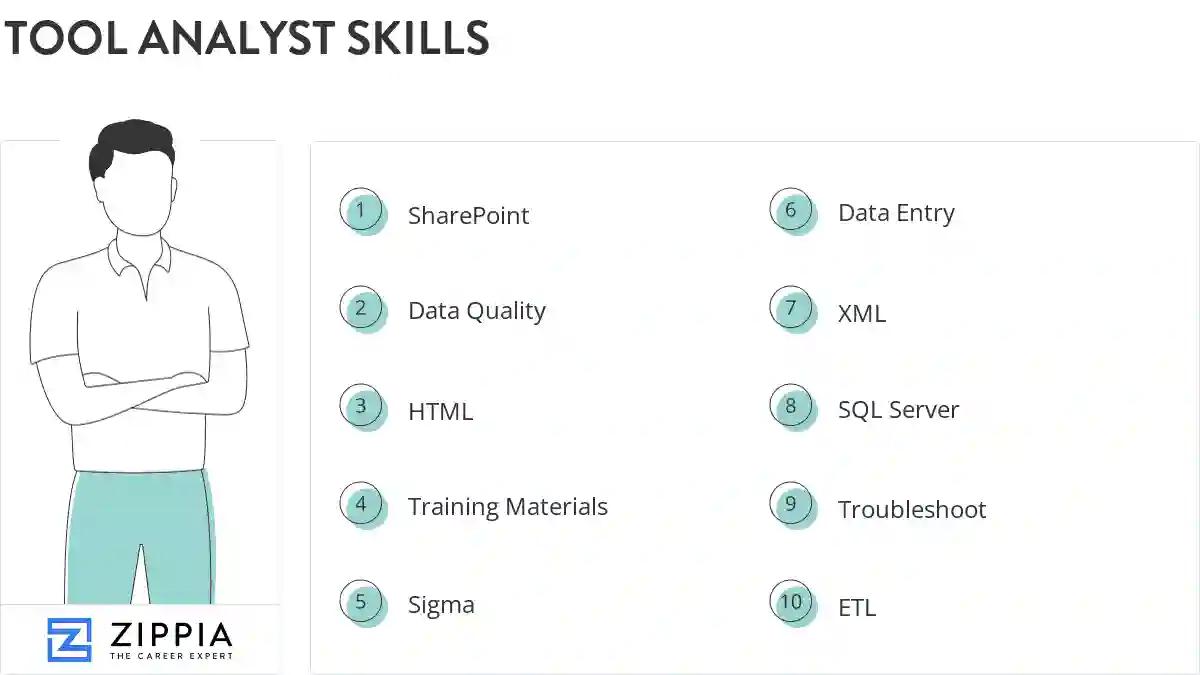
The most important skills for a tool analyst resume and required skills for a tool analyst to have include:
- SharePoint
- Data Quality
- HTML
- Training Materials
- Sigma
- Data Entry
- XML
- SQL Server
- Troubleshoot
- ETL
- Windows
- Production Environment
- ERP
Updated January 8, 2025
