Explore jobs
Find specific jobs
Explore careers
Explore professions
Best companies
Explore companies
What is a training analyst and how to become one
The training analyst supports the training program manager with developing and conducting the company's Legal training program. You will participate in the training of new hires and targeted legal training. You will assist the Program Manager in maintaining the Training Program Manual through effective training and record keeping. Also, you will research and support the team to update the training manual when needed. You can also assist the program manager to assess, track and report the program effectiveness. In addition, you will draft reports and presentations to the compliance committees concerning the training, policies, and procedures.
To be eligible for the post of Training Analyst, you must have a strong work ethic and the ability to produce high-quality work under tight deadlines. Years of working experience in the same post or related post is also important. Excellent skills in using Microsoft Excel are also needed. You must have excellent organizational and analytical skills and have the ability to work in a team environment. You will earn an average of $24.41 an hour and $50,775 annually.
What general advice would you give to a training analyst?
Michael Broetzmann
Manager- Technical Training, Gasoline Engines, Kohler Engines
We know that many of the Small Engine Mechanics in our industry come directly out of high school or vocational school, where they were traditionally trained with hands-on, instructor-led, technical training courses. The past year, COVID has drastically changed how technicians are trained and how they must consume information to be prepared for the job. Schools and industry alike, have been force to transition this training to a virtual environment, which poses obstacles for a demographic that usually thrives in hands-on learning.
The good news is there are plenty of opportunities and avenues to learn, whether they are still in school or already landed a job. Whether it is organizations like the EETC that offers a wide array of eLearning courses to cover the basics, or industry/manufacturing training courses that focus on specific products and procedures; the resources are available to bring them up to speed in the absence of traditional training.
One thing has remained constant through these times, the need for highly trained technicians to service equipment is growing, and regardless of the situation, the training tools will be provided to give them the knowledge and skills that are needed to be successful.
Avg. Salary $70,346
Avg. Salary $59,228
Growth rate 8%
Growth rate 0.3%
American Indian and Alaska Native 0.51%
Asian 5.83%
Black or African American 11.92%
Hispanic or Latino 16.79%
Unknown 6.29%
White 58.67%
Genderfemale 47.77%
male 52.23%
Age - 44American Indian and Alaska Native 3.00%
Asian 7.00%
Black or African American 14.00%
Hispanic or Latino 19.00%
White 57.00%
Genderfemale 47.00%
male 53.00%
Age - 44Stress level is manageable
7.1 - high
Complexity level is challenging
7 - challenging
Work life balance is fair
6.4 - fair
Training analyst career paths
Key steps to become a training analyst
Explore training analyst education requirements
Start to develop specific training analyst skills
Skills Percentages Training Programs 9.41% Training Materials 6.41% PowerPoint 6.33% DOD 5.79% SME 5.51% Complete relevant training analyst training and internships
Accountants spend an average of 6-12 months on post-employment, on-the-job training. New training analysts learn the skills and techniques required for their job and employer during this time. The chart below shows how long it takes to gain competency as a training analyst based on U.S. Bureau of Labor Statistics data and data from real training analyst resumes.Research training analyst duties and responsibilities
- Manage internal and external procedures and guideline changes are appropriately communicate via SharePoint or external notification.
- Team exceed DoD requirements of 15 minutes, completing the task in only 11 minutes 15 seconds.
- Utilize a proprietary SDLC methodology.
- Conduct train-the-trainer sessions and administer on-job-training (OJT) when require by production manager.
Prepare your training analyst resume
When your background is strong enough, you can start writing your training analyst resume.
You can use Zippia's AI resume builder to make the resume writing process easier while also making sure that you include key information that hiring managers expect to see on a training analyst resume. You'll find resume tips and examples of skills, responsibilities, and summaries, all provided by Zippi, your career sidekick.
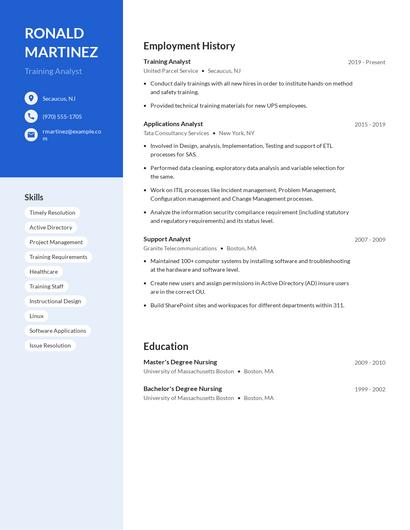
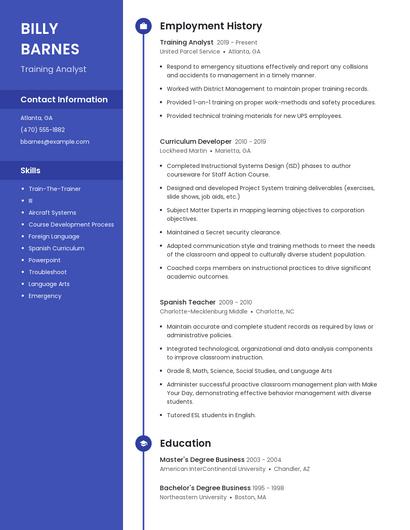
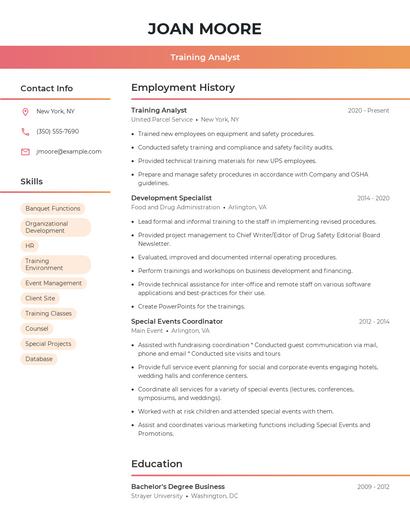
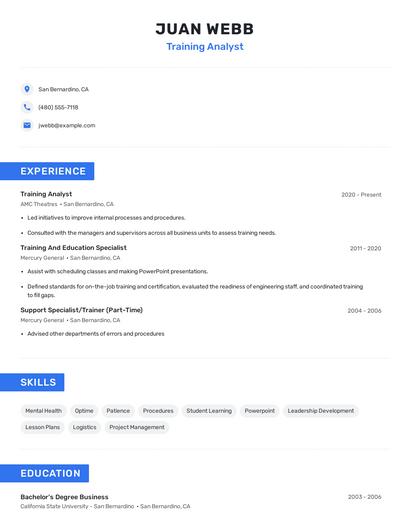
Choose from 10+ customizable training analyst resume templates
Build a professional training analyst resume in minutes. Browse through our resume examples to identify the best way to word your resume. Then choose from 10+ resume templates to create your training analyst resume.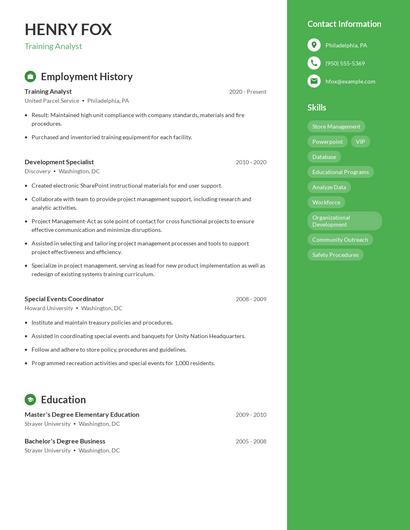
Apply for training analyst jobs
Now it's time to start searching for a training analyst job. Consider the tips below for a successful job search:
- Browse job boards for relevant postings
- Consult your professional network
- Reach out to companies you're interested in working for directly
- Watch out for job scams
How did you land your first training analyst job

Are you a training analyst?
Share your story for a free salary report.
Average training analyst salary
The average training analyst salary in the United States is $70,346 per year or $34 per hour. Training analyst salaries range between $50,000 and $98,000 per year.
What am I worth?

How do training analysts rate their job?
Training analyst reviews

Healthcare IT experience; business operations experience; billing experience
Under appreciated and low pay without certification
Sharing your experience for the benefit of others. Making the learners feel enriched with their take always from your session. Are able to execute and apply their learnings, successfully.
simply wasting time
Updated January 8, 2025
