
Automatically apply for jobs with Zippia
Upload your resume to get started.
Training analyst skills for your resume and career
15 training analyst skills for your resume and career
1. Training Programs
- Conducted effective training programs for all phases and levels of the computerized operational systems crucial to financial and operational success.
- Collect data on recurring maintenance issues to support on-site assessments of customer and supplier maintenance/training programs to identify process improvements.
2. Training Materials
- Developed training materials, and provided formal classroom and informal training to nurses and physicians in preparation of implementation.
- Directed 6 trainers and ancillary staff assigned to specialized training facility tasked with analysis of training materials and results.
3. PowerPoint
- Revised PowerPoint training presentations with updated subject matter and established company formats for trouble-free and accurate deployment of required training modules.
- Reviewed and scored contract proposals, instructed self-sufficiency workshops; developed and conducted presentations using PowerPoint.
4. DOD
Definition of Done (DoD) is a set of deliverables that are needed to devise software. These deliverables are valuable to the system and can be exemplified by writing code, coding comments, unit testing, integration testing, design documents, release notes, and so on.
- Trusted to train Commissioned Officers, DoD civilians and peers in logistics plans and Special Operations support.
- Maintain a DoD Secret security clearance in order to access locations and networks.
5. SME
The term ‘small and medium-sized enterprises' is meant to describe businesses of varied sizes who fall below certain limits and targets set by various organizations, such as the World Bank and the UN. SMEs, as they are commonly known, are an important part of any economy and generally, in healthy economies, should vastly outnumber other forms of business, such as multi-level corporations, because they collectively employ more people, pay better, and produce more money.
- Lead out the Curriculum Review Board sessions with appointed SME s to make sure training documents were vetted for clinical relevance.
- Interviewed subject matter experts and functional SME's for process flow content and business process content.
6. Course Content
- Prepared changes and recommendations as needed to ensure course content is current and complies with Navy training and education regulations.
- Determined the scope, audience and goals of assigned training projects, and identified subject matter for course content.
Choose from 10+ customizable training analyst resume templates
Build a professional training analyst resume in minutes. Our AI resume writing assistant will guide you through every step of the process, and you can choose from 10+ resume templates to create your training analyst resume.7. Subject Matter Experts
- Collaborated with engineering, accounting, human resources and other subject matter experts when gathering product requirements.
- Interact with customer and subject matter experts to ensure technical accuracy of instructional content.
8. Curriculum Development
- Provided TSIP and Curriculum Development Weekly Meeting Minutes.
- Develop presentation slides for curriculum development.
9. Project Management
- Managed 2,000,000 training projects for highway construction industry, utilizing instructional systems design, project management and change management methodologies.
- Position included teaching a CPM project management system and developing blended learning for financial systems.
10. Logistics
Logistics is a complete organization and implementation of a problem. Logistics are often considered in a complex business operation, as some works need detailed plannings. Logistics are also used in military action.
- Performed equipment logistics analysis in the development of maintainability and reliability data to ensure high reliability, high quality systems design.
- Identified and arranged travel, and answers questions regarding logistics, audio/visual equipment requirements.
11. Training Classes
A training class is a series of classes/lessons designed to impart skills and knowledge for a specific job or activity or to develop skills and knowledge or fitness to specific useful skills in oneself or others. There are a variety of benefits for the trainee, including improved self-esteem, motivation, and confidence, acquiring a new skill or qualification, updating skills, and keeping in touch with new developments in the field.
- Facilitated, scheduled and conducted daily training classes; administered proficiency assessments.
- Handle all safety and training classes that are required by MSHA and the State of West Virginia.
12. Doctrine
- Provided consulting expertise to military and civilian clients in the development and evaluation of military training and doctrine.
- Demonstrated ability to edit and consolidate data received from various resources for input into doctrine materials.
13. Combat
Combat is a violent conflict between two parties. Combat can be held by using weapons or unarmed. The fighting between the armed forces of different countries can also be called combat and the main purpose of the combat is to eliminate and stop your opponent from achieving their goal.
- Participated in analyst to analyst exchanges with customers in combat zone and sanctuary operations.
- Coordinated with marketing department to understand and combat competitive offers.
14. Field Training
- Evaluated programs for ways to improve training capabilities; delivered feedback following field training exercises.
- Briefed meteorological data to pilots and battalioncommanders.Extensive field training and marksmanship fundamentals, proficient in Marine Corps MartialArts Program.
15. Training Curriculum
- Audited and reviewed customer files, responded to audit findings, developed training curriculum and facilitated workshops.
- Develop and deliver training curriculum to educate stakeholders on new processes and improvements.
5 Training Analyst resume examples
Build a professional training analyst resume in minutes. Browse through our resume examples to identify the best way to word your resume. Then choose from 5+ resume templates to create your training analyst resume.

What skills help Training Analysts find jobs?
Tell us what job you are looking for, we’ll show you what skills employers want.
What training analyst skills would you recommend for someone trying to advance their career?
Jaunelle Celaire
Chair, Professor of Voice, University of Alaska Fairbanks
What technical skills for a training analyst stand out to employers?
Maria Salazar Ph.D.
Professor, University of Denver
It is important to foster a growth-mindset in oneself, and also in one's school community. Employers are also looking for a commitment to educational equity. With emerging consciousness of racial inequality and the need for systems that promote racial justice, employers want to hire people who are culturally competent and can move beyond statements of the value of diversity, to the enactment of educational environments that promote equity for those who are marginalized. This skill set includes: cross-cultural communication, culturally responsive teaching, and strength-based practices.
List of training analyst skills to add to your resume
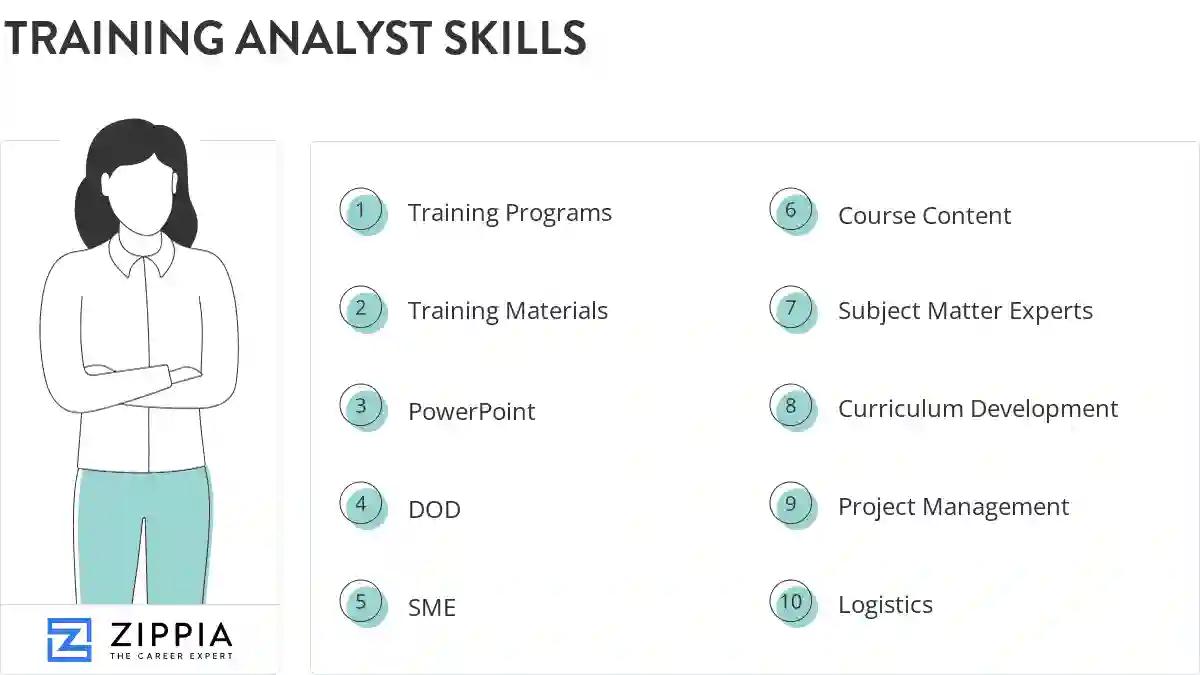
The most important skills for a training analyst resume and required skills for a training analyst to have include:
- Training Programs
- Training Materials
- PowerPoint
- DOD
- SME
- Course Content
- Subject Matter Experts
- Curriculum Development
- Project Management
- Logistics
- Training Classes
- Doctrine
- Combat
- Field Training
- Training Curriculum
- Provide Technical Assistance
- Technical Training
- Technical Support
- HR
- Training Objectives
- Learning Management System
- Training Analysis
- Training Sessions
- EHR
- Professional Development
- CBT
- Manpower
- Military Training
- Customer Satisfaction
- Training Content
- Training Environment
- AAR
- Training Courses
- EMR
- Instructional Materials
- Course Materials
- National Security
- Software Applications
- ELearning
- QA
- ISO
- Training Modules
- Cerner
- Computer System
- Process Improvement
- Go-Live
- Captivate
- Business Processes
Updated January 8, 2025
