
Automatically apply for jobs with Zippia
Upload your resume to get started.
Transaction processor skills for your resume and career
15 transaction processor skills for your resume and career
1. Clerical Tasks
Clerical tasks are general office maintenance duties such as answering phone calls, filing and sorting documents, handling deliveries, data entry, and other administrative or office support tasks. Modern clerical roles require basic computer skills and good communication skills.
- Performed clerical tasks in the data entry functions and carry boxes
- Perform clerical tasks in data entry.
2. Computer Database
A database or a computer database is a cluster of structured information stored in an electronic archive. This electronic data is administered through a database management system (DBMS), both (data and DBMS) of which are collectively referred to as a database system. The data is normally portrayed in the form of rows and columns for easy organization, management, alteration, and access. The organization of data in computer database enables users to write and query data efficiently.
- Provide administrative support to business operations by performing data entry of material from source documents to a computer database.
- Verified and corrected the accuracy of source material inputted into computer database by coworkers.
3. Business Operations
The operations that carry out the inner working of an organization are called business operations. From creating products, to marketing them, business operations play a vital role in every step.
- Provided administrative support to business operations by performing processing tasks such as data entry, and similar activities.
- Provided administrative support to business operations by performing the processing task of mail sorting.
4. Data Entry Functions
- Perform clerical task in the data entry functions Receive and distributes incoming mail and materials provide administrative support to business operation.
- Performed mailroom and data entry functions such as: Call Center agent ICD9/CPT4 Coding Data Entry Research Specialist
5. Processing Tasks
- Provide administrative support by performing processing tasks such as data entry, scanning, mail sorting or similar activities.
- Support to administrative commercial operations Data Entry, digitalization, classification of medical records and perform processing tasks.
6. Completeness Data
- Ensured accuracy and completeness data.
- Ensured completeness data and quality assurance of the label addresses to the attorneys.
Choose from 10+ customizable transaction processor resume templates
Build a professional transaction processor resume in minutes. Our AI resume writing assistant will guide you through every step of the process, and you can choose from 10+ resume templates to create your transaction processor resume.7. Quality Standards
Quality standards are a specific level of standards of products that are set by the companies for the customers that have to be met and maintained throughout the process until the time of delivery. Quality standards are information that includes the customer's requirements, guidelines, and characteristics for the needed final product or service.
- Verified and processed data transactions, ensuring quality standards and following policies and procedures to meet audit requirements.
- Meet/exceed production goal while maintaining quality standards.
8. Medicaid
- Process Provider Medicaid applications according to various state and federal regulations Communicate with Providers to ensure proper processing
- Furnished Medicaid recipients with policy information and plan maintenance.
9. Quality Checks
Quality checks are a component of quality control aimed at ensuring that quality requirements are met. Internally, quality checks provide assurance to managers, and externally, it provides assurance to clients, federal departments, authorities, and certifiers.
- Scanned confidential client materials and oversaw Quality check and assurance.
- Completed quality checks on assigned data entered.
10. Account Maintenance
Account maintenance is a practice in accounting that ensures that all transactions and accounting records are per the general principles of accounting and applicable laws. The accounts should be maintained enough to permit the annual audit and clear the inspection of financial statements.
- Processed and reviewed various securities transactions such as purchases, sales, transfers and general account maintenance within established regulatory guidelines.
- Review and process general data entry transactions for various transaction types including transfers, purchases/sells, and account maintenance.
11. Computer System
- Process medical claims and enter claim information into computer system
- Performed data entry of State and license plate information into computer system for non-paying toll road customers for issuance of tickets.
12. Payroll
Payroll is the sum of all the compensation that an organization has to pay to employees at a specified time. Payroll is managed by the finance or HR department while small business owners may handle it themselves. Payroll isn't fixed as it varies every month due to sick leaves, overtime, etc.
- Processed Payroll and tax calculations for major corporations.
- Processed one version of international payroll utilized J.D.
13. Sales Transactions
Sales transaction is defined as the completed agreement between two or more parties involved in selling and payment of goods or services in exchange for money. The steps or procedure done is called sales transaction, which may include negotiation or bargaining, settlement of agreement including the agreement on the price, discount, and payment method whether this will be on cash basis or installment. The buyer may inquire about the product or services during the sales transaction and making the necessary adjustment with the seller until they come up with a specific agreement.
- Processed sales transactions quickly, accurately and efficiently.
- Processed all sales transactions accurately, had daily sale goals $800 day, commission based.
14. Xerox
- Performed digital imaging of documents and checks via Kodak Document Scanners and Xerox Solutions custom imaging software.
- Worked via contract the State of Connecticut's, Department of Social Services under Xerox.
15. HIPAA
- Demonstrated knowledge of HIPAA Privacy and Security Regulations by appropriately handling client's information.
- Completed training courses in: Security and Privacy Awareness, HIPAA Awareness, Code of Conduct, Code of Ethics
5 Transaction Processor resume examples
Build a professional transaction processor resume in minutes. Browse through our resume examples to identify the best way to word your resume. Then choose from 5+ resume templates to create your transaction processor resume.

What skills help Transaction Processors find jobs?
Tell us what job you are looking for, we’ll show you what skills employers want.
List of transaction processor skills to add to your resume
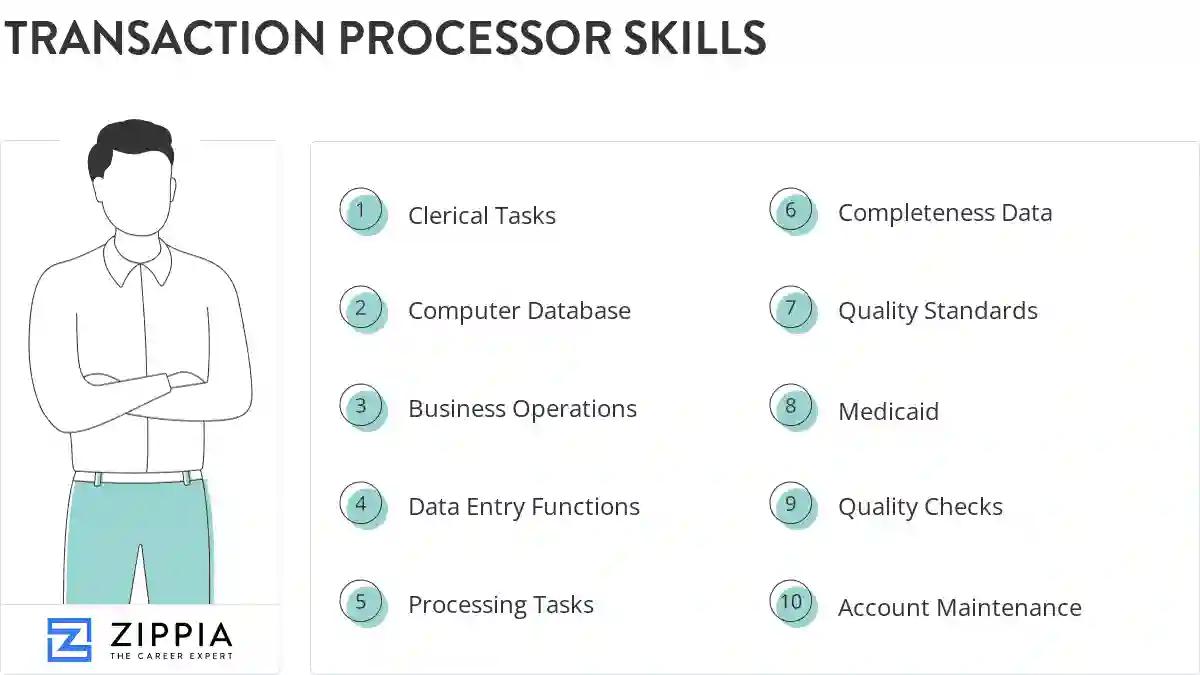
The most important skills for a transaction processor resume and required skills for a transaction processor to have include:
- Clerical Tasks
- Computer Database
- Business Operations
- Data Entry Functions
- Processing Tasks
- Completeness Data
- Quality Standards
- Medicaid
- Quality Checks
- Account Maintenance
- Computer System
- Payroll
- Sales Transactions
- Xerox
- HIPAA
- Customer Inquiries
- Medical Insurance Claims
- ACH
- Process Claims
- Medical Terminology
- Outbound Calls
- Hippa
- OpEx
- HR
- Dental Claims
- CPT
- PowerPoint
- Process Transactions
- Customer Accounts
- Student Loans
- QA
- Account Numbers
- Financial Transactions
- Process Checks
- Cash Drawers
- Ub04
- HCFA
- Retail Environment
- Bank Deposits
- Office Support
- ICD-9
- ATM
- Select Product
- USPS
- FedEx
- Kodak
Updated January 8, 2025
