Explore jobs
Find specific jobs
Explore careers
Explore professions
Best companies
Explore companies
What is a transit operator and how to become one
Avg. Salary $38,023
Avg. Salary $59,228
Growth rate 5%
Growth rate 0.3%
American Indian and Alaska Native 1.15%
Asian 4.90%
Black or African American 25.13%
Hispanic or Latino 17.04%
Unknown 4.12%
White 47.66%
Genderfemale 38.60%
male 61.40%
Age - 56American Indian and Alaska Native 3.00%
Asian 7.00%
Black or African American 14.00%
Hispanic or Latino 19.00%
White 57.00%
Genderfemale 47.00%
male 53.00%
Age - 56Stress level is high
7.1 - high
Complexity level is challenging
7 - challenging
Work life balance is fair
6.4 - fair
Transit operator career paths
Key steps to become a transit operator
Explore transit operator education requirements
Start to develop specific transit operator skills
Skills Percentages Transport Passengers 23.95% CDL 11.51% Passenger Endorsement 8.33% Safety Procedures 8.12% Vehicle Inspections 7.51% Complete relevant transit operator training and internships
Accountants spend an average of 1-3 months on post-employment, on-the-job training. New transit operators learn the skills and techniques required for their job and employer during this time. The chart below shows how long it takes to gain competency as a transit operator based on U.S. Bureau of Labor Statistics data and data from real transit operator resumes.Obtain the necessary licensing
Becoming a licensed transit operator usually doesn't require a college degree. However, you need to pass an exam to become a licensed transit operator in most of states. 18 states require transit operators to have license for their work. You can see the list of states below.State Education Exam License url Kentucky Specific course required State exam required School Bus Driver Maryland Specific course required State exam required BUS DRIVER, SCHOOL Alaska Specific course required State exam required Bus Driver, School Idaho - State exam required Commercial Drivers Illinois Specific course required State exam required COMMERCIAL DRIVER (TRUCK AND BUS OPERATOR) Research transit operator duties and responsibilities
- Provide station area land-use, density and urban network design recommendations base on best practices and GIS network analysis.
- Operate heavy machinery such as bobcat equipment and also operate and pave asphalt perform demolition work.
- Document mileage and client information into SCR computer system (MDT).
Prepare your transit operator resume
When your background is strong enough, you can start writing your transit operator resume.
You can use Zippia's AI resume builder to make the resume writing process easier while also making sure that you include key information that hiring managers expect to see on a transit operator resume. You'll find resume tips and examples of skills, responsibilities, and summaries, all provided by Zippi, your career sidekick.
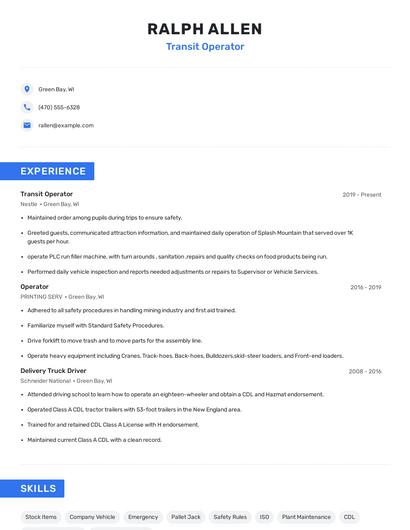
Choose from 10+ customizable transit operator resume templates
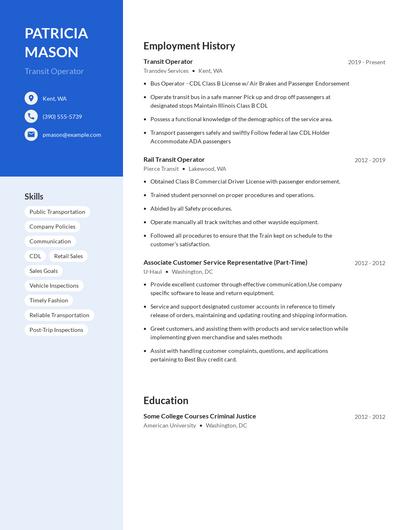
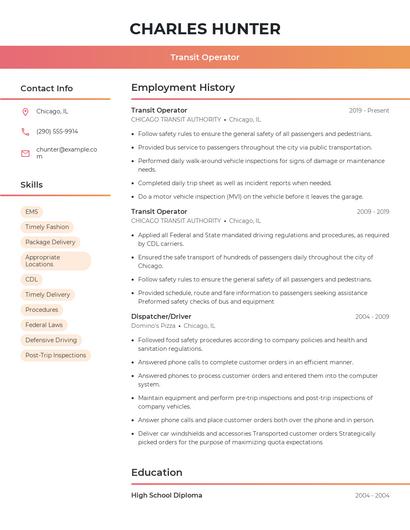
Build a professional transit operator resume in minutes. Browse through our resume examples to identify the best way to word your resume. Then choose from 10+ resume templates to create your transit operator resume.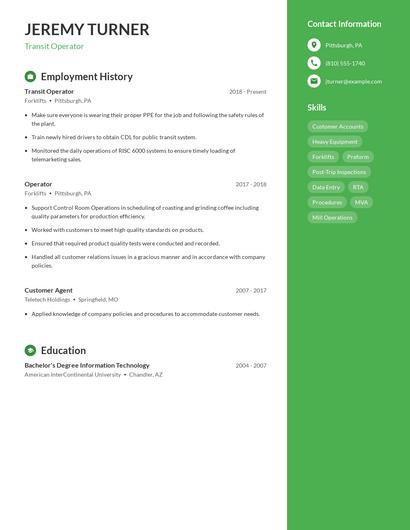

Apply for transit operator jobs
Now it's time to start searching for a transit operator job. Consider the tips below for a successful job search:
- Browse job boards for relevant postings
- Consult your professional network
- Reach out to companies you're interested in working for directly
- Watch out for job scams
How did you land your first transit operator job

Are you a transit operator?
Share your story for a free salary report.
Average transit operator salary
The average transit operator salary in the United States is $38,023 per year or $18 per hour. Transit operator salaries range between $30,000 and $46,000 per year.
What am I worth?

How do transit operators rate their job?
Transit operator reviews

The freedom to work on your own schedule.
The road rage drivers: people lose their empathy when driving. They become aggressive and angry by the slightest event on the road. Hence, taking the fun out of driving. However, driving is still relaxing and fun.
Meeting new people, seeing new places, and the pay when you work for private transportation
traffic in the bay area
Spit shift, working with children, off in the summer
Poor salaries, threat of job lose when contract expires, lack of respect for drivers
Updated January 8, 2025
