What does a truss assembler do?
The major responsibility of a truss assembler is to gather pre-cut wood parts and use them to build wall sections, or trusses, that support construction projects. To do this, they first place metal reinforcements over connections. They use various tools such as hammers, screwdrivers, or staple guns. They are expected to communicate effectively with other members of the assembly team and to also assist in moving and pushing trusses. They are also required to clean the work area regularly.
Truss assembler responsibilities
Here are examples of responsibilities from real truss assembler resumes:
- Load sheet goods to CNC machine.
- Read detailed blueprints, set up jigs and produce trusses.
- Lead truss builder, run cutting see, inventory of wood stick, maintenance around the shop
- Work with, computer panel see, cnc router, boring machines and drill driver sets.
- Work in a fast pace environment assembling pallets and cleaning of pallets also making there are no damage.
- Assemble and weld medical gas cabinets, gun safes, drive forklift, setup and run brake pressesand metalshears
- Move pallet up and down, using tweezers, to test and adjust endshake and estimates movement within acceptable limits.
- Assemble pallets, machine operator and operate other equipment.
- Verify all documentation accompanying each manufacturing lot for completeness and accuracy according to GMP and ISO guidelines.
- Experience include extensive PC board manufacturing, engineering support, and production team supervision.=================================
Truss assembler skills and personality traits
We calculated that 42% of Truss Assemblers are proficient in Assembly Line, Tape Measure, and Hand Tools. They’re also known for soft skills such as Business skills, Detail oriented, and Dexterity.
We break down the percentage of Truss Assemblers that have these skills listed on their resume here:
- Assembly Line, 42%
Assemble roofing frames on an assembly line in a timely, proper and safe manner.
- Tape Measure, 17%
Measured and marked cutting lines on materials, using a tape measure, pencil, chalk, and marking gauge.
- Hand Tools, 10%
Assemble truss from components using hand tools.
- Safety Procedures, 9%
Assured quality control and safety procedures.
- Nail Guns, 5%
Assembled trusses, operated nail guns, hammers, measuring tapes and skill saws.!
- Jigs, 4%
Used forklift to move specified precut parts to work area and positioned parts in jig by hand following Supervisor instructions.
Common skills that a truss assembler uses to do their job include "assembly line," "tape measure," and "hand tools." You can find details on the most important truss assembler responsibilities below.
Business skills. To carry out their duties, the most important skill for a truss assembler to have is business skills. Their role and responsibilities require that "self-employed carpenters must conduct activities such as bidding on new jobs, tracking inventory, and directing workers." Truss assemblers often use business skills in their day-to-day job, as shown by this real resume: "assembled roof trussesreason for leaving: company went out of business"
Detail oriented. Another essential skill to perform truss assembler duties is detail oriented. Truss assemblers responsibilities require that "carpenters must be able to precisely cut, measure, and modify the materials they work with." Truss assemblers also use detail oriented in their role according to a real resume snippet: "dispose of damaged or defective items skills used -paying attention to detail -reading blueprints -reading a tape measure and useing a hammer"
Dexterity. Another skill that relates to the job responsibilities of truss assemblers is dexterity. This skill is critical to many everyday truss assembler duties, as "carpenters use many tools and need hand-eye coordination to avoid injuring themselves or damaging materials." This example from a resume shows how this skill is used: "build roof truss and floor truss by using various hand tools*operate various saws to construct truss*operate floor jacks and lifts*heavy lifting"
Math skills. truss assembler responsibilities often require "math skills." The duties that rely on this skill are shown by the fact that "carpenters frequently use math skills, including basic trigonometry, to calculate the area, size, and amount of material needed for the job. ." This resume example shows what truss assemblers do with math skills on a typical day: "use of a tape measure skills used math"
Physical strength. Another crucial skill for a truss assembler to carry out their responsibilities is "physical strength." A big part of what truss assemblers relies on this skill, since "carpenters use heavy tools and materials that weigh up to 100 pounds." How this skill relates to truss assembler duties can be seen in an example from a truss assembler resume snippet: "trained new employees assembled housing for automobile parts tested strength of finished product connected various electrical components"
Problem-solving skills. Another skill commonly found on truss assembler job descriptions is "problem-solving skills." It can come up quite often in truss assembler duties, since "carpenters may work independently with little guidance." Here's an example from a resume of how this skill fits into day-to-day truss assembler responsibilities: "tested all electrical components and assemblies; troubleshot circuits and interfaces; tenaciously resolved any post-production issues. "
The three companies that hire the most truss assemblers are:
- Builders FirstSource79 truss assemblers jobs
- UFP Industries31 truss assemblers jobs
- US LBM24 truss assemblers jobs
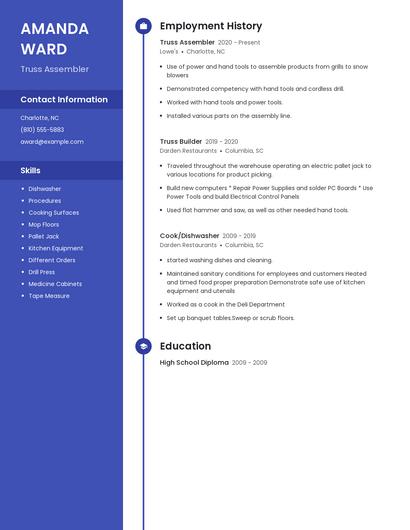
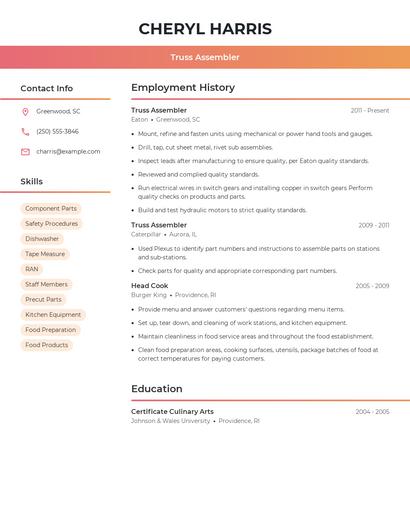
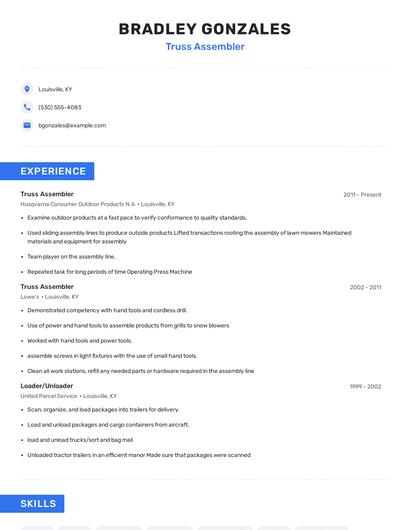
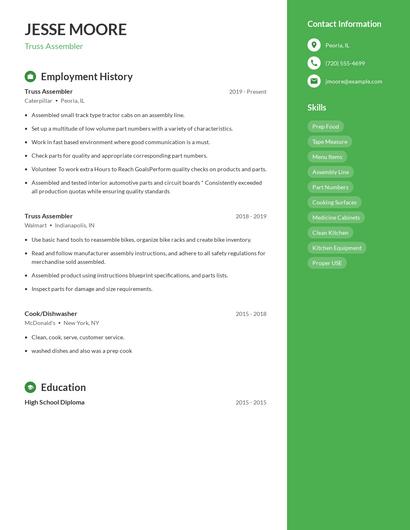
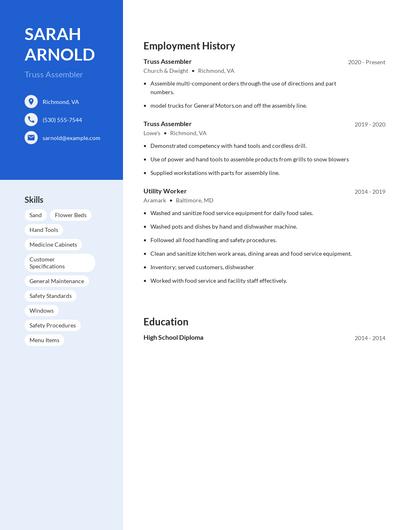
Choose from 10+ customizable truss assembler resume templates
Build a professional truss assembler resume in minutes. Our AI resume writing assistant will guide you through every step of the process, and you can choose from 10+ resume templates to create your truss assembler resume.



Compare different truss assemblers
Truss assembler vs. Fabrication technician
Fabrication technicians are skilled employees who are responsible for using specialized equipment to assemble components for a variety of products or finished products. These technicians are required to perform inspections on the tools and mechanical equipment as well as provide maintenance and repair. They are required to complete the assembly of equipment by following the engineering drawings and specifications. Fabrication technicians must also follow established safety procedures when maintaining work areas and troubleshooting problems with machinery.
While similarities exist, there are also some differences between truss assemblers and fabrication technician. For instance, truss assembler responsibilities require skills such as "nail guns," "safety rules," "blueprint specifications," and "safety regulations." Whereas a fabrication technician is skilled in "math," "customer service," "cnc," and "calipers." This is part of what separates the two careers.
Fabrication technicians earn the highest salaries when working in the finance industry, with an average yearly salary of $39,731. On the other hand, truss assemblers are paid more in the technology industry with an average salary of $33,387.The education levels that fabrication technicians earn slightly differ from truss assemblers. In particular, fabrication technicians are 1.3% more likely to graduate with a Master's Degree than a truss assembler. Additionally, they're 0.1% more likely to earn a Doctoral Degree.Truss assembler vs. Metal fabricator
A metal fabricator manipulates metal for construction and manufacturing companies. They are required to cut, shape, position and align different metals. They must also understand assembly instructions, ensure required parts are available, and ensure parts meet quality control standards. They attend product development meetings, test products for functionality, troubleshoot and stress test products to determine possible shortcomings, make detailed reports outlining product malfunctions, verify product dimensions, and maintain the product schedule.
In addition to the difference in salary, there are some other key differences worth noting. For example, truss assembler responsibilities are more likely to require skills like "safety procedures," "nail guns," "safety rules," and "safety regulations." Meanwhile, a metal fabricator has duties that require skills in areas such as "mig," "aluminum," "press brake," and "drill press." These differences highlight just how different the day-to-day in each role looks.
Metal fabricators may earn a higher salary than truss assemblers, but metal fabricators earn the most pay in the automotive industry with an average salary of $45,267. On the other hand, truss assemblers receive higher pay in the technology industry, where they earn an average salary of $33,387.Average education levels between the two professions vary. Metal fabricators tend to reach similar levels of education than truss assemblers. In fact, they're 0.8% more likely to graduate with a Master's Degree and 0.1% less likely to earn a Doctoral Degree.Truss assembler vs. Steel fabricator
Some important key differences between the two careers include a few of the skills necessary to fulfill the responsibilities of each. Some examples from truss assembler resumes include skills like "assembly line," "safety procedures," "nail guns," and "safety rules," whereas a steel fabricator is more likely to list skills in "mig," "stainless steel," "steel fabrication," and "aluminum. "
Most steel fabricators achieve a similar degree level compared to truss assemblers. For example, they're 2.7% more likely to graduate with a Master's Degree, and 0.4% more likely to earn a Doctoral Degree.Truss assembler vs. Lead fabricator
Types of truss assembler
Updated January 8, 2025
