
Automatically apply for jobs with Zippia
Upload your resume to get started.
Trust accounts supervisor skills for your resume and career
15 trust accounts supervisor skills for your resume and career
1. Real Estate
Real estate is land that has buildings on it. This kind of property consists of permanent improvements either natural or man-made, which include, houses, fences, bridges, water trees, and minerals. There are 4 types of real estate namely; residential real estate, commercial real estate, industrial real estate, and vacant land.
- Collaborated with legal and real estate departments in developing accounting system for estates and trusts held by non-profit hospital.
- Provided fund accounting for 8 closely held Real Estate Investment Trusts (REIT).
2. Reconciliations
- Supported Trust Accounting Department by completing account reconciliations for retirement plans and other plan valuation activities.
- Developed procedures to assisted team members to navigate systems, applications and difference reconciliations.
3. Tax Returns
- Review with clients their tax returns, loan history and bank reconciliation.
- Processed the payroll and filed federal and state payroll tax returns.
4. Financial Statements
A financial statement is a report of an individual or a company that includes all the information about the declared assets, the use of money, income, and also the contribution of shareholders over a certain period.
- Prepared financial statements for the trust accounting department -Completed distributions for clients and organized financial and client information using Microsoft Excel
- Prepared a variety of detailed accounting, statistical, and narrative financial statements and reports requiring analysis and interpretation.
5. CPA
- Review financial statements with upper management and outside CPA firm periodically.
- Process yearly county business property tax reporting, including 1096 and 1099, and corporate tax return paperwork for CPA review.
6. Journal Entries
Journal entries can be defined as an act of keeping or making records of any transactions either economic or non-economic. The journal entries are made in the accounting systems of an organization. The entries are filled with two main fields; debit and credit. The debit and credit must be equal at the end of a journal entry else it is not considered correct. The journal entries also keep the date of transactions and the names of the accounts that were affected by the transactions.
- Prepared month-end review of all assets and account activities to ensure proper journal entries and/ or transfers have been made.
- Prepared the remainder closing end month journal entries, as well assisted other associates.
7. ACH
Automated Clearing House, ACH is a computerized electronic network to process, coordinate and manage transactions (credit and debit) and automated money transfers between banks and other financial institutions without the use of paper checks, electronic transfers, credit cards, or cash networks. The ACH network is regulated by the federal government and managed by the National Automated Clearing House Association (NACHA).
- Interfaced with Customer Service and Issues Resolutions teams to submit payment files to the bank for check and ACH issuance.
- Project managed ACH and P-Card implementation including monthly reconciliation.
8. Correctional
- Supervised warehouse, commissary, laundry inmate phones & inmate funds Prepared and submitted yearly budgets Correctional worker
- Initial Position: Correctional Officer Position at Retirement: Trust Fund Supervisor Starting Salary: $14,300.00 Ending Salary: $83,300.00
9. Gl
- Posted all GL entries, created income/expense reports and calculated the quarterly NAV for each fund.
- Improved reconciliation of trust GL accounts to better catch system and input errors.
10. Bank Accounts
- Reconcile bank accounts, cash flow statements, trust trial balances & P&L analysis.
- Trust Accountant Valued member in my division, and was successful in managing many company bank accounts on a daily basis.
11. Financial Reports
- Prepared annual financial reports for domestic and international equity funds.
- Prepare financial reports that are used in the process of filling tax forms.
12. Payroll
Payroll is the sum of all the compensation that an organization has to pay to employees at a specified time. Payroll is managed by the finance or HR department while small business owners may handle it themselves. Payroll isn't fixed as it varies every month due to sick leaves, overtime, etc.
- Reconciled federal, state and local payroll taxes paid to tax agencies for terminated customer accounts.
- Reconciled on daily basis federal payroll taxes, researched and resolved out of balances.
13. GAAP
- Complete preliminary financial reporting monthly various analyses, reporting of outstanding expense liabilities in accordance to GAAP standards.
- Managed the coordination and preparation of all statutory/regulatory and GAAP reporting.
14. Probate
- Audited, corrected client statements, and prepared estate and probate accounts.
- Coordinated the preparation of various reports to be filed with Probate Courts.
15. Bank Statements
- Worked with client's banks directly on questions and charges against client bank statements.
- Reconciled trustee bank statements, identifying and correcting trade discrepancies.

What skills help Trust Accounts Supervisors find jobs?
Tell us what job you are looking for, we’ll show you what skills employers want.
List of trust accounts supervisor skills to add to your resume
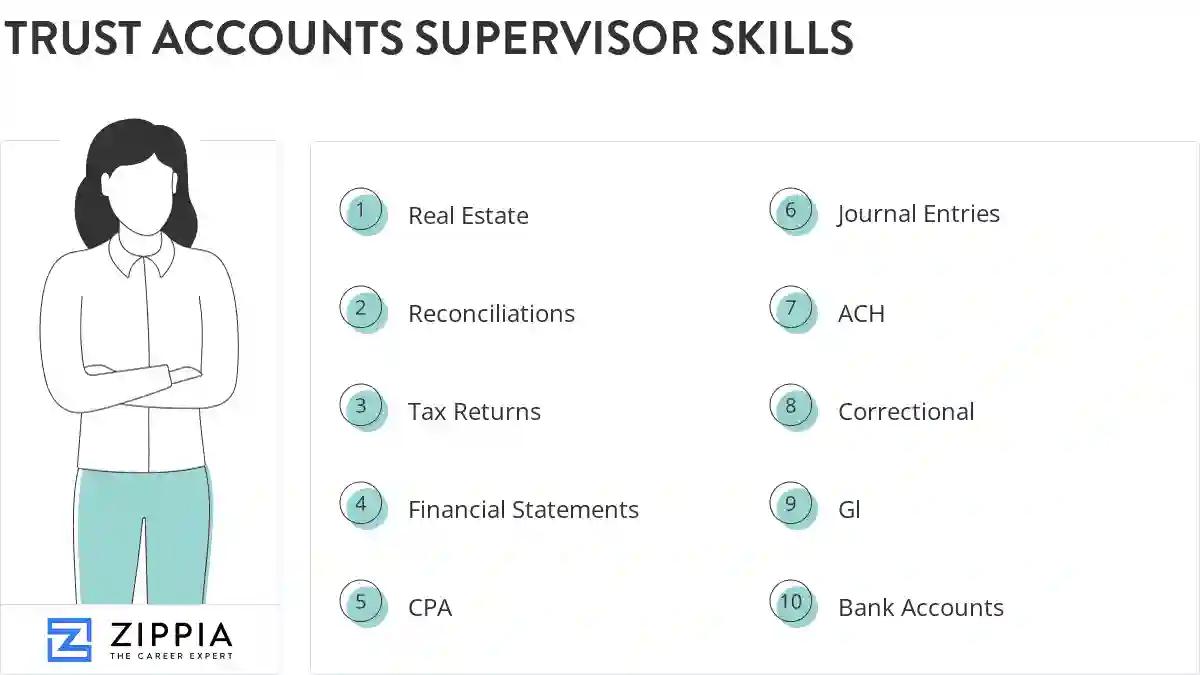
The most important skills for a trust accounts supervisor resume and required skills for a trust accounts supervisor to have include:
- Real Estate
- Reconciliations
- Tax Returns
- Financial Statements
- CPA
- Journal Entries
- ACH
- Correctional
- Gl
- Bank Accounts
- Financial Reports
- Payroll
- GAAP
- Probate
- Bank Statements
- Wire Transfers
- Financial Data
- IRS
- Trust Agreements
- Client Accounts
- Corporate Actions
- Administrative Reports
- NAV
- Asset Value
- TWIC
- Insurance Carriers
- Corporate Trust
- Due Dates
- Financial Transactions
- Investment Accounts
- Customer Accounts
Updated January 8, 2025
