What does a verification engineer do?

A verification engineer is responsible for running quality tests to the production processes to ensure high-quality outputs according to business requirements and client specifications. Verification engineers develop testing methodologies, inspect tools and equipment, and creating instructional manuals. They also resolve inconsistencies within the process, calibrating technical mechanisms, and identifying areas of improvement to enhance efficiency and build accurate deliverables. A verification engineer must have excellent communication and technical skills, especially in monitoring progress and coordinating with clients for necessary plan adjustments.
Verification engineer responsibilities
Here are examples of responsibilities from real verification engineer resumes:
- Develop PERL base tools to automate feature testing which result in the reduction of the feature and system test intervals.
- Manage EDA license forecasting and work with project managers and license operations team to track license resource capability and capacity requirements.
- Develop a Perl script to convert a proprietary XML description of register definition to generate SV UVM register file.
- Prepare economics and AFE's for measurement projects.
- Used RF skills to match input circuits for maximum output power, PAE and linearity performance.
- Work on hardware test procedure for central processing unit, engine input/output and engine interface unit FPGA's.
- Perform ECO changes for the bug relate to MPHY.TEST mode, read the timing report and analyze it.
- Work with the chief architects, designers, software and firmware groups to get the ASIC deliver on time.
- Prove specification compliance of communication device ASIC products including USB embed host and UART designs with SPI and I2C interfaces.
- Ensure that new tools and rules (IBM VHDL Libraries/Packages) are adequately test before they are put into production.
- Test system recovery following catastrophic failures including power outages, RF cable cuts, variable attenuation, and ingress noise.
- Design, and implement FPGA verification suite used to test a software define radio (SDR) for the JTRS project.
- Streamline VHDL code and apply more detail constraints to effectively meet timing and area constraints during synthesis and place and route.
- Execute HW engineering support and testing require for mainframe data library product development in support of v1.0 and v2.0 product releases.
- Implement gate-level ECO by formality.
Verification engineer skills and personality traits
We calculated that 10% of Verification Engineers are proficient in Python, UVM, and Architecture. They’re also known for soft skills such as Analytical skills, Communication skills, and Problem-solving skills.
We break down the percentage of Verification Engineers that have these skills listed on their resume here:
- Python, 10%
Created a script using Python to automatically hard code values in embedded C code for testing purposes.
- UVM, 8%
Authored test environment specification and Implemented UVM Verification Methodology for Architecture level simulations.
- Architecture, 6%
Identified numerous issues working closely with design and architecture teams ensuring accurate and robust implementation of solutions.
- Object Oriented Programming, 5%
Developed transactor, driver, checker and verification environment with openVera, similar to SystemVerilog, object oriented programming, OOP.
- SOC, 5%
Developed and debugged system level test patterns for SoC verification.
- Design Verification, 4%
Conducted design verification of innovative consumer electronic devices which included hardware, firmware and software.
Common skills that a verification engineer uses to do their job include "python," "uvm," and "architecture." You can find details on the most important verification engineer responsibilities below.
Analytical skills. One of the key soft skills for a verification engineer to have is analytical skills. You can see how this relates to what verification engineers do because "computer hardware engineers use computer programming tools to analyze the digital circuits in hardware to determine the best design." Additionally, a verification engineer resume shows how verification engineers use analytical skills: "created matlab scripts to generate valid vhdl code from data maintained in excel spreadsheet format. "
Communication skills. Another soft skill that's essential for fulfilling verification engineer duties is communication skills. The role rewards competence in this skill because "engineers often work on teams and must be able to communicate with other types of engineers, software developers and programmers, as well as with nontechnical team members." According to a verification engineer resume, here's how verification engineers can utilize communication skills in their job responsibilities: "enhanced communication between developers and verification leads to streamline writing test cases. "
Problem-solving skills. Another skill that relates to the job responsibilities of verification engineers is problem-solving skills. This skill is critical to many everyday verification engineer duties, as "computer hardware engineers identify complex problems in computer hardware, develop and evaluate possible solutions, and figure out the best way to implement them." This example from a resume shows how this skill is used: "task involves understanding the issue, related test cases and providing solution. "
The three companies that hire the most verification engineers are:
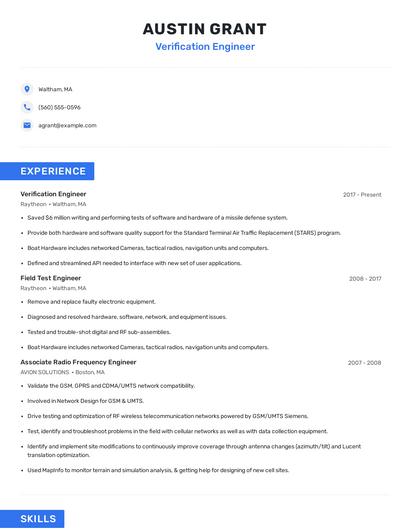
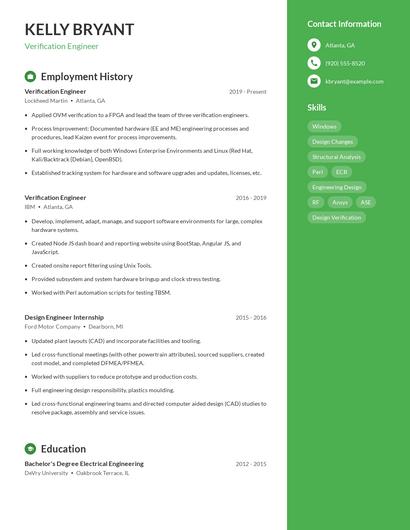
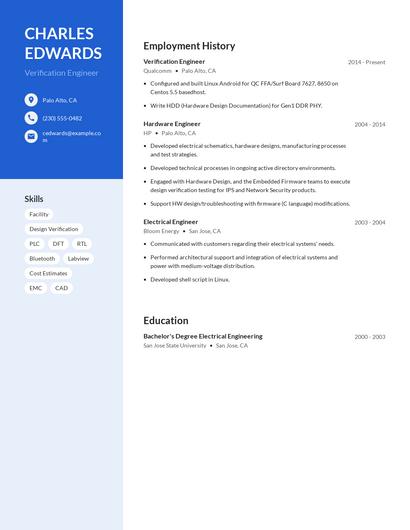
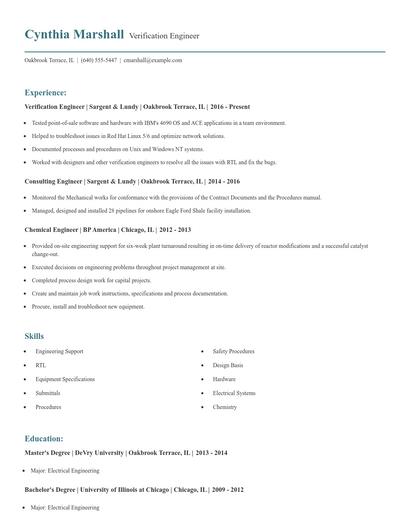
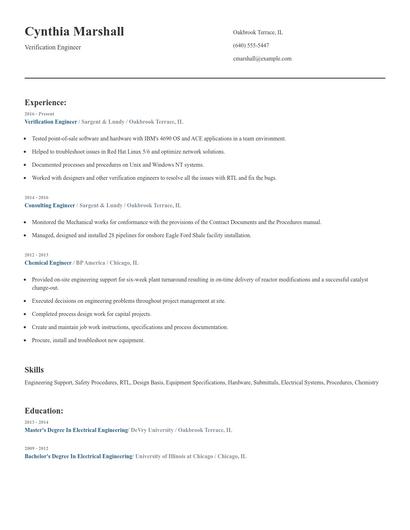
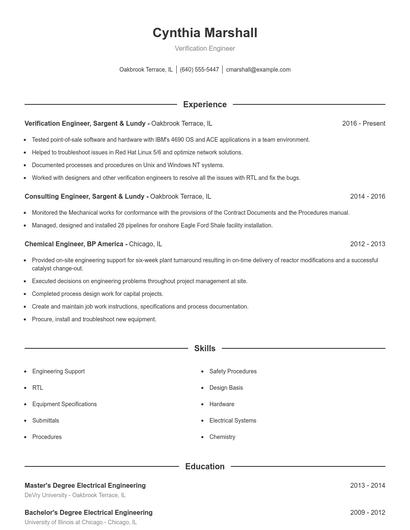
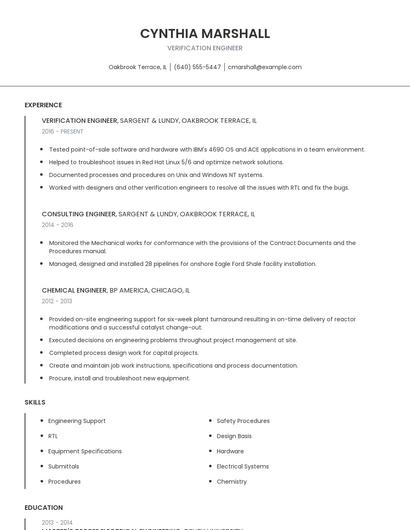
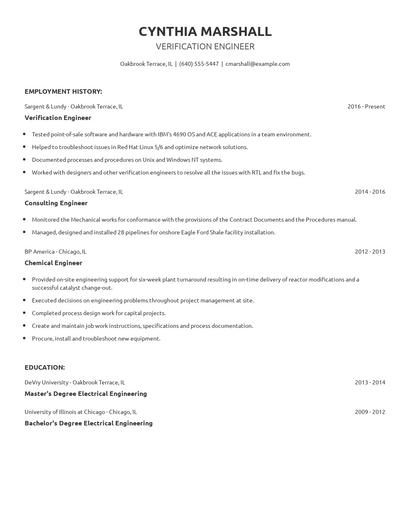
Choose from 10+ customizable verification engineer resume templates
Build a professional verification engineer resume in minutes. Our AI resume writing assistant will guide you through every step of the process, and you can choose from 10+ resume templates to create your verification engineer resume.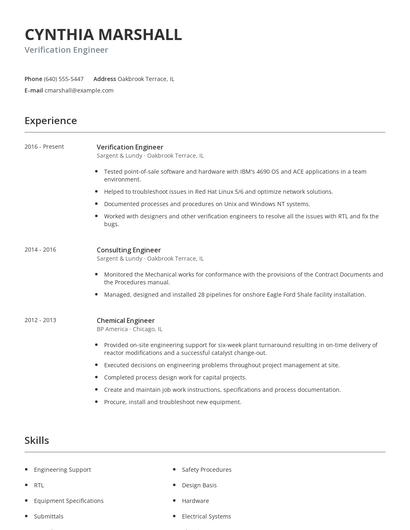
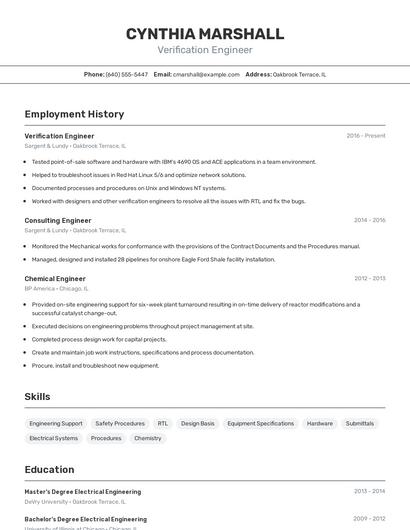
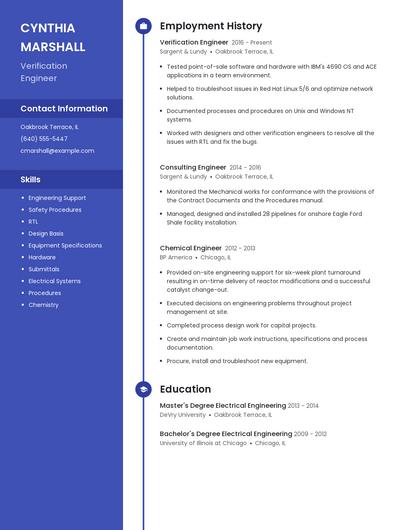
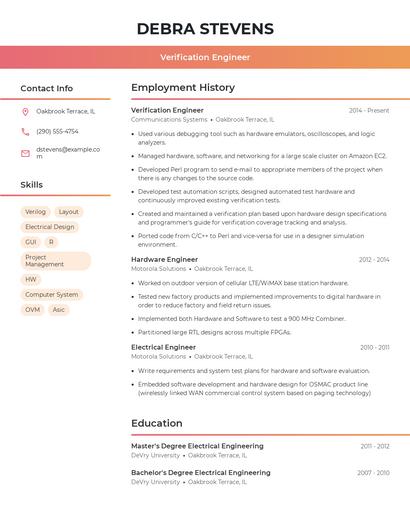
Compare different verification engineers
Verification engineer vs. Hardware manager
Computer hardware developers handle the physical aspect of computers. The developers research, design, and manufacture test computer systems and components. They make sure that they function to their full capacity with the software they are being used with. Their duties include designing new computer hardware, manufacturing computer equipment schematics, analyzing the test results, and modifying the design of the new hardware as needed. They update the already existing computer equipment so it works with new software and oversee every step of the manufacturing process.
There are some key differences in the responsibilities of each position. For example, verification engineer responsibilities require skills like "python," "uvm," "architecture," and "object oriented programming." Meanwhile a typical hardware manager has skills in areas such as "customer service," "product knowledge," "cad," and "design reviews." This difference in skills reveals the differences in what each career does.
Hardware managers tend to make the most money working in the retail industry, where they earn an average salary of $118,711. In contrast, verification engineers make the biggest average salary, $109,698, in the automotive industry.hardware managers tend to reach lower levels of education than verification engineers. In fact, hardware managers are 13.7% less likely to graduate with a Master's Degree and 0.3% more likely to have a Doctoral Degree.Verification engineer vs. Computer hardware developer
When it comes to a hardware engineering internship, an intern's primary responsibility is to perform support tasks while gathering industry insights. Typically following the directives of a manager or senior engineer, an intern may assist in developing and assembling components, participate in the installation and repair of facilities, and conduct maintenance checks and tests while under the supervision of a more experienced engineer. An intern may also perform clerical tasks such as processing documents, maintaining records, managing information databases, organizing supplies and materials, and running other errands.
While some skills are similar in these professions, other skills aren't so similar. For example, resumes show us that verification engineer responsibilities requires skills like "uvm," "architecture," "object oriented programming," and "perl." But a computer hardware developer might use other skills in their typical duties, such as, "mechanical design," "firmware," "hardware development," and "risc."
On average, computer hardware developers earn a lower salary than verification engineers. Some industries support higher salaries in each profession. Interestingly enough, computer hardware developers earn the most pay in the technology industry with an average salary of $111,631. Whereas verification engineers have higher pay in the automotive industry, with an average salary of $109,698.Average education levels between the two professions vary. Computer hardware developers tend to reach similar levels of education than verification engineers. In fact, they're 3.4% less likely to graduate with a Master's Degree and 0.3% more likely to earn a Doctoral Degree.Verification engineer vs. Computer hardware designer
Some important key differences between the two careers include a few of the skills necessary to fulfill the responsibilities of each. Some examples from verification engineer resumes include skills like "uvm," "architecture," "object oriented programming," and "design verification," whereas a computer hardware designer is more likely to list skills in "cad," "pcb," "hardware development," and "control systems. "
Most computer hardware designers achieve a lower degree level compared to verification engineers. For example, they're 7.3% less likely to graduate with a Master's Degree, and 1.8% less likely to earn a Doctoral Degree.Verification engineer vs. Hardware engineering internship
Types of verification engineer
Updated January 8, 2025
