What does a voice-over talent do?
Voice-over talent responsibilities
Here are examples of responsibilities from real voice-over talent resumes:
- Supervise, engineer, manage and maintain multiple telecommunication, and telephony engineering projects.
- Voice overs for cable TV including MTV, CNN (mostly IHOP spots )
- Work with Avaya to ensure all phases of this project are in line with company needs and on time.
- Execute testing, perform issue identification and resolution, and create deployment documentation for commercial services delivery via VoIP.
- Assist with evaluation and preparation of production cost estimates and distribution of finalize documentaries by internet etc.
Voice-over talent skills and personality traits
We break down the percentage of Voices-Over Talent that have these skills listed on their resume here:
- TV Commercials, 78%
Recorded voice-overs and dialogue for documentaries, radio and TV commercials
- IVR, 22%
Monitored System Performance and provided Troubleshooting support of the IVR System for reported issues.
Communication skills. One of the key soft skills for a voice-over talent to have is communication skills. You can see how this relates to what voices-over talent do because "producers and directors must convey information and ideas clearly in order to coordinate many people to finish a production on time and within budget." Additionally, a voice-over talent resume shows how voices-over talent use communication skills: "performed all still photography and photo communications within the division. "
Creativity. Another soft skill that's essential for fulfilling voice-over talent duties is creativity. The role rewards competence in this skill because "because a script may be interpreted in different ways, directors must decide on their approach and on how to represent the script’s ideas for the production." According to a voice-over talent resume, here's how voices-over talent can utilize creativity in their job responsibilities: "supported new business development efforts with estimating, creative research and video production. "
Leadership skills. A big part of what voices-over talent do relies on "leadership skills." You can see how essential it is to voice-over talent responsibilities because "directors instruct actors and help them portray their characters in a believable manner." Here's an example of how this skill is used from a resume that represents typical voice-over talent tasks: "worked with internal hris to develop internal metric recommendations and program outline for review by executive leadership team. "
The three companies that hire the most voice-over talents are:
- Cedar Fair1 voices-over talent jobs
- Americorps1 voices-over talent jobs
- Worlds of Fun1 voices-over talent jobs
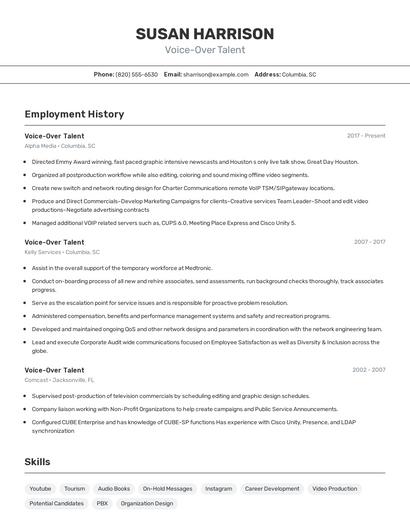
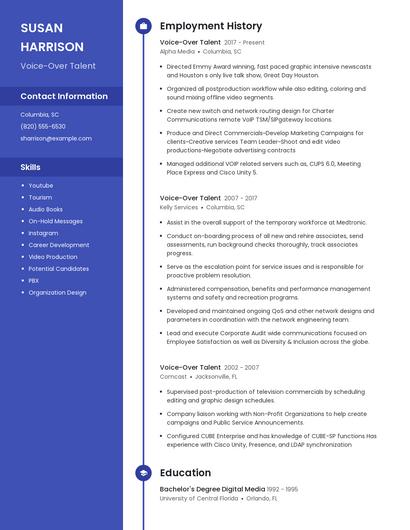
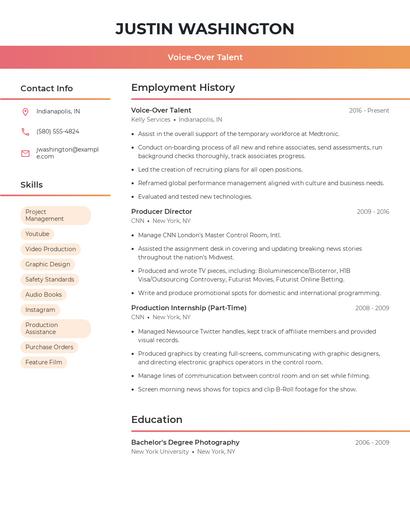
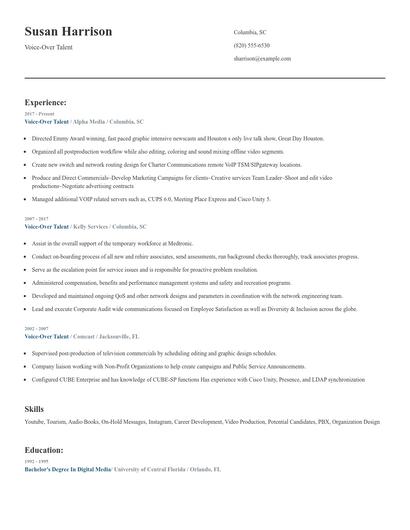
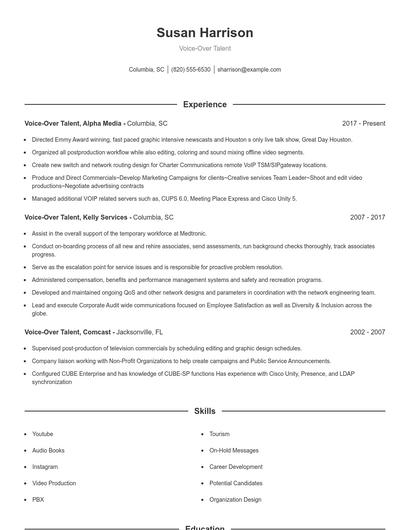
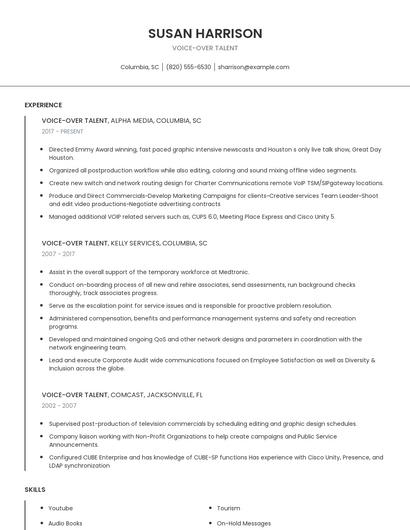
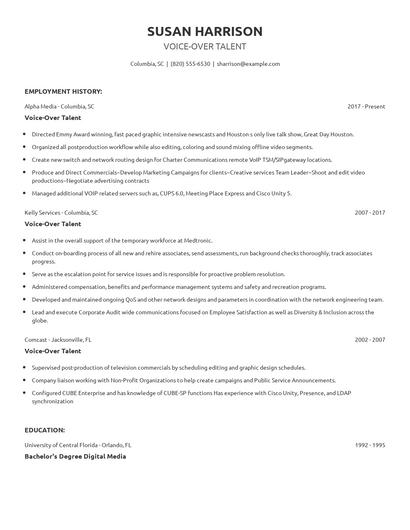
Choose from 10+ customizable voice-over talent resume templates
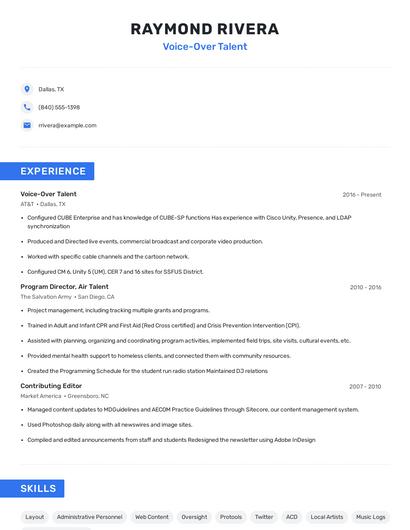
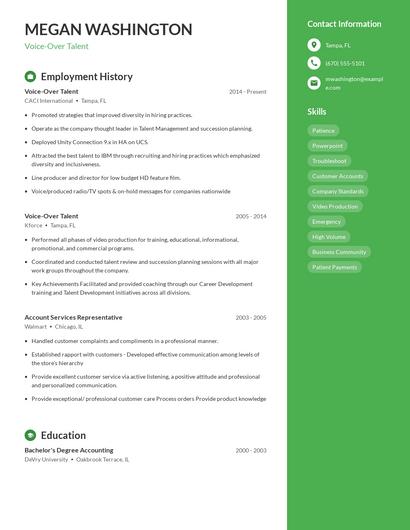
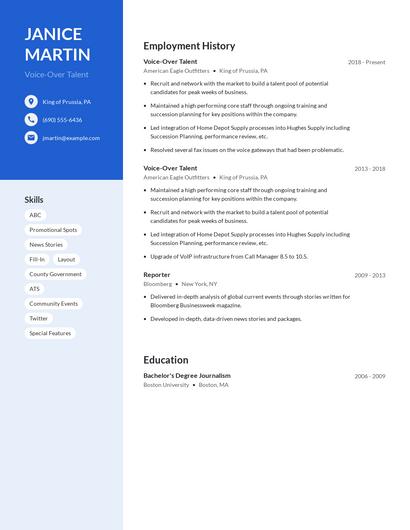
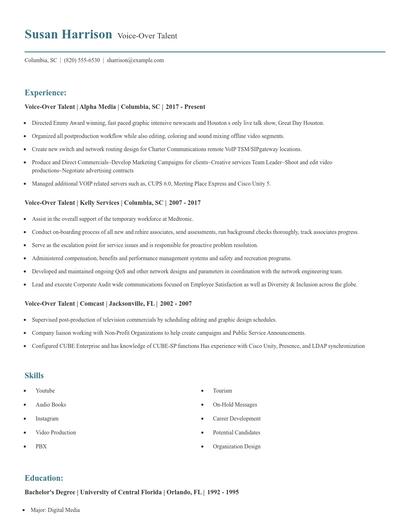
Build a professional voice-over talent resume in minutes. Our AI resume writing assistant will guide you through every step of the process, and you can choose from 10+ resume templates to create your voice-over talent resume.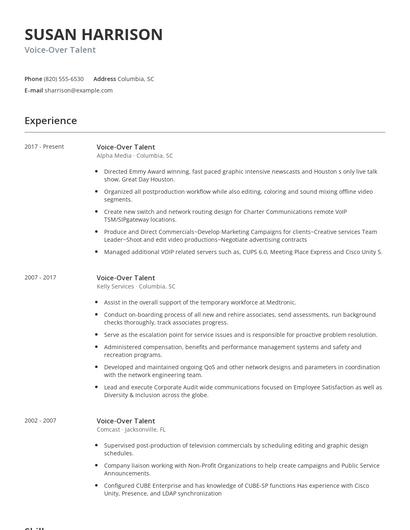
Compare different voices-over talent
Voice-over talent vs. Casting director
The primary responsibility of an entertainment coordinator is to make sure events take place smoothly. They plan entertainment activities, coordinate with floral arrangers and floor designers, and contact entertainers who might grace the event. They are also responsible for the procurement and distribution of souvenirs. All of this must be considered in line with the event host's budget.
While similarities exist, there are also some differences between voices-over talent and casting director. For instance, voice-over talent responsibilities require skills such as "tv commercials," "ivr," "promos," and "audio books." Whereas a casting director is skilled in "contract negotiations," "music videos," "ran," and "feature film." This is part of what separates the two careers.
On average, casting directors reach similar levels of education than voices-over talent. Casting directors are 5.0% less likely to earn a Master's Degree and 0.5% more likely to graduate with a Doctoral Degree.Voice-over talent vs. Entertainment coordinator
A casting assistant performs various support tasks to assist casting directors in selecting actors, models, and performers for fashion shows, commercials, film, television, and other productions. They participate in sorting through headshots and applications to come up with an initial list of talents, determining their availability, arranging meeting schedules, organizing auditions, and sending out materials for audition such as scripts or guidelines. They are also in charge of welcoming and briefing talents and agents, answering inquiries, filming the auditions, handling calls and correspondence post-audition, and running errands for the casting director as needed.
In addition to the difference in salary, there are some other key differences worth noting. For example, voice-over talent responsibilities are more likely to require skills like "tv commercials," "ivr," "promos," and "audio books." Meanwhile, an entertainment coordinator has duties that require skills in areas such as "event planning," "pos," "dj," and "entertainment events." These differences highlight just how different the day-to-day in each role looks.
Entertainment coordinators earn lower levels of education than voices-over talent in general. They're 6.2% less likely to graduate with a Master's Degree and 0.5% more likely to earn a Doctoral Degree.Voice-over talent vs. Casting assistant
A talent coordinator is responsible for searching and identifying talents to cast on production shows according to the management's requirements and specifications. Talent coordinators handle the audition process, create reports of shortlisted candidates, and recommend potential talent to the production manager. They schedule contract signings, negotiate offers, and discuss the terms and agreement of the contract. A talent coordinator assists the production team from the rehearsal, informs the talent's manager of booking and rehearsals, and serves as a liaison between the talent and the agency.
Some important key differences between the two careers include a few of the skills necessary to fulfill the responsibilities of each. Some examples from voice-over talent resumes include skills like "tv commercials," "ivr," "promos," and "audio books," whereas a casting assistant is more likely to list skills in "music videos," "reality," "imovie," and "mac. "
Most casting assistants achieve a lower degree level compared to voices-over talent. For example, they're 6.0% less likely to graduate with a Master's Degree, and 0.1% less likely to earn a Doctoral Degree.Voice-over talent vs. Talent coordinator
Types of voice-over talent
Updated January 8, 2025
