
Automatically apply for jobs with Zippia
Upload your resume to get started.
Water team leader skills for your resume and career
14 water team leader skills for your resume and career
1. Water Quality
- Perform water quality analysis testing and verification of 3 Reverse Osmosis Water Processing vehicles.
- Water quality survey at three locations.
2. Safety Policies
Safety policies are the rules and codes of conduct developed by an organization to ensure workplace safety.
- Understand and comply with Corporate policies and procedures, Health and Safety policies and procedures, and other requirements/regulations as required.
3. Water Treatment Plant
Water treatment refers to the process of improving water quality in a way that it becomes appropriate for a specific use. The uses maybe industrial water supply, irrigation, drinking, water recreation or river flow maintenance. The water treatment process usually removes contamination from an undesirable component, if not completely then at least partially.
- Maintain, repair and perform new installations on Water & Wastewater Treatment Plants, water lines and wastewater collection lines.
- Managed the Wastewater Treatment Plant and the Water Depts.For Antrim & Bennington NH
4. Water Systems
Water systems refer to any plumbing or equipment that filters or cleans water as it passes through a city or other residential area. As much of the water used in residential areas pass through a series of sewer pipes and other plumbing, there are many associations that monitor the cleanliness of the water. In order to do this, water may be treated with filtration pumps, softeners, and other methods of disinfection to ensure the water is safe to drink and use.
- Operate and maintain the Fatty Acid making process as well as four separate water systems that run throughout the plant.
5. Potable Water
- Supervised the operation of potable water storage and distribution points.
- Selected ROWPU teams to setup in different combat sites to operate and distribute potable water.
6. Frac Operations
- Be able to communicate with company man and frac crew if any problems arise during frac operations
- Maintain equal water level in frac tanks during frac operations.
7. Pump Stations
Pump stations fulfill the job of transferring liquids from one place to another. These operate on a small scale for the increase in water pressure at homes or restaurants -- similarly, it works on a larger scale at petrol stations or supplies water in canals. With the volume and amount of the liquid set as a subject, the pump station's size corresponds with its cost. The ideal pump station is efficient and less costly with the proper and safe transfer of liquid.
- Reviewed improvement designs of water, wastewater, storm water, tanks and pump stations.
8. Rig
Rigging includes designing, preparing, or setting up equipment for drilling operations. This skill is one of the main and most important activities in the oil and gas industry, whether it's for onboard operations or port operations. Rigging systems should have parts like master links, shackles, slings, and lifting bags for underwater lifting. Professionals working with rigging systems are responsible for tasks like operating platform lifts, forklifts, and overhead cranes.
- Rig up and Rig down of all equipment used in this field.
9. CPR
Cardiopulmonary resuscitation or CPR is a medical procedure that involves chest compression to help a patient breathe. This artificial ventilation helps in keeping the brain function in place and regulates blood throughout the body. CPR is a lifesaving procedure that is used in emergencies.
- Organized CPR certification training and testing for over 960 Soldiers which resulted in 100% certification rate for two separate classes
- Received training in CPR and First Aid, Disaster Relief, Shelter Operations and Diversity.
10. Water Pumps
Water Pumps transfer water from one area to the next through a pumping system. These pumps are often used to extract all the water from one area for a variety of purposes, such as future construction or to help flooded areas. Water pumps are also used in cars to push the cold water through the car's cooling system.
- Worked as sub-team leader to create a sustainable hand-powered water pump for treatment plants.
11. Onsite
- Coordinated employee's work schedules and onsite supervision.
12. RAN
RAN stands for "revenue anticipation note," which refers to a practice where an organization (often the government) borrows money to support a specific project. When these funds are then repaid, the money given to the lenders comes from the profits generated by the business originally funded.
- Trained and ran crew on location.
13. DOT
- Maintained operator logs, forms and records in accordance with company policies and DOT regulations.
- Executed daily pre-trip and post-trip inspections and documentation in compliance with DOT guidelines and company policies.
14. Quality Standards
Quality standards are a specific level of standards of products that are set by the companies for the customers that have to be met and maintained throughout the process until the time of delivery. Quality standards are information that includes the customer's requirements, guidelines, and characteristics for the needed final product or service.
- Support Engineering and Quality departments, responsible for coordinating equipment upgrades to increase productivity as well as improve quality standards.
- Managed inventory in accordance with company freshness and quality standards so that all products exceed customer expectations.

What skills help Water Team Leaders find jobs?
Tell us what job you are looking for, we’ll show you what skills employers want.
List of water team leader skills to add to your resume
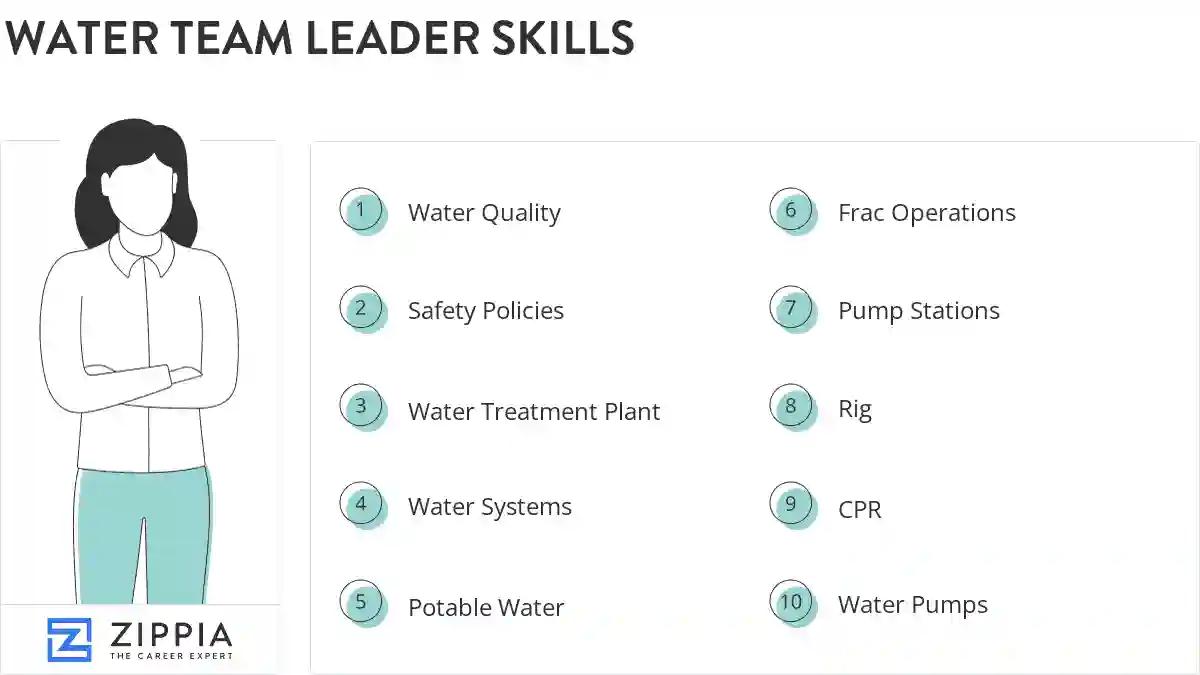
The most important skills for a water team leader resume and required skills for a water team leader to have include:
- Water Quality
- Safety Policies
- Water Treatment Plant
- Water Systems
- Potable Water
- Frac Operations
- Pump Stations
- Rig
- CPR
- Water Pumps
- Onsite
- RAN
- DOT
- Quality Standards
Updated January 8, 2025
