
Automatically apply for jobs with Zippia
Upload your resume to get started.
Weaver skills for your resume and career
12 weaver skills for your resume and career
1. Patrol
- Patrol, check for any defects, and start up any machines that has malfunctioned.
- Patrol looms and examine woven fabric for defects for defining cause of loom stoppage.
2. Quality Defects
- Check for quality defects during equipment operations.
3. Safety Procedures
Safety procedures are a set of standardized procedures, that ensures minimal to no risk to people, resources, and the work environment. A company follows the step-by-step safety procedures as it they not only keep the customers and the employees safe, but also help in avoiding legal claims.
- Expected to follow all safety procedures for the job duties assigned.
- Use proper safety equipment and follow safety procedures.
4. Creel
- Clean and set up Creel with Bobbins to get ready to start up loom.
- Lifted spools of wire, and placed them on spindles of creel.
5. Quality Checks
Quality checks are a component of quality control aimed at ensuring that quality requirements are met. Internally, quality checks provide assurance to managers, and externally, it provides assurance to clients, federal departments, authorities, and certifiers.
- Performed quality checks on products and parts.
6. Mechanical Defects
- Examined looms to determine causes of loom stoppage, such as warp filling, harness breaks, or mechanical defects.
- Examined looms to determine causes of loom stoppage or mechanical defects.
Choose from 10+ customizable weaver resume templates
Build a professional weaver resume in minutes. Our AI resume writing assistant will guide you through every step of the process, and you can choose from 10+ resume templates to create your weaver resume.7. Doff
- Doff off machine as needed per yardage doff.
- Strip 8 modules and also doff finished rolls.
8. Textile Machines
- Operate textile machines that perform textile processing and manufacturing operations.
- Operated textile machines that performed weaving processing.
9. Quality Standards
Quality standards are a specific level of standards of products that are set by the companies for the customers that have to be met and maintained throughout the process until the time of delivery. Quality standards are information that includes the customer's requirements, guidelines, and characteristics for the needed final product or service.
- Entrusted repeatedly to maintain and exceed department productivity goals, quality standards and lead operations in the absence of supervision.
- Insure cloth met quality standards.
10. Production Process
The production process is a series of events and industrial activities that come into play when raw material are delivered onto the production facility for manufacturing. The process involves different steps of production from start to finish such as; research, design formation, design testing, product manufacturing, and assembly according to the design, product experimentations, and supply.
- Rotated through all the tasks required in a particular production process.
- Operated machinery used in the production process.
11. Drop Wires
- Replace defective tension springs, drop wires, needles and heddle eyes using hand tools.
12. Customer Specifications
A Customer Specification is a document that describes the general requirement of an expected service from a contractor. It outlines the key requirements of the customer. Customer specifications should be written in simple and general language so that the contractor clearly understands the expectations of the customer. It is also known as a User Specification.
- Operated looms and checked fabric for flaws according to customer specifications.
- Weave with different makes of yarn to customer specifications.

What skills help Weavers find jobs?
Tell us what job you are looking for, we’ll show you what skills employers want.
List of weaver skills to add to your resume
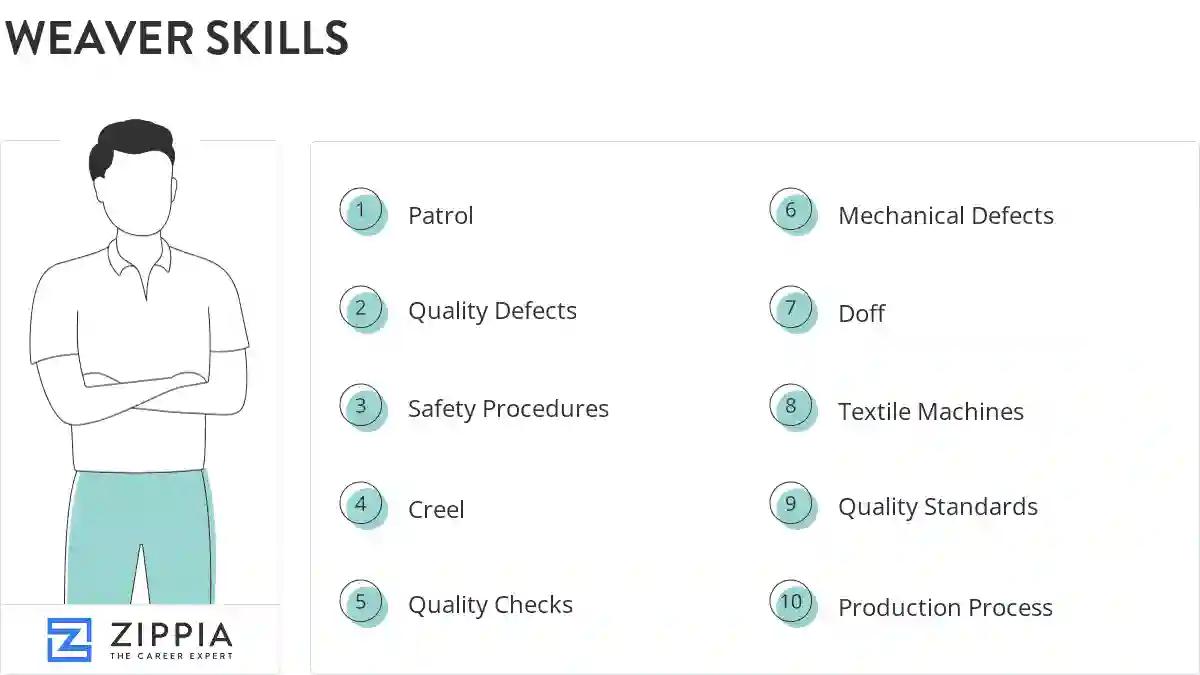
The most important skills for a weaver resume and required skills for a weaver to have include:
- Patrol
- Quality Defects
- Safety Procedures
- Creel
- Quality Checks
- Mechanical Defects
- Doff
- Textile Machines
- Quality Standards
- Production Process
- Drop Wires
- Customer Specifications
Updated January 8, 2025
