What does a weight inspector do?
Weight Inspectors play a significant role in confirming the compliance of packaged goods to the agreed content, quantity, and packaging. The inspectors test and re-calibrate measuring and weighing equipment for accuracy. They investigate the products that are short of the required weights. Their job involves checking goods sold according to their weight. Weight Inspectors are expected to develop skills and knowledge in physical inspection, proper weight classes, heavy equipment, and measures laws.
Weight inspector responsibilities
Here are examples of responsibilities from real weight inspector resumes:
- Manage cad files and plotting operations, as cad manager.
- Test and inspect tank trucks, fuel oil trucks, propane trucks.
- Document all corrections and enter all data into AS400 system timely and efficiently.
- Train and instruct others in the group on the usage of AS400 system.
- Participate in NMFTA special research projects to provide accurate information on new and changing commodities.
- Oversee installation of concrete sidewalks, wheel chair ramps, driveway aprons, asphalt and slurry projects in subdivisions.
- Maintain all records for products used as well as the cost of products ranging from bridge steel to tons of asphalt.
- tip elevations and calculate the pile cutoff elevations according to plan specifications.
- Perform weekly boiler inspections at several APS schools
Weight inspector skills and personality traits
We calculated that 33% of Weight Inspectors are proficient in Commodities, AS400, and Propane. They’re also known for soft skills such as Communication skills, Craft experience, and Detail oriented.
We break down the percentage of Weight Inspectors that have these skills listed on their resume here:
- Commodities, 33%
Participated in NMFTA special research projects to provide accurate information on new and changing commodities.
- AS400, 21%
Documented all corrections and entered all data into AS400 system timely and efficiently.
- Propane, 12%
Test and inspect tank trucks, fuel oil trucks, propane trucks.
- Freight Carriers, 10%
Determined proper weight classes in accordance with the National Motor Freight Carriers guidelines.
- Physical Inspections, 8%
Completed physical inspections and corrected errors based on cubic capacity calculations as well as class changes according to density when applicable.
- State Laws, 4%
Inspect and weigh vehicles to determine compliance with state laws, assess proper permits, and assign citations for permit violations.
"commodities," "as400," and "propane" are among the most common skills that weight inspectors use at work. You can find even more weight inspector responsibilities below, including:
Communication skills. One of the key soft skills for a weight inspector to have is communication skills. You can see how this relates to what weight inspectors do because "inspectors must be able to explain problems they discover and to write a report that clearly describes their findings." Additionally, a weight inspector resume shows how weight inspectors use communication skills: "operate communication and computer equipment. "
Detail oriented. weight inspectors are also known for detail oriented, which are critical to their duties. You can see how this skill relates to weight inspector responsibilities, because "inspectors thoroughly examine many different construction activities." A weight inspector resume example shows how detail oriented is used in the workplace: "prepared, and wrote in detailed accurate loss prevention reports. "
Mechanical knowledge. weight inspector responsibilities often require "mechanical knowledge." The duties that rely on this skill are shown by the fact that "inspectors use a variety of testing equipment to check complex systems and must therefore understand how the systems operate." This resume example shows what weight inspectors do with mechanical knowledge on a typical day: "provide structural, electrical, mechanical, plumbing, appliances, drainage, ventilation, roofing, and hvac inspection services. "
Physical stamina. Another common skill required for weight inspector responsibilities is "physical stamina." This skill comes up in the duties of weight inspectors all the time, as "inspectors are frequently on their feet and often climb and crawl through attics and other tight spaces." An excerpt from a real weight inspector resume shows how this skill is central to what a weight inspector does: "completed physical inspections and corrected errors based on cubic capacity calculations as well as class changes according to density when applicable. "
The three companies that hire the most weight inspectors are:
- Dayton Freight7 weight inspectors jobs
- Career Company in Silicon Valley7 weight inspectors jobs
- Department of Public Social Services3 weight inspectors jobs
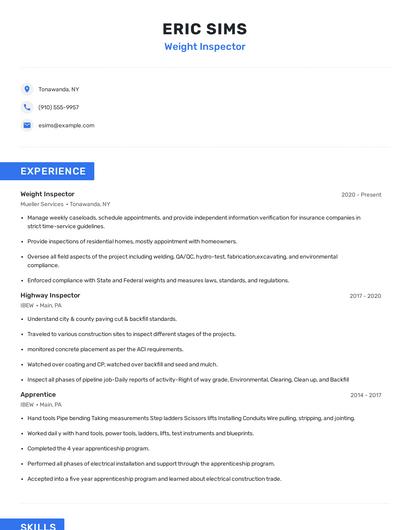
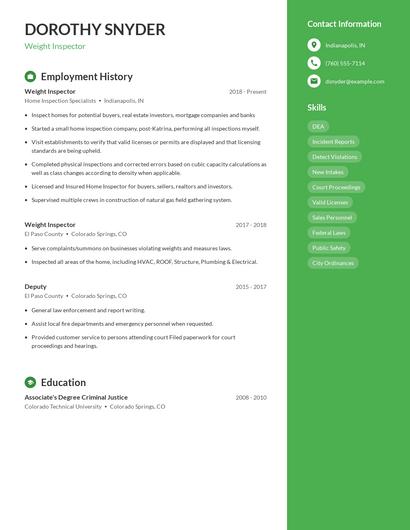
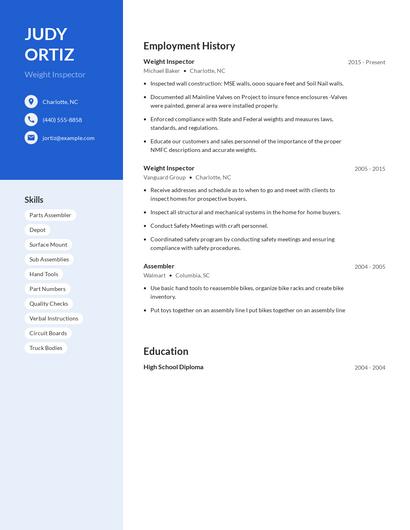
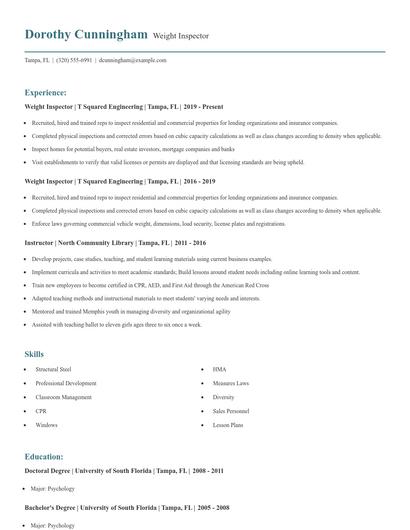
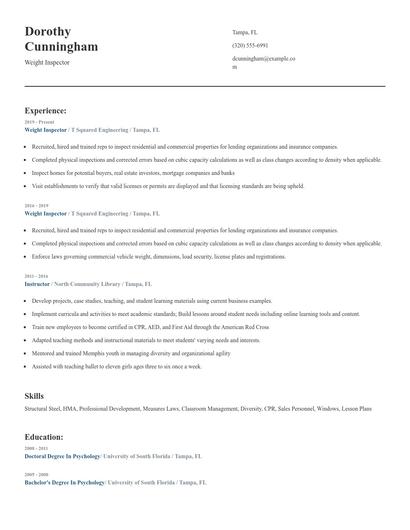
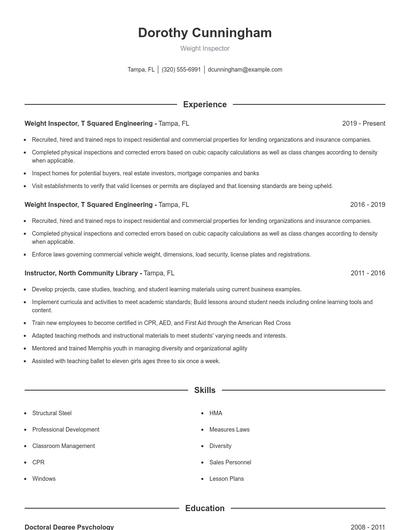
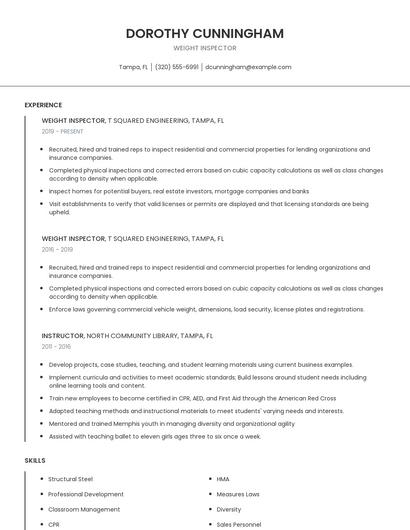
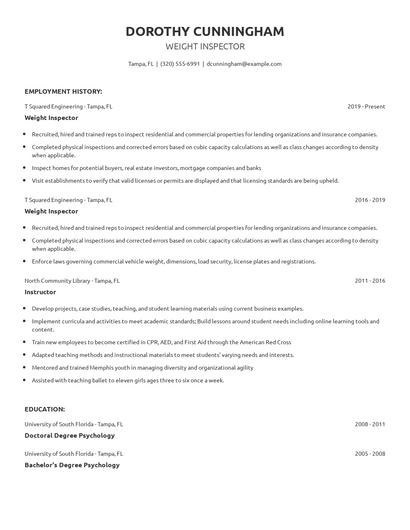
Choose from 10+ customizable weight inspector resume templates
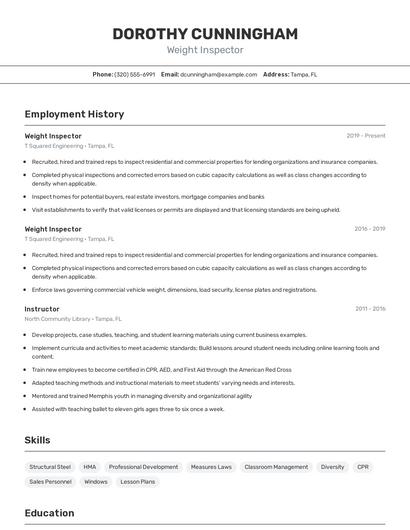
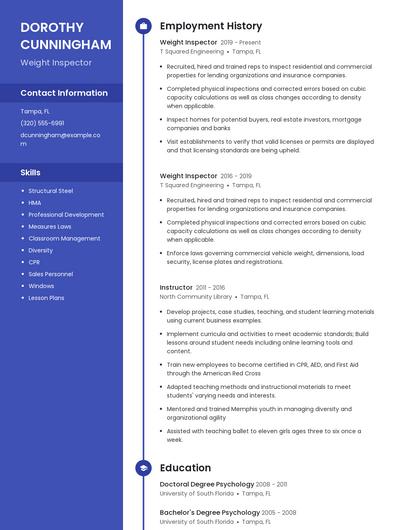
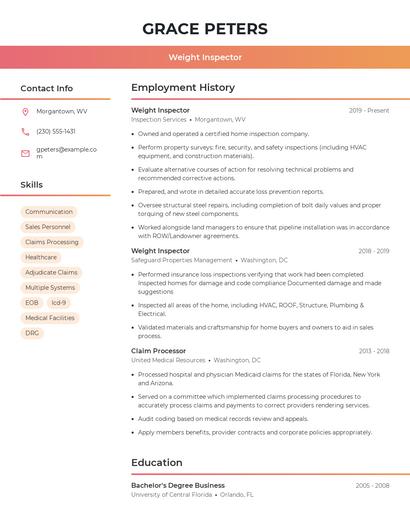
Build a professional weight inspector resume in minutes. Our AI resume writing assistant will guide you through every step of the process, and you can choose from 10+ resume templates to create your weight inspector resume.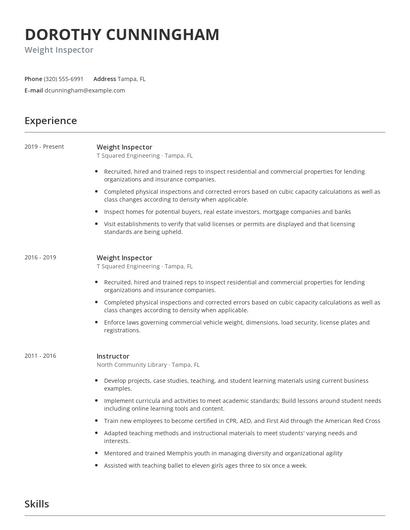
Compare different weight inspectors
Weight inspector vs. Plans examiner
A plans examiner is typically in charge of evaluating construction or work plans, ensuring compliance with regulations and zoning ordinances. Their responsibilities revolve around gathering and reviewing applications and documentation, verifying the accuracy and authenticity of requirements, and assuring that they adhere to the safety policies and standards. Furthermore, as a plans examiner, it is essential to liaise with clients and other officials, maintain records of all transactions, and provide advice on whether the applications are suitable for permits.
While similarities exist, there are also some differences between weight inspectors and plans examiner. For instance, weight inspector responsibilities require skills such as "commodities," "as400," "propane," and "freight carriers." Whereas a plans examiner is skilled in "certifications," "plumbing," "customer service," and "life safety." This is part of what separates the two careers.
Plans examiners really shine in the government industry with an average salary of $57,301. Comparatively, weight inspectors tend to make the most money in the transportation industry with an average salary of $51,133.On average, plans examiners reach higher levels of education than weight inspectors. Plans examiners are 5.9% more likely to earn a Master's Degree and 1.0% more likely to graduate with a Doctoral Degree.Weight inspector vs. Construction analyst
A Construction Analyst prepares statements, annual financial reports, exhibits, transmittal letters, schedules, statistical tables, management analysis, and management discussion. They handle business forecast analysis, cash flow projection analysis, statistical report analysis, government requirement analysis, financial plan analysis, budget analysis, and forecast analysis. Construction Analysts also prepare review recommendations, create and modify current procedures and policies.
While some skills are similar in these professions, other skills aren't so similar. For example, resumes show us that weight inspector responsibilities requires skills like "commodities," "as400," "propane," and "freight carriers." But a construction analyst might use other skills in their typical duties, such as, "construction projects," "construction management," "cost estimates," and "real estate."
On average, construction analysts earn a higher salary than weight inspectors. Some industries support higher salaries in each profession. Interestingly enough, construction analysts earn the most pay in the manufacturing industry with an average salary of $80,747. Whereas weight inspectors have higher pay in the transportation industry, with an average salary of $51,133.construction analysts earn higher levels of education than weight inspectors in general. They're 5.9% more likely to graduate with a Master's Degree and 1.0% less likely to earn a Doctoral Degree.Weight inspector vs. Building code administrator
Some important key differences between the two careers include a few of the skills necessary to fulfill the responsibilities of each. Some examples from weight inspector resumes include skills like "commodities," "as400," "propane," and "freight carriers," whereas a building code administrator is more likely to list skills in "windows server," "maven," "java," and "build scripts. "
When it comes to education, building code administrators tend to earn higher degree levels compared to weight inspectors. In fact, they're 12.2% more likely to earn a Master's Degree, and 1.2% more likely to graduate with a Doctoral Degree.Weight inspector vs. Grade checker
Even though a few skill sets overlap between weight inspectors and grade checkers, there are some differences that are important to note. For one, a weight inspector might have more use for skills like "commodities," "as400," "propane," and "freight carriers." Meanwhile, some responsibilities of grade checkers require skills like "gps," "grade control," "hand tools," and "highway construction. "
Grade checkers reach similar levels of education compared to weight inspectors, in general. The difference is that they're 2.3% more likely to earn a Master's Degree, and 0.0% less likely to graduate with a Doctoral Degree.Types of weight inspector
Updated January 8, 2025
