- Facts and Figures
- Social Security Statistics
- Social Media Statistics
- Cell Phone Usage Statistics
- Cryptocurrency Statistics
- White Collar Crime Statistics
- Crowdfunding Statistics
- Branding Statistics
- How Many Emails Are Sent Per Day
- Money Laundering Statistics
- Childcare Availability Statistics
- Cold Calling Statistics
- Automation And Job Loss Statistics
- Student Loan Statistics
- Spam Statistics
- Password Statistics
- Ransomware Statistics
- Christmas Spending Statistics
- Average Grocery Cost By State
- Average Screen Time Statistics
- Average Monthly Expenses
- IoT Statistics
- Gen Z Statistics
30+ Social Security Statistics [2026]: Average Social Security Benefit
Research Summary. Millions of current and future retirees depend on Social Security, one of the largest federal programs in the U.S. Despite its significance, many Americans remain unaware of its scope and how it operates. This article provides insights into the program, including:
-
Approximately 66 million Americans receive Social Security benefits each month.
-
The average Social Security benefit is around $1,550 per month.
-
The annual expenditure for Social Security approaches $1.2 trillion.
-
Approximately 46 million retirees rely on Social Security benefits.
-
Social Security represents about 4.8% of the U.S. total GDP.
For further analysis, we provide a breakdown of the data in the following categories:
Types of Benefits | Disability Benefits | Trends | Projections | Retirement Benefits
General Social Security Statistics
Social Security is a pivotal program in the U.S. budget, providing essential support to those unable to work. However, many retirees and disabled Americans find their benefits insufficient to cover monthly expenses. Here are some critical facts:
-
About 25% of American adults receive some form of Social Security.
This indicates that over a quarter of all Americans rely on Social Security for some monthly payments, with around 18% being retirees, 3% disabled, and 2.3% survivors.
-
6.2% of Social Security funding comes from mandatory payroll taxes.
Both employers and employees contribute 6.2% on wages up to a taxable maximum, which remains unchanged since 1990.
-
The projected income shortfall for Social Security is expected to be around 1.2% over the next several decades.
Current funding levels through taxes and other sources are not sufficient to meet future obligations.
-
The average monthly disability benefit is approximately $1,280.
A disabled individual relying solely on Social Security would earn around $15,360 annually, significantly below the poverty line.
-
The average retirement benefit currently stands at about $1,550 monthly, with a maximum benefit around $3,345.
However, the average recipient earns less than $20,000 annually, placing them below the poverty threshold.
Social Security Statistics by Types of Benefits
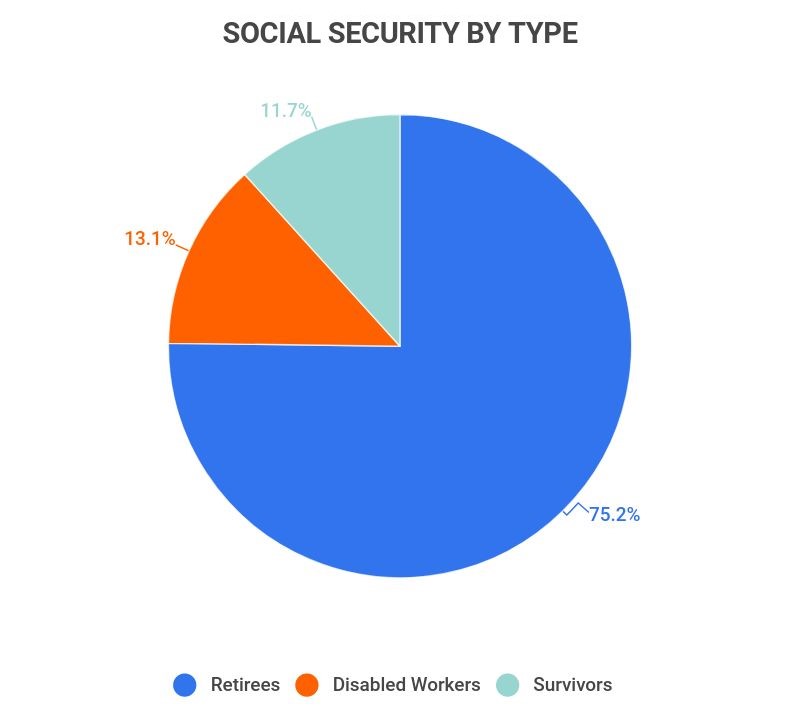
While retirees constitute the majority of Social Security beneficiaries, the program encompasses various types of benefits. Here are notable statistics:
-
49.6 million retirees and their dependents received Social Security benefits recently.
This includes approximately 46 million retirees and nearly 3 million dependents, with the average retiree receiving about $1,555 monthly.
-
5.9 million survivors receive benefits.
These benefits support family members of deceased workers, with 96% of covered workers having survivor protection for their minor children and spouses.
-
9.5 million disabled workers and dependents benefit from Social Security.
This group represents about 13% of all beneficiaries, making it the second-largest segment after retirees.
-
8.2 million Americans receive Supplemental Security Income (SSI).
Among these, 12.9% are children, 61.4% are working-age adults, and 25.7% are seniors.
Social Security Statistics by Disability Benefits
Approximately 8.1 million Americans depend on Social Security for a livable income due to disabilities. Here are key facts regarding disability benefits:
-
12 million people aged 18-64 received Social Security disability benefits recently.
-
28.5% of Americans aged 18-64 with SSI also receive OASDI benefits.
-
86% of SSI recipients qualify due to a disability.
-
Over 10 million Americans qualify for Medicaid based on disability.
-
The states with the highest numbers of disability beneficiaries include California, Texas, and Florida.
Social Security Trends
Since its inception during the Great Depression in 1935, Social Security has evolved significantly. Here are some trends illustrating the program’s development over recent decades:
-
The number of Social Security beneficiaries has increased substantially, reflecting demographic changes and economic factors. This growth is outpacing the overall population increase, indicating rising dependency on the program.
-
The average monthly Social Security payout has risen significantly over time, but inflation has also increased, affecting real income gains.
-
The prevalence of disabilities in the U.S. workforce has changed, necessitating ongoing adjustments to Social Security provisions.
Social Security Projections
Looking ahead, various projections highlight potential challenges for the future of Social Security:
-
By 2034, payroll income may only cover about 77% of full monthly benefits.
-
In a high-cost scenario, Social Security reserves could be depleted as early as 2031.
-
Conversely, a low-cost scenario may extend reserves until 2052.
Social Security Statistics by Retirement Benefits
Despite the average benefits falling below the poverty line, many retirees still depend on Social Security as their primary income source. Key insights include:
-
15% of women and 12% of men rely on Social Security for over 90% of their income.
-
Approximately 21% of married couples depend on Social Security for over 90% of their income.
-
Roughly 45% of single retirees depend entirely on Social Security for their income.
Social Security Statistics FAQ
-
What percentage of the U.S. population receives Social Security benefits?
About 25% of the adult U.S. population receives some form of Social Security benefit, divided primarily among retirees, disabled individuals, and survivors.
-
What is the average Social Security check?
The average Social Security check is around $1,550 per month, with significant variations among different beneficiary groups.
-
How many people receive Social Security?
As of recent data, 66 million Americans receive Social Security benefits each month, demonstrating a significant increase over the past two decades.
-
What percentage of retirees live on Social Security?
Approximately 40% of retirees rely on Social Security for their livelihood.
-
Do millionaires get Social Security?
Yes, millionaires can receive Social Security benefits if they have paid into the system sufficiently during their working years.
-
At what age is Social Security not taxable?
Typically, Social Security is tax-free at ages 65 to 67, depending on the individual’s income.
-
How much Social Security retirement will I get if I make $50,000 a year?
If you earn approximately $50,000 per year, your monthly benefit will vary depending on your retirement age.
-
Does a spouse receive their partner’s Social Security if they die?
Yes, a surviving spouse can receive their partner’s Social Security benefits upon their passing, subject to certain conditions.
Key Insights on Social Security
Social Security serves as a crucial income source for approximately 66 million Americans, including retirees, survivors, and disabled individuals. Many of these individuals rely on it for up to 90% of their income.
However, the average benefit often falls below the poverty level, raising concerns about adequacy. As the number of beneficiaries increases, the program’s funding challenges become more pronounced, necessitating attention and potential reform to ensure its sustainability.
- Facts and Figures
- Social Security Statistics
- Social Media Statistics
- Cell Phone Usage Statistics
- Cryptocurrency Statistics
- White Collar Crime Statistics
- Crowdfunding Statistics
- Branding Statistics
- How Many Emails Are Sent Per Day
- Money Laundering Statistics
- Childcare Availability Statistics
- Cold Calling Statistics
- Automation And Job Loss Statistics
- Student Loan Statistics
- Spam Statistics
- Password Statistics
- Ransomware Statistics
- Christmas Spending Statistics
- Average Grocery Cost By State
- Average Screen Time Statistics
- Average Monthly Expenses
- IoT Statistics
- Gen Z Statistics

Author

Sky Ariella is a professional freelance writer, originally from New York. She has been featured on websites and online magazines covering topics in career, travel, and lifestyle. She received her BA in psychology from Hunter College.