Yes, the majority of Americans have access to benefits, although part-time, low-income, and private-sector employees often face barriers. As of now, approximately 54.3% of Americans have healthcare benefits provided by their employers. The most prevalent benefits include retirement plans, life insurance, healthcare coverage, and paid leave.
Factors influencing access to benefits include employment status (full-time vs. part-time), income level, geographical location, and company size.
To provide a clearer picture, we compiled data on the most common benefits available to Americans in both the private and public sectors. From our extensive analysis:
-
69% of workers in the private sector have access to retirement benefits, compared to 92% in the public sector.
-
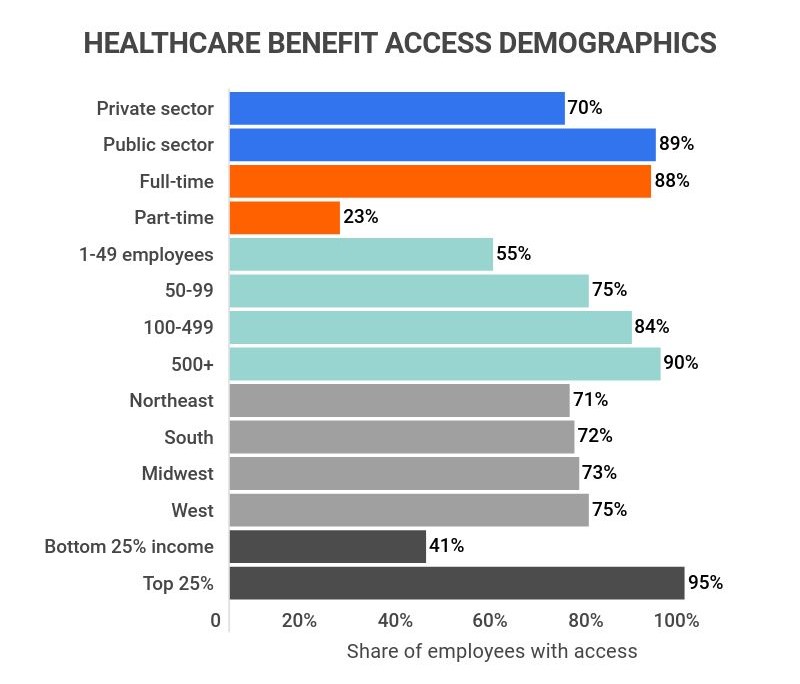
70% of private-sector employees have access to healthcare benefits, while 89% of public-sector workers do.
-
81% of full-time workers have retirement benefits, in contrast to only 43% of part-time employees.
-
90% of those employed at companies with 500+ employees have access to healthcare benefits, while only 55% of those at companies with 1 to 49 employees do.
-
90% of employees in the West have access to paid sick leave, compared to only 71% in the South.
-
Only 41% of individuals in the bottom 25% income bracket have access to healthcare benefits, whereas 95% of those in the top 25% do.
For further insights, we have categorized this data in the following ways:
Sector | Industry | Company Size | Region | Income
Average Access To Benefits By Sector
| Type of benefit | Private industry | State and local government |
|---|---|---|
| Retirement | 69% | 92% |
| Life insurance | 57% | 83% |
| Healthcare | 70% | 89% |
| Paid sick leave | 77% | 92% |
| Paid vacation | 79% | 61% |
| Paid holidays | 81% | 68% |
Full-Time and Part-Time Access To Benefits By Industry
| Type of benefit | Full-Time | Part-Time |
|---|---|---|
| Retirement | 81% | 43% |
| Life insurance | 74% | 16% |
| Healthcare | 88% | 23% |
| Paid sick leave | 88% | 51% |
| Paid vacation | 88% | 40% |
| Paid holidays | 89% | 49% |
Average Access To Benefits By Company Size
| Type of benefit | 1-49 Employees | 50-99 Employees | 100-499 Employees | 500+ Employees |
|---|---|---|---|---|
| Retirement | 54% | 72% | 83% | 91% |
| Life insurance | 38% | 62% | 72% | 84% |
| Healthcare | 55% | 75% | 84% | 90% |
| Paid sick leave | 70% | 79% | 84% | 91% |
| Paid vacation | 70% | 75% | 83% | 83% |
| Paid holidays | 72% | 76% | 85% | 86% |
Average Access To Benefits By Region
| Type of benefit | Northeast | South | Midwest | West |
|---|---|---|---|---|
| Retirement | 71% | 72% | 74% | 71% |
| Life insurance | 58% | 60% | 63% | 60% |
| Healthcare | 71% | 72% | 73% | 75% |
| Paid sick leave | 83% | 71% | 74% | 90% |
| Paid vacation | 74% | 78% | 77% | 78% |
| Paid holidays | 77% | 80% | 79% | 80% |
Average Access To Benefits By Income
| Type of benefit | Bottom 25% | Top 25% |
|---|---|---|
| Retirement | 48% | 92% |
| Life insurance | 28% | 86% |
| Healthcare | 41% | 95% |
| Paid sick leave | 57% | 94% |
| Paid vacation | 56% | 82% |
| Paid holidays | 60% | 85% |
Access To Benefits FAQ
-
How many Americans get their health insurance through their employer?
Approximately 155 million Americans receive their health insurance from their employers. However, access varies significantly based on factors like region, job type, and income level.
For instance, about 95% of the wealthiest Americans (top 25%) have healthcare benefits, compared to just 41% for those in the bottom 25%. Additionally, only 23% of part-time employees have access to health insurance, while 88% of full-time employees do.
It is crucial to review job descriptions and inquire during interviews to confirm whether a position includes healthcare benefits.
-
Why is US healthcare tied to employment?
The linkage of US healthcare to employment serves as a key incentive. This system emerged during WWII, when a labor shortage prompted employers to offer healthcare benefits to attract workers, particularly women.
While this approach was effective at the time, recent surveys show that 63% of US adults believe healthcare coverage should be the government’s responsibility. Consequently, employer-sponsored healthcare may face declining interest as public healthcare initiatives gain traction.
-
What are the four mandatory benefits for an employee?
The four mandatory benefits for employees in the US include paid annual leave, parental leave, worker’s compensation insurance, and paid sick leave. These benefits are generally required only for full-time employees.
Moreover, the extent of paid leave offered can vary significantly between companies, as employers have discretion over the specific policies they implement.
-
Does federal law require employers to offer retirement plans?
No, federal law does not mandate that employers establish retirement plans. However, those who do offer plans must comply with specific minimum standards. Examples of ERISA regulations include:
-
Part-time employees working 1,000 hours or more annually must receive proportional benefits.
-
Employers must provide employees with relevant plan information about features and funding.
-
Plans cannot discriminate based on age or other demographics.
Despite the lack of a legal requirement, many employers opt to offer retirement plans to attract top talent.
-
Conclusion
While employer-sponsored benefits are prevalent in the US, access largely depends on the type of benefits and individual employee circumstances. For example, while 88% of full-time employees have healthcare benefits, only 23% of part-time workers do.
In summary, full-time, higher-income, public sector employees are significantly more likely to access benefits compared to their part-time, lower-income, private sector counterparts.
If having access to benefits is a priority for you, be sure to thoroughly analyze job descriptions and ask the hiring manager about coverage during your interview.
Source:
-
BLS – Employee Benefits in the United States

Author

Jack Flynn is a writer for Zippia. In his professional career he’s written over 100 research papers, articles and blog posts. Some of his most popular published works include his writing about economic terms and research into job classifications. Jack received his BS from Hampshire College.