Average Sales Commission Overview for 2026: A career in sales can be incredibly rewarding, especially when commissions significantly boost your income.
Whether you’re a job seeker curious about potential commission earnings or an established sales professional evaluating your performance, this guide provides valuable insights into average sales commissions in the U.S. based on our latest research:
Key Insights:
-
The average sales commission in the U.S. ranges from 20-30% of gross margins.
-
Architecture sales boast the highest average commission at 37%.
-
Pharmaceutical sales lead in additional compensation, averaging $41,475.
-
Entry-level sales representatives might start with commissions as low as 5%, while experienced professionals can earn commissions up to 100% without base pay.
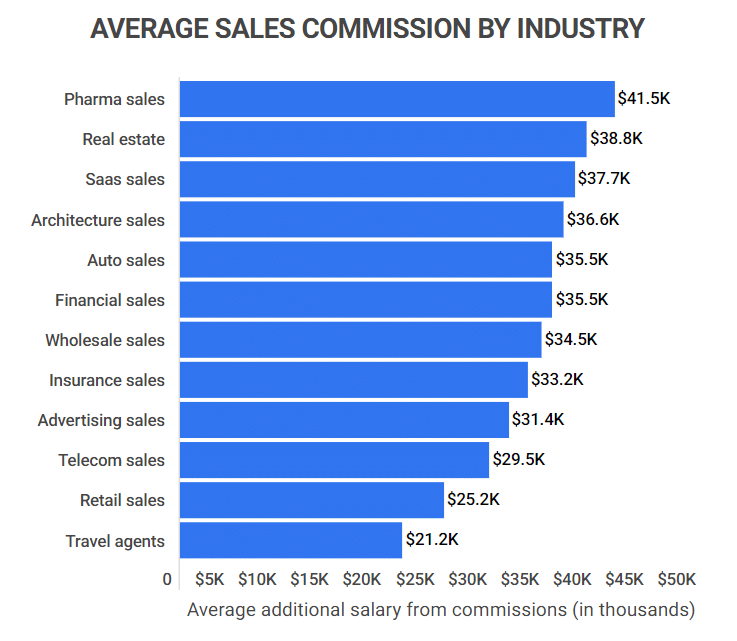
Average Sales Commission Rates by Industry
Commission rates can vary significantly across different industries, influenced by factors such as product type and sales methodologies. For instance, the commission structure for a real estate agent differs greatly from that of retail sales.
Below is a detailed chart of average sales commissions by industry:
Average Sales Commission by Industry
| Industry | Average Sales Commission as Gross Margin | Average Additional Pay |
|---|---|---|
| Architecture Sales | 37% | $36,581 |
| Retail Sales | 36% | $25,166 |
| Pharmaceuticals Sales | 35% | $41,475 |
| Telecommunications Sales | 35% | $29,519 |
| Travel Agents | 35% | $21,233 |
| Wholesale Sales | 34% | $34,490 |
| Insurance Sales | 33% | $33,252 |
| Advertising Sales | 32% | $31,373 |
| Financial Sales | 32% | $35,485 |
| Software as a Service (SaaS) | 32% | $37,702 |
| Auto Sales | 30% | $35,524 |
| Real Estate | 28% | $38,784 |
Among the industries listed, Architecture ranks highest with an average sales commission of 37%. Conversely, Real Estate offers a lower average sales commission of 28%. However, annual sales commissions in Real Estate can often exceed those in Architecture due to the higher value of transactions. Notably, the highest additional pay comes from the Pharmaceutical sector, averaging $41,475, while Travel Agents earn the least at $21,233.
Factors Influencing Average Sales Commission
The typical sales commission falls between 20-30% for most representatives, but various factors can affect these rates. Some industries may offer commissions as low as 5%, while others might provide a commission-only structure.
Key factors include:
-
Sales Volume: Exceeding established targets can result in higher commission rates on additional sales.
-
Sales Difficulty and Duration: Certain products or industries require more time and relationship-building to sell, often leading to lower commission rates but higher base salaries.
-
Experience Level: New entrants typically receive lower commission percentages alongside a higher base salary, while seasoned professionals may have a more lucrative commission structure.
If you’re uncertain about the appropriate commission rate for your role, consider your expertise and research industry standards. Once informed, discuss commission expectations with your current or prospective employer.
Average Sales Commission FAQ
-
What are sales commission rates?
Sales commission rates represent the share of a sale’s value that is paid to the salesperson. For example, a real estate agent selling a house for $500,000 at a 6% commission would earn $30,000:
-
Sale Value ($500,000) x Sales Commission Rate (6% or 0.06) = Commission ($30,000)
-
-
How much do sales representatives make?
The average salary for sales representatives is approximately $56,500 annually, though this can vary widely across industries. For instance, the Auto industry offers a higher average base salary of $80,980, compared to the Travel industry, which averages $39,029. Despite similar base salaries, Pharmaceutical representatives typically earn $6,000 more in commissions.
Average sales representative salaries are often calculated based on On-target earnings (OTE), reflecting the typical income when achieving sales goals. However, individual results can differ significantly based on performance.
-
What are common sales commission structures?
Sales roles can feature various commission structures. Here are popular examples:
-
Commission Draw: You receive guaranteed pay upfront, which can be adjusted based on earned commissions.
-
Base Salary + Commission: You earn a fixed salary plus a set commission rate for sales.
-
Residual Commission: Earnings come from ongoing revenue from existing accounts.
-
Tiered Commission: Your commission increases when specific targets are met.
-
Multiplier Commission: Additional commission rates apply once initial quotas are met.
-
Gross Margin Commission: Commissions are calculated as a percentage of total profit from sales.
-
Revenue Commission: Commissions are based on the cost of the product sold.
-
100% Commission: All income is derived from sales performance without a base salary.
-
Territory Volume: Commissions are shared among a team based on collective sales within a territory.
-
-
Is a 15% sales commission good?
A 15% commission is below the average of 20-30%, but its adequacy largely depends on the industry and base salary. For example, real estate agents and auto salespeople may have lower commission rates due to the high value of their products, which often compensate for it.
In roles with higher base salaries, high commission rates may be less critical since the base income provides financial stability.
-
How do you determine a fair sales commission rate?
To determine a fair commission rate, consider market research and be prepared to discuss it with your employer or potential employer. Factors to consider include:
-
Compensation trends among competitors.
-
Typical duration of the sales process.
-
Effort involved in relationship-building for sales.
-
Adjustments based on the price of the product or service.
-
Geographic influences on compensation.
These insights will equip you for informed discussions regarding commission rates, ensuring you know your worth.
-
Conclusion
The average sales commission rate in 2026 remains between 20-30% of gross margins, indicating that a substantial portion of sales representatives’ earnings comes from commissions.
Commission rates fluctuate by industry, with Architecture (37%) and Retail (36%) leading, while Auto (30%) and Real Estate (28%) are on the lower end. Ultimately, a sales professional’s final earnings are influenced by their industry, employer, and skill level. When assessing commission structures, it’s essential to consider various factors to ensure a fair compensation package.
References

Author

Jack Flynn is a writer for Zippia. In his professional career he’s written over 100 research papers, articles and blog posts. Some of his most popular published works include his writing about economic terms and research into job classifications. Jack received his BS from Hampshire College.