- Quality Of Life At Work Statistics
Research Summary: In 2026, enhancing employee loyalty remains crucial for businesses aiming to boost retention and minimize turnover. Recent trends indicate a continuing decline in employee loyalty, significantly impacting the job market and organizational dynamics.
To better understand these shifts, we have compiled key trends and statistics regarding employee loyalty in the US. Our extensive research reveals:
-
Employees who feel unrecognized are twice as likely to be seeking new job opportunities.
-
40% of employees leave their jobs due to insufficient career advancement opportunities.
-
55% of employee engagement stems from nonfinancial forms of recognition.
-
64% of employees believe that trust in senior management is critical to their job satisfaction.
-
Employees who perceive their company as having a purpose beyond profit are 27% more likely to demonstrate loyalty.
For a comprehensive analysis, we have categorized the data as follows:
Reasons Employees Stay | Reasons Employees Quit | Loyalty and Engagement Insights
General Employee Loyalty Statistics
Despite ongoing efforts to bolster employee loyalty, challenges persist. Here are some current statistics that illuminate the landscape of employee loyalty:
-
20% of HR managers prioritize employee retention as their top goal.
Although this may seem low, it ranks higher than other priorities; only 14% of HR managers cite recruitment and 12% emphasize company culture.
-
The average cost of employee turnover is at least 33% of their annual salary.
This turnover cost can equate to over six months of an employee’s salary. For instance, replacing an employee with a $60,000 salary could cost an employer as much as $20,000.
-
Recognition and appreciation stand as the primary factors driving employee retention.
Staff members are more inclined to remain loyal when they feel acknowledged for their contributions, with work-life balance and opportunities for training and development also playing significant roles—often outweighing salary considerations.
Reasons Employees Stay
While recognition, work-life balance, and development are crucial, what specifically encourages employees to remain with their employers? Our research indicates:
-
33% of employees who rate their work-life balance positively intend to stay at their current jobs.
In fact, employees with a strong perception of their work-life balance are 10% more likely to remain at their jobs compared to those who do not.
-
94% of employees would extend their tenure if companies invested in their professional growth.
A vast majority of employees, regardless of their industry, express a strong desire for career development, representing a significant opportunity for employers aiming to enhance retention.
-
Employees who perceive career progression are 20% more likely to still be with their employer after one year.
Stagnation is a major factor driving employees away, highlighting the necessity for companies to regularly provide new responsibilities and training.
-
93% of employees believe that empathy is essential for retention.
Employees are particularly discouraged by unsympathetic leadership, with 82% stating they would leave a job for a more compassionate organization.
-
40% of Millennials indicate that a company’s work environment influences their decision to stay.
Millennials favor a collaborative, peaceful workplace, with 88% expressing a preference for teamwork over competition.
Reasons Employees Quit
Even a single negative factor can prompt employees to seek new opportunities. Here are key statistics regarding why employees leave their jobs:
-
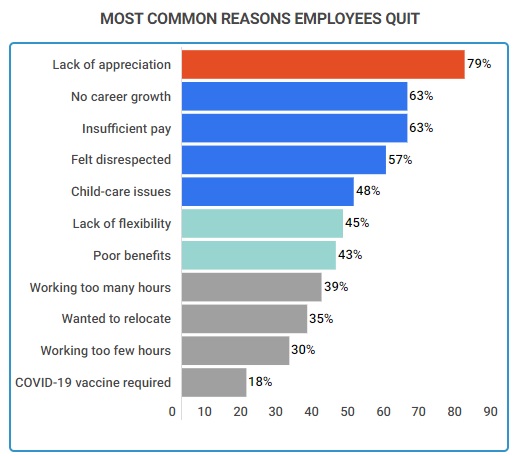
79% of employees attribute their departure to a lack of appreciation.
-
63% quit because they see no prospects for advancement.
-
57% leave due to feeling disrespected in the workplace.
-
A lack of flexibility is a reason for quitting for 45% of employees.
Most Common Reasons Employees Quit
| Reason for Quitting | Employees Who Say It Was a Factor |
|---|---|
| Lack of Appreciation | 79% |
| No Opportunities for Advancement | 63% |
| Insufficient Pay | 63% |
| Felt Disrespected | 57% |
| Child-Care Issues | 48% |
| Lack of Flexibility | 45% |
| Poor Benefits | 43% |
| Working Too Many Hours | 39% |
| Wanted to Relocate | 35% |
| Working Too Few Hours | 30% |
| Employer Vaccine Mandate | 18% |
Loyalty and Engagement Statistics
Employee engagement and loyalty are closely linked, with engaged employees more likely to stay with their companies. However, achieving high engagement levels remains a challenge. Consider the following facts:
-
Only 36% of US employees report being engaged at work.
Globally, engagement rates are even lower, with just 20% of employees feeling engaged.
-
Organizations with high employee engagement see a 59% reduction in turnover.
Additionally, heightened engagement correlates with a 41% decrease in absenteeism.
-
Employees who feel heard are 4.6 times more likely to give their best effort.
A supportive company culture significantly enhances engagement and retention, as employees who feel a sense of belonging are 5.3 times more likely to excel in their work.
-
66% of employees believe training and development are the employer’s responsibility.
Employees expect their employers to provide ongoing skill development, with 84% affirming that their company should assist in their professional growth over time.
Employee Loyalty FAQs
-
Do companies value loyal employees?
Yes, companies value loyal employees. Loyalty offers several advantages:
-
Enhanced Productivity. Engaged, loyal employees can improve productivity by up to 12%, yielding cost savings and supporting annual growth.
-
Higher Retention. Loyal employees are up to 87% less likely to leave, significantly reducing turnover and absenteeism costs for businesses.
-
Alignment with Purpose. Loyal employees contribute positively to a company’s mission and culture, enhancing workplace morale and attracting customers.
-
-
How crucial is employee loyalty?
Employee loyalty is critically important. The average exit cost for an employee is 33% of their annual salary, often exceeding $15,000, alongside ongoing recruitment expenses.
Furthermore, loyalty leads to significant benefits, including increased productivity, reduced turnover, and improved work quality.
-
How is employee loyalty assessed?
Employee loyalty is often evaluated using a Net Promoter Score (NPS). This metric gauges employee likelihood to recommend their employer to others, typically scored on a range from one to ten, or -100 to 100.
-
Are loyal employees more productive?
Yes, loyal employees can be up to 12% more productive. Similarly, remote work has been shown to boost productivity by 13%. Thus, loyalty is a key factor in enhancing productivity.
Final Thoughts
Employee loyalty is vital for cultivating a thriving organization. Nonfinancial recognition proves to be the most effective strategy for enhancing loyalty. Employees prioritize recognition, work-life balance, and opportunities for training and development over salaries.
In fact, 55% of employee engagement is linked to nonfinancial recognition.
Despite these insights, many companies in the US continue to struggle with maintaining employee loyalty. A lack of loyalty can lead to poor retention rates, high absenteeism, and increased costs. To address these challenges, businesses must focus on empathy, robust training programs, and flexible work arrangements to harness the full potential of employee loyalty.
References
-
McKinsey & Company – Money can’t buy your employees’ loyalty
-
SHRM – Respect and trust top the list of most important employee job satisfaction factors
-
Paycor – Paycor Survey Reveals Retention is the #1 Priority of HR in 2023
-
TERRA – The Real Cost of Employee Turnover in 2021
-
Workest – 6 Main Drivers of Employee Retention
-
Hire – The Ideal Millennial Work Environment
-
Leadership Freak – Nearly 80% Say Lack of Appreciation Is a Major Reason for Leaving
-
Gallup – U.S. Employee Engagement Data Hold Steady in First Half of 2021
-
Forbes – The Overlooked Way To Reduce Employee Turnover By 59%
-
Trailhead – Understand the Business Impact of Inclusive Leadership
-
Clutch – How Should Companies Deliver Employee Training and Development Opportunities?
- Quality Of Life At Work Statistics

Author

Jack Flynn is a writer for Zippia. In his professional career he’s written over 100 research papers, articles and blog posts. Some of his most popular published works include his writing about economic terms and research into job classifications. Jack received his BS from Hampshire College.