- Industry Statistics
- Wedding Industry Statistics
- Yoga Industry Statistics
- Music Industry Statistics
- Landscaping Industry Statistics
- Bicycle Industry Statistics
- Coffee Industry Statistics
- Car Rental Industry Statistics
- Home Improvement Industry Statistics
- Insurance Industry Statistics
- Supplements Industry Statistics
- Golf Industry Statistics
- Fitness Industry Statistics
- US Media And Entertainment Industry Statistics
- Firearm Industry Statistics
- Financial Services Industry Statistics
- Health And Wellness Industry Statistics
- Trucking Industry Statistics
- Wine Industry Statistics
- Pet Industry Statistics
- Mobile App Industry Statistics
- Digital Marketing Industry Statistics
- Hotel Industry Statistics
- Retail Statistics
- Robotics Industry Statistics
- Jewelry Industry Statistics
- Appointment Scheduling statistics
- Restaurant Industry Statistics
- Food Delivery Statistics
- Food Truck Industry
- Fashion Industry
- Real Estate Industry
- US Film Industry
- US Beverage Industry
- USu202fFast Food Restaurants
- US Construction Industry
- US Book Industry
- Cosmetics Industry
- US Food Retail Industry
- US Pharmaceutical Industry
- US Healthcare Industry
- Airline Industry
- Automobile Industry
- Transportation Industry Statistics
- Event Industry Statistics
- Project Management Statistics
- Oil And Gas Industry Statistics
- Nursing Home Statistics
- Nursing Shortage Statistics
- Nursing Statistics
25+ Trending Financial Services Industry Statistics [2026]: How Many Jobs Are Available In Finance?
Research Summary. The financial services industry plays a crucial role in our economy, influencing everything from investments to insurance. Here are some updated key statistics for 2026:
-
As of February 2026, approximately 6.68 million Americans are employed in the finance and insurance sector.
-
There are currently over 374,000 job openings available in the finance industry.
-
The finance and insurance sector maintains a 2% unemployment rate.
-
This industry contributes nearly $2 trillion or 7.4% of the total U.S. GDP.
-
The global financial services market is projected to grow at a CAGR of 6% from 2020 to 2025, with a value of approximately $28.53 trillion by 2025.
For further analysis, we have categorized the data as follows:
Global | Trends and Projections | U.S. Banking | Employment | Marketing
General U.S. Financial Services Industry Statistics
-
The finance and insurance sector contributes $2 trillion to the U.S. GDP.
-
This sector accounts for approximately 7.4% of the country’s total GDP.
-
The gross output of the financial services industry is estimated at $3.59 trillion as of 2022.
-
There are around 539,447 private establishments in finance and insurance.
-
Approximately 1,041 government establishments operate within this sector.
Global Financial Services Industry Statistics
-
The global financial services market is valued at $20.49 trillion as of 2020.
This figure was projected to reach $28.53 trillion by 2025.
-
Western Europe represents the largest share of the global financial services market, accounting for 40%. North America follows with 27%.
-
The financial services sector constitutes about 20-25% of the global economy.
-
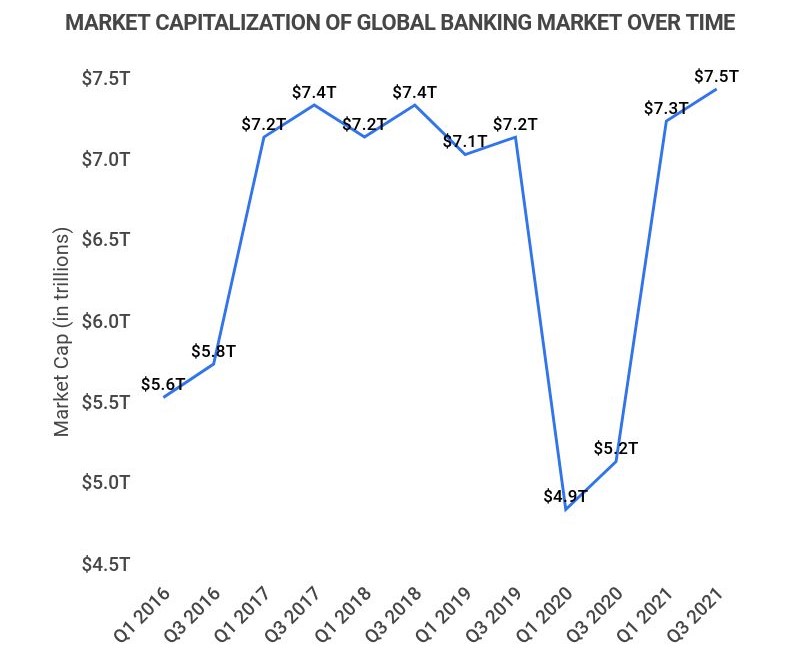
The market capitalization of the global banking sector was about $8.36 trillion as of Q3 2021.
Financial Services Industry Trends and Projections
-
The U.S. financial industry workforce grew from 6.09 million in 2016 to 6.68 million in 2026.
Here’s the year-by-year breakdown:
Size of U.S. Financial Industry Workforce
Year (Numbers From January of Each Year) Number of Employees 2016 6.09 million 2017 6.23 million 2018 6.28 million 2019 6.38 million 2020 6.49 million 2021 6.52 million 2022 6.55 million 2023 6.68 million -
The U.S. finance and insurance sector’s unemployment rate was 1.8% in October 2021 and has stabilized at 2% as of February 2026.
The monthly breakdown from January 2020 until February 2026 is as follows:
Finance and Insurance Industry Monthly Unemployment Rate (2020 to 2026)
J F M A M Jn Jl A S O N D 2020 2.2% 1.4% 1.9% 3.8% 3.3% 3.8% 3.6% 3.1% 3.6% 3.0% 2.6% 2.8% 2021 2.8% 3.0% 3.0% 2.0% 2.3% 2.8% 3.1% 3.5% 2.0% 1.8% 1.7% 2.2% 2022 1.8% 2.4% 1.7% 1.7% 1.6% 1.9% 1.5% 1.5% 1.0% 1.4% 1.6% 2.5% 2023 2.2% 2.0% 2.1% 2.0% 2.1% 2.0% 2.0% 2.0% 2.0% 2.0% 2.0% 2.0% 2024 2.0% 2.0% 2.0% 2.0% 2.0% 2.0% 2.0% 2.0% 2.0% 2.0% 2.0% 2.0% 2025 2.0% 2.0% 2.0% 2.0% 2.0% 2.0% 2.0% 2.0% 2.0% 2.0% 2.0% 2.0% 2026 2.0% 2.0% 2.0% 2.0% 2.0% 2.0% 2.0% 2.0% 2.0% 2.0% 2.0% 2.0% -
From 2020 to 2025, the global financial industry is expected to maintain a CAGR of 6%, reaching a value of $28.53 trillion.
Financial Services Industry Statistics by U.S. Banking
-
The U.S. banking system has approximately $18 trillion in assets as of the end of 2025.
-
The net income of the U.S. banking system is projected at $240 billion for 2025.
-
JP Morgan Chase remains the largest bank in the U.S. and globally, with a market capitalization exceeding $500 billion.
Financial Services Industry Statistics by Employment
-
Approximately 6.68 million Americans are employed in the finance and insurance sector as of February 2026.
The most common roles include tellers (414,680), securities, commodities, and financial services sales agents (412,970), with loan officers, insurance sales agents, and accountants rounding out the top five.
-
The average annual salary for finance and insurance professionals is around $72,400.
Securities, commodities, and financial services sales agents have the highest average annual salary at approximately $96,000.
Here’s a breakdown of median and mean annual salaries for key occupations in finance and insurance:
Median and Mean Salaries of Financial Industry Occupations
Occupation Median Annual Salary Mean Annual Salary Accountants and auditors $78,600 $87,660 Insurance Sales Agents $52,210 $69,200 Loan Officers $63,130 $76,230 Securities, commodities, and financial services sales agents $63,820 $96,000 Tellers $32,600 $32,930 -
Currently, there are approximately 374,000 job openings in the finance and insurance industry as of February 2026.
This is a decrease from the 439,000 openings reported in January 2022.
-
The finance and insurance sector’s unemployment rate stands at 2% as of February 2026.
This is higher than the January 2022 unemployment rate of 1.8% but lower than the national unemployment rate of 3.8% in February 2022.
Financial Services Industry Statistics by Marketing
-
Mobile Google searches for financial planning and management are up 70% from 2016 to 2025.
-
Mobile searches for “bank near me” have seen an increase of over 60% from 2017 to 2025.
-
The financial services industry allocated nearly $20 billion for digital advertising in 2022, ranking as the second-most of any industry after retail.
Benefits in Financial Industry
| Type of Benefit | % of Employees with Access | % of Participating Employees |
|---|---|---|
| Retirement Plans | 92 | 86 |
| Defined Benefit Plans | 46 | 29 |
| Defined Contribution Plans | 92 | 83 |
Financial Services Industry Statistics FAQ
-
How many jobs are available in finance?
There are over 374,000 finance jobs available across various fields in the U.S. The Analyst position continues to have the most openings in 2026. Other in-demand roles include:
-
How big is the financial services industry worldwide?
The financial services industry is worth approximately $28.53 trillion globally. This valuation is projected based on growth trends from 2020 to 2025.
Experts estimate that this sector constitutes about 20-25% of the global economy.
-
How big is the financial services industry in the U.S.?
The U.S. financial services industry is valued at about $3.59 trillion. This gross output is based on 2022 figures, contributing $2 trillion or 7.4% to the U.S. GDP.
There are over 540,000 private and more than 1,000 government finance and insurance establishments employing approximately 6.68 million people—an increase from 6.55 million in 2021.
Size of U.S. Financial Industry
Year Private Industry Local Government State Government Federal Government 2011 463.2 167 83 873 2012 464.9 175 88 849 2013 466.2 163 81 827 2014 472.4 160 84 795 2015 476.5 169 92 800 2016 480.5 171 90 793 2017 484.8 169 86 792 2018 491.8 173 85 789 2019 498.1 185 88 783 2020 512.6 184 90 767 -
What are the main sectors of the financial services industry?
The main sectors of the financial services industry include Monetary Authorities, Credit Intermediation, Securities, Commodity Contracts, Insurance Carriers, and Financial Vehicles.
These sectors are defined by the U.S. Bureau of Labor Statistics as part of the Finance and Insurance sector, which is a subcategory of the Financial Activities supersector.
-
Is the financial services industry growing?
Yes, the financial services industry is experiencing growth. Following the recovery from previous economic downturns, the sector is projected to grow steadily, with a CAGR of 6% anticipated from 2020 to 2025.
-
What is the future of the financial services industry?
The financial services industry is poised for continued growth. The global market is expected to grow at a CAGR of 6%, reaching $28.53 trillion by 2025, with the U.S. market following similar trends.
-
What are the main challenges for the financial services industry in the next five years?
Key challenges include adapting to regulatory changes and technological advancements while safeguarding against data breaches.
Conclusion
The financial services industry is a cornerstone of the U.S. economy, contributing 7.4% or $2 trillion to the total GDP. With over 540,000 private and more than 1,000 government establishments, this sector employed about 6.68 million Americans as of early 2026. Together with the financial services sectors in Canada and Mexico, this industry comprises 27% of the global financial market, valued at roughly $28.53 trillion. Although this represents a significant share, Western Europe leads with a 40% market share.
The global financial services industry has rebounded strongly, with a projected growth rate of 6% through 2025, indicating a robust future ahead.
References
-
U.S. Bureau of Labor Statistics. “Finance and Insurance: NAICS 52.” Accessed on March 31, 2022.
-
SelectUSA. “Financial Services Spotlight: The Financial Services Industry in the United States.” Accessed on March 31, 2022.
-
Statista. “Banking, Finance & Insurance in the U.S. 2021.” Accessed on March 31, 2022.
-
Business Wire. “Global Financial Services Market Outlook 2021-2030; Expected to Reach $28.52 Trillion by 2025 – ResearchAndMarkets.com.” Accessed on March 31, 2022.
-
Investopedia. “Financial Services: Sizing the Sector in the Global Economy.” Accessed on March 31, 2022.
-
Statista. “Market Capitalization of Banking Market Worldwide From 1st Quarter 2016 to 3rd Quarter 2021.” Accessed on March 31, 2022.
-
U.S. Bureau of Labor Statistics. “Databases, Tables & Calculators by Subject: Employment, Hours, and Earnings From the Current Employment Statistics Survey (National).” Accessed on March 31, 2022.
-
U.S. Bureau of Labor Statistics. “Databases, Tables & Calculators by Subject: Labor Force Statistics From the Current Population Survey.” Accessed on March 31, 2022.
-
Statista. “U.S. Banking Industry – Statistics & Facts.” Accessed on March 31, 2022.
-
U.S. Bureau of Labor Statistics. “Databases, Tables & Calculator: Labor Force Statistics From the Current Population Survey.” Accessed on March 31, 2022.
-
Think with Google. “Consumer Insights.” Accessed on March 31, 2022.
-
Think with Google. “Marketing Strategies.” Accessed on March 31, 2022.
-
Insider Intelligence. “U.S. Financial Services Digital Ad Spending 2020: Ad Spending Continues to Grow, Despite the Pandemic.” Accessed on March 31, 2022.
-
Bureau of Labor Statistics. “Industries at a Glance: Finance and Insurance.” Accessed on March 13, 2023.
-
Bureau of Economic Analysis. “GDP by Industry.” Accessed on March 13, 2023.
- Industry Statistics
- Wedding Industry Statistics
- Yoga Industry Statistics
- Music Industry Statistics
- Landscaping Industry Statistics
- Bicycle Industry Statistics
- Coffee Industry Statistics
- Car Rental Industry Statistics
- Home Improvement Industry Statistics
- Insurance Industry Statistics
- Supplements Industry Statistics
- Golf Industry Statistics
- Fitness Industry Statistics
- US Media And Entertainment Industry Statistics
- Firearm Industry Statistics
- Financial Services Industry Statistics
- Health And Wellness Industry Statistics
- Trucking Industry Statistics
- Wine Industry Statistics
- Pet Industry Statistics
- Mobile App Industry Statistics
- Digital Marketing Industry Statistics
- Hotel Industry Statistics
- Retail Statistics
- Robotics Industry Statistics
- Jewelry Industry Statistics
- Appointment Scheduling statistics
- Restaurant Industry Statistics
- Food Delivery Statistics
- Food Truck Industry
- Fashion Industry
- Real Estate Industry
- US Film Industry
- US Beverage Industry
- USu202fFast Food Restaurants
- US Construction Industry
- US Book Industry
- Cosmetics Industry
- US Food Retail Industry
- US Pharmaceutical Industry
- US Healthcare Industry
- Airline Industry
- Automobile Industry
- Transportation Industry Statistics
- Event Industry Statistics
- Project Management Statistics
- Oil And Gas Industry Statistics
- Nursing Home Statistics
- Nursing Shortage Statistics
- Nursing Statistics

Author

Abby is a writer who is passionate about the power of story. Whether it’s communicating complicated topics in a clear way or helping readers connect with another person or place from the comfort of their couch. Abby attended Oral Roberts University in Tulsa, Oklahoma, where she earned a degree in writing with concentrations in journalism and business.