- Cover Letter Format
Find a Job You Really Want In
Effective cover letter formatting is essential for presenting a professional image to potential employers. Even minor details, such as font choice, can impact how your qualifications are perceived. In today’s job market, where hybrid and remote work have become the norm, a well-structured cover letter can set you apart from other candidates.
If you’re navigating the job search process in 2026 and crafting your cover letter, this guide will provide insights on proper formatting, its significance, and a practical template for your reference.
Key Takeaways
-
A cover letter should contain a greeting, three to four paragraphs, and a sign-off.
-
Choose a professional font like Arial, Calibri, or Times New Roman.
-
Set your cover letter margins to either 1 or 1.5 inches.
What is the purpose of a cover letter?
The primary objective of a cover letter is to articulate how your unique experiences and skills position you as an ideal candidate for the role you’re pursuing. It should complement, not replicate, your resume; while your resume summarizes your education and work history, the cover letter provides context and clarity about your qualifications.
Cover letter format walk-through
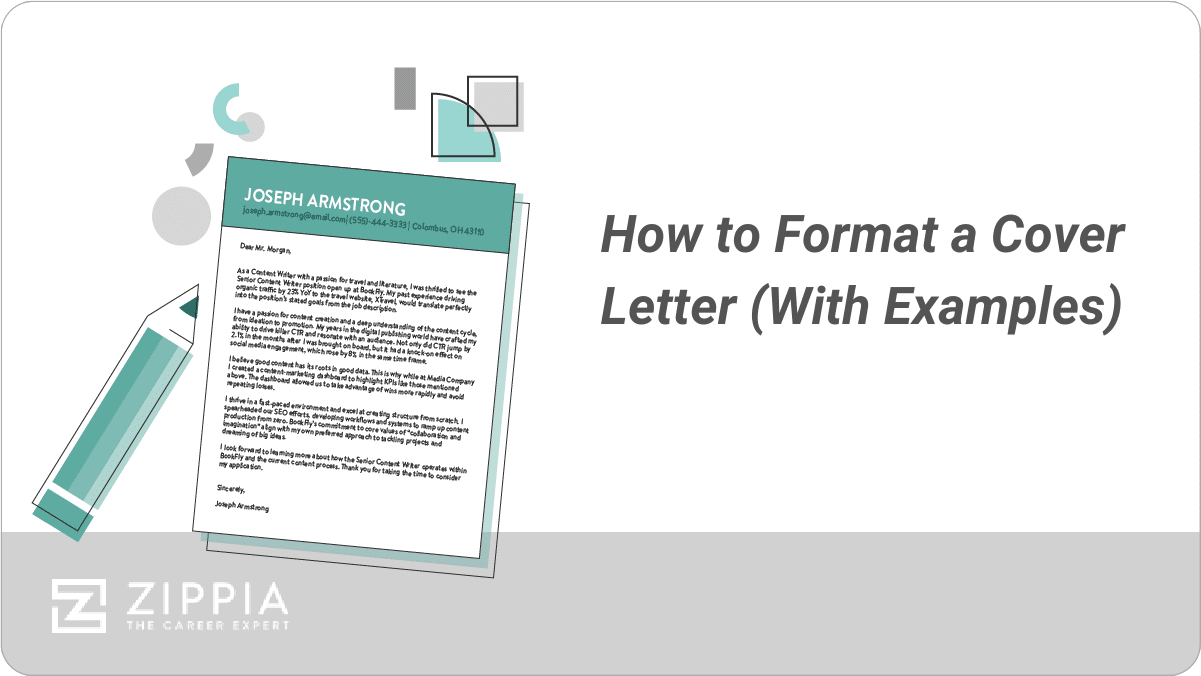
Here’s a basic template to guide you as you draft your cover letter:
-
Standard heading and greeting. Start with your name and contact information at the top, followed by the date and the recipient’s details. Use a formal greeting like “Dear Ms. Smith” or “Dear Mr. Rodriguez.” If you can’t find their name, “Dear Hiring Manager” is acceptable.
Example cover letter header and greeting[Your name]
[Your email address]
[Your phone number]
[Your mailing address][Date]
[Hiring Manager’s name]
[Company address]
[Company phone number]
[Hiring Manager’s email address]Dear [Hiring Manager’s name],
If you’re sending this as an email, omit the header and place your contact information below your signature.
-
Opening paragraph. Your opening should include:
-
Your name
-
An overview of your professional background
-
Your interest in the role
This paragraph should be concise, ideally no more than three or four sentences.
-
-
Second paragraph. This section should directly address the specific job description.
Highlight how your academic and professional experiences uniquely qualify you for the role. Include specific achievements and skills that demonstrate your suitability, using quantifiable data when possible.
-
Third paragraph. This optional paragraph can showcase your understanding of the company’s current challenges and how you can contribute to overcoming them.
By doing so, you demonstrate that you’ve researched the company and grasp the requirements outlined in the job listing.
If this section doesn’t fit the context of your application, feel free to omit it.
-
Concluding paragraph. This short paragraph serves two purposes:
-
A call-to-action
Your call-to-action might be an invitation for follow-up discussions, reinforcing your eagerness for the opportunity. Conclude with a heartfelt thanks for their consideration.
-
-
The sign-off. End your cover letter with a professional closing such as “Sincerely,” followed by your name. For emails, include your contact info below your name:
Example cover letter email signatureSincerely,
[Your Name]
[Your Phone Number]
[Your Email Address]
[Link to Your LinkedIn Profile or Online Portfolio (optional)] -
Saving the file. When it’s time to save your cover letter, choose a format that is easily accessible for both you and hiring managers. Word documents or PDFs are generally recommended, as they are compatible with most applicant tracking systems (ATS).
Name your file something like: FirstName-LastName-Cover-Letter for easy identification.
Cover letter format examples
These examples illustrate professional cover letter formatting:
-
Cover letter format example
Eloise Horton
eloisehorton@email.com
222-333-4444
5678 Oak Street
Roanoke, VA 24001September 24, 2026
Wesley Patterson
3456 Main Street
Roanoke, VA 24002
333-444-7777
wesleypatterson@email.comDear Mr. Patterson,
I am writing to express my interest in the Business Analyst position at QuintilesIMS.
For the past three years, I have been part of the business development team at ZippiaILM, a leading IT firm in Virginia. During my tenure, I have consistently demonstrated the skills required of a Business Analyst:
-
Comprehensive system and business analysis
-
Data-driven decision-making
-
Collaboration across diverse teams
-
Serving as a liaison between IT and client needs
-
Consultation on system limitations
-
Implementation of business process and decision models
With my experience and prior achievements, I am well-equipped to help your team achieve its goals.
My resume is attached for your review, and I look forward to your response. Thank you for considering my application.
Sincerely,
Eloise Horton
-
-
Email cover letter format example
Subject: Winston Schmidt – Cover Letter
Dear Ms. Hernandez,
My name is Winston Schmidt, and I am applying for the Account Manager position at ACME, Inc. I bring six years of experience in sales and account management and am eager to contribute to ACME’s mission of delivering top-tier service and products.
In my previous role, I managed eight accounts, consistently receiving high customer service ratings. By focusing on client needs, five accounts increased spending by over 15% in the first year, and all eight saw at least a 10% year-over-year increase.
I understand your company aims to enhance customer retention, and I believe my experience and dedication to client satisfaction position me to make a significant impact.
I look forward to discussing this opportunity further. Thank you for your consideration.
Sincerely,
Winston Schmidt
Account Manager
333-444-5555
wschmidt@email.com
linkedin.com/winston-schmidt
Tips for formatting a cover letter
By investing time in properly formatting your cover letter, you demonstrate to employers that you are detail-oriented and organized—qualities they highly value.
Here are some important tips to keep in mind:
-
Keep it to one page or less. Given the busy schedules of hiring managers, a concise cover letter—ideally a single page—is crucial. Avoid repeating your resume; instead, emphasize why you are a strong fit for the position.
-
Select a traditional font that is easy to read. Options like Arial, Calibri, Helvetica, Verdana, or Times New Roman work well.
-
Choose a font size between 10 and 12 points. This range ensures readability without taking up excessive space.
-
Set your document margins to either 1” or 1.5”. Proper margins enhance readability and overall presentation.
-
Avoid sending generic cover letters. Tailor your cover letter to address the specific needs and concerns of each employer, showcasing how you would add value to their organization.
Taking the time to format your cover letter correctly can significantly influence your chances of standing out and securing an interview.
Cover letter format FAQ
-
Why is it important to properly format a cover letter?
Proper formatting showcases your attention to detail. Employers appreciate candidates who demonstrate professionalism and care in all aspects of their application.
-
What is the correct format for a cover letter?
The correct format includes:
-
Professional header
-
Greeting
-
Introductory paragraph
-
Body paragraph
-
Conclusion paragraph
-
Signature
-
-
How long should a cover letter be?
A cover letter should be one page or less, typically around 250-400 words.
Final thoughts
In the competitive job market of 2026, meticulous attention to your job application is crucial. Ensure your resume is polished and up-to-date, and familiarize yourself with the current interview standards.
Moreover, investing time in crafting an effective cover letter is essential. This document is your opportunity to capture a hiring manager’s attention by highlighting key elements of your experience and qualifications that align with the role.
References
-
Purdue Online Writing Lab – Quick Formatting Tips for Cover Letters
-
Massachusetts Institute of Technology – How to Write an Effective Cover Letter (With Samples)
- Cover Letter Format

Author

Chris Kolmar is a co-founder of Zippia and the editor-in-chief of the Zippia career advice blog. He has hired over 50 people in his career, been hired five times, and wants to help you land your next job. His research has been featured on the New York Times, Thrillist, VOX, The Atlantic, and a host of local news. More recently, he's been quoted on USA Today, BusinessInsider, and CNBC.
Expert
Matt Warzel a President of a resume writing firm (MJW Careers, LLC) with 15+ years of recruitment, outplacement, career coaching and resume writing experience. Matt is also a Certified Professional Resume Writer (CPRW) and Certified Internet Recruiter (CIR) with a Bachelor of Science in Business Administration (Marketing Focus) from John Carroll University.