Research Summary. After thorough analysis, our data team has found:
-
Food services and drinking places continue to lead with the highest turnover rates, as employees stay an average of just 1.8 years.
-
Food prep and serving-related jobs follow closely at 1.9 years.
-
Employees in the utilities sector enjoy the longest tenure in the private sector, with an average of 7.4 years.
-
Public sector workers tend to have a significantly longer average tenure of 7.7 years compared to the private sector average of 3.7 years.
-
Management positions show the longest employment duration, averaging 6.3 years.
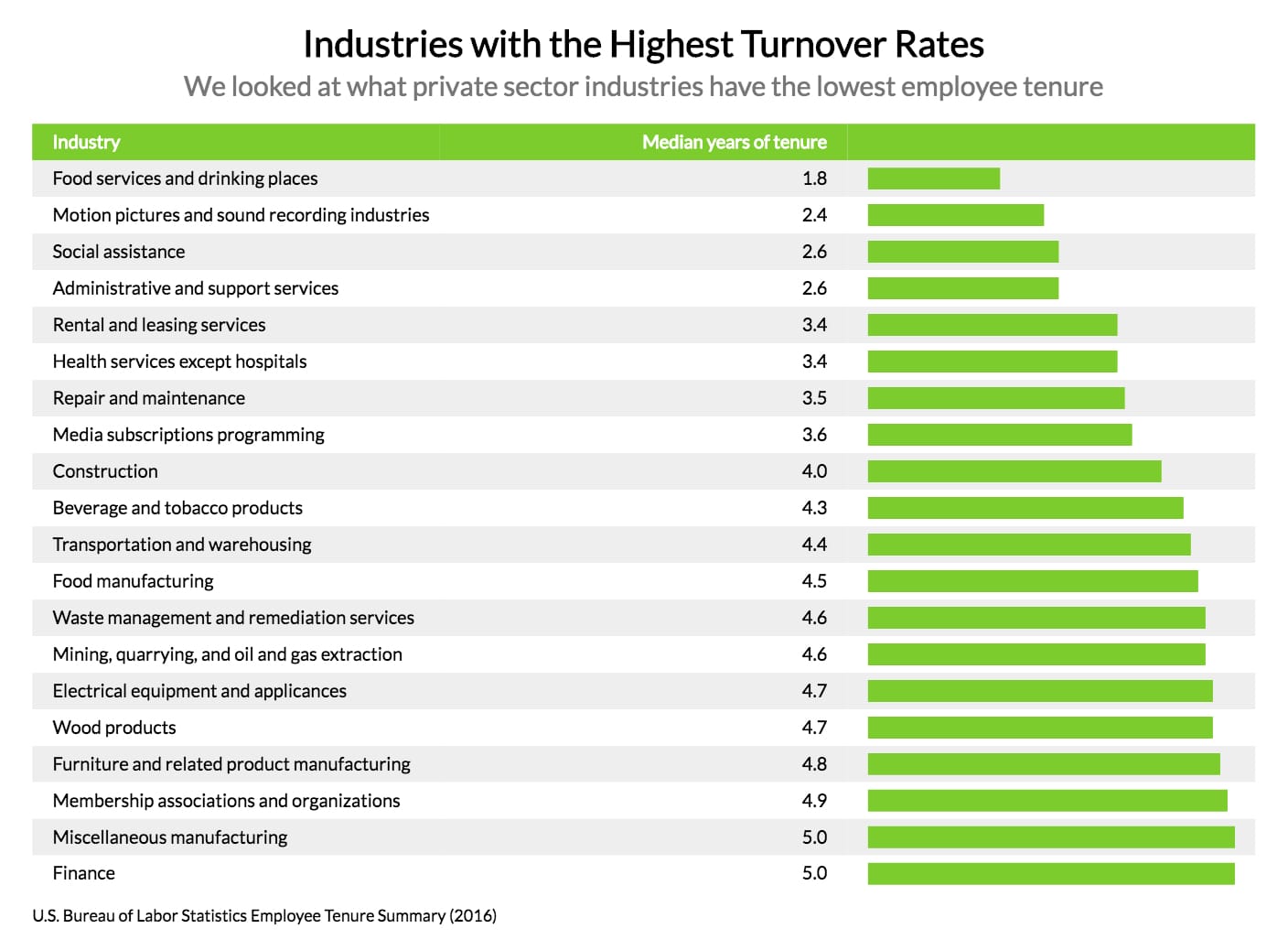
Industries With The Highest Turnover Rates
Attention to all recent graduates feeling overwhelmed about landing the ideal job immediately after school:
Your first job likely won’t be your last job, and statistics support this notion.
As of early 2026, the average tenure for wage and salary workers with their current employer is approximately 4.2 years, a figure that reflects the dynamic nature of the modern workforce.
Below are the 10 industries with the shortest median years of employee tenure, indicating where workers typically remain for brief periods:
10 Industries With Highest Turnover
-
Food services and drinking places – 1.8 years
-
Motion pictures and sound recording industries – 2.4 years
-
Social assistance – 2.6 years
-
Administrative and support services – 2.6 years
-
Rental and leasing services – 3.4 years
-
Health services (excluding hospitals) – 3.4 years
-
Repair and maintenance – 3.5 years
-
Radio and television broadcasting and cable subscriptions – 3.6 years
-
Construction – 4.0 years
-
Beverage and tobacco products – 4.3 years
As illustrated, there are numerous job sectors characterized by high turnover rates.
Methodology
Our findings are based on the Employee Tenure Survey, a biennial study conducted by the Bureau of Labor Statistics that analyzes how long employees remain in their current roles. We focused on industries with a median tenure of five years or less, highlighting sectors where workers typically change jobs more frequently.
Food Services and Drinking Places
As of 2026, full-service restaurants remain one of the largest employers in the United States, second only to educational institutions.
With approximately 11.9 million individuals employed in the food services sector, and a projected increase of 1.2 million workers by the end of the decade, the industry is expected to continue experiencing high turnover.
Given that many roles in this sector do not necessitate a college degree, food service positions are often ideal for young people and students seeking summer employment.
Motion Pictures and Sound Recording Industries
This industry has witnessed considerable growth recently, reaching its highest employment levels since the Bureau of Labor Statistics began tracking data in 1990.
While the peak employment figure exceeded 442,000 in late 2016, current statistics show over 400,000 workers are still engaged in this field.
The median tenure in this industry is just below 2.5 years, largely due to the project-based nature of work, where professionals like actors, animators, or editors often transition from one project to the next within limited time frames.
Social Assistance
Social workers and personal care aides represent a significant portion of the social assistance sector, which has seen steady growth, employing around 3.8 million individuals as of early 2026.
Despite this growth, high turnover remains a challenge, driven by the demanding nature of the work, which includes supporting vulnerable populations and addressing complex social issues, contributing to the sector’s low average tenure.
In summary, understanding turnover trends across different industries can provide valuable insights for both job seekers and employers. As labor markets continue to evolve, being aware of these dynamics can help shape career decisions and organizational strategies.

Author

McLeod Brown is a former writer and researcher for the Zippia Career Advice blog. His work at Zippia focused on understanding the relationship between colleges, debt, and jobs. A graduate of the University of North Carolina at Wilmington with a BA in Business Administrator, he is now pursuing a masters of science in analytics from the Institute of Advanced Analytics.