Research Summary: The US is a big country, and following opportunities often means leaving your hometown. Whether they’re moving to the next county or all the way across the country, many Americans regularly choose to relocate for work.
To find out more about job relocation in the US, here are some crucial insights our research uncovered:
-
62% of people are willing to relocate for career advancement or an opportunity to make more money.
-
The average job relocation package is $72,000-$97,000 for homeowners and $19,000-$24,000 for renters.
-
5 million Americans moved because of remote work in 2020.
-
Only 1.6% of Americans relocated for a new job in 2022.
For further analysis, we broke down the data in the following ways:
Demographics | Packages | Employee Opinions
Job Relocation by Demographics
There are many factors that contribute to whether or not someone relocates for work. Demographically, small and midsize companies are more likely to support job relocations than larger companies, and that’s just one example. To further explore the demographic differences, here are some interesting statistics:
-
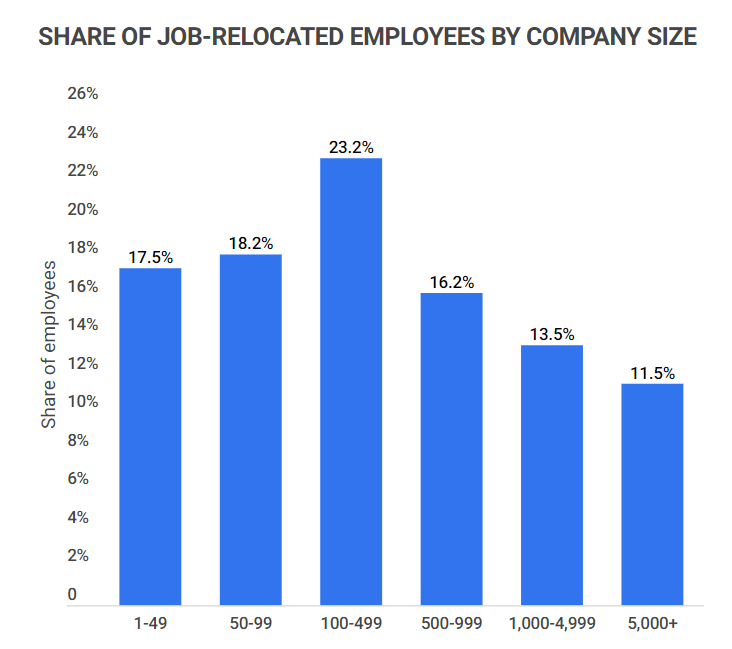
Companies with 100-499 employees are the most likely to support job relocations, with 23.18% of employees being the result of them.
In order from most to least likely to have employees who’ve relocated, here are the statistics for different company sizes: 50-99 employees (18.18%), 1-49 employees (17.48%), 500-999 employees (16.18%), 1,000-4,999 employees (13.49%) and 5,000+ employees (11.49%).
Share of Job-Relocated Employees By Company Size
Company size Share of employees 1-49 employees 17.48% 50-99 18.18% 100-499 23.18% 500-999 16.18% 1,000-4,999 13.49% 5,000+ 11.49% -
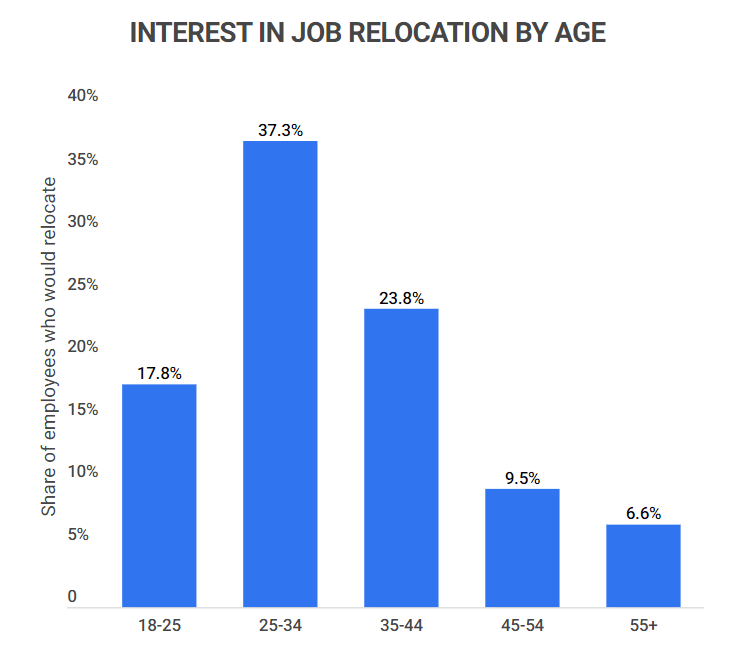
Those between 25-34 are most likely to relocate for their job, with 37.25% wanting to move.
Younger demographics are less likely to want to move, but the demographic with the least amount of interest is older Americans. For example, only 6.59% of those 55+ say they would relocate for a job.
Interest In Job Relocation By Age
Age range Share of employees who would relocate 18-25 17.78% 25-34 37.25% 35-44 23.78% 45-54 9.49% 55+ 6.59% -
Men are 3.7x more likely to move for work than women.
Men account for 82.4% of the employees who relocate for a job, while women only constitute 17.6%.
Job Relocation Packages
To incentivize employees to relocate, many companies offer job relocation packages. These packages can help employees find homes or apartments and offer other benefits. To find out more, here are some key facts:
-
64% of people who moved for a job received a relocation package.
Surprisingly, nearly one-third of employees still choose to relocate even if they don’t receive a relocation package.
-
The highest average job relocation package is for current employees who are also homeowners, at $97,166.
New employees who are homeowners receive an average relocation package of $72,627. On the other hand, renters receive far less on average, with current employees who rent getting an average of $24,216 and new employees only getting $19,309.
-
Only 38% of employers pay for a new hire’s moving expenses.
While a much higher 66% of employers will pay for the moving expenses of a current employee who’s being transferred.
-
56% of companies include a lump sum within their job relocation package.
The average lump sum paid to employees is $7,200; however, lump sums can fall anywhere between $2,500 to $15,000 typically.
-
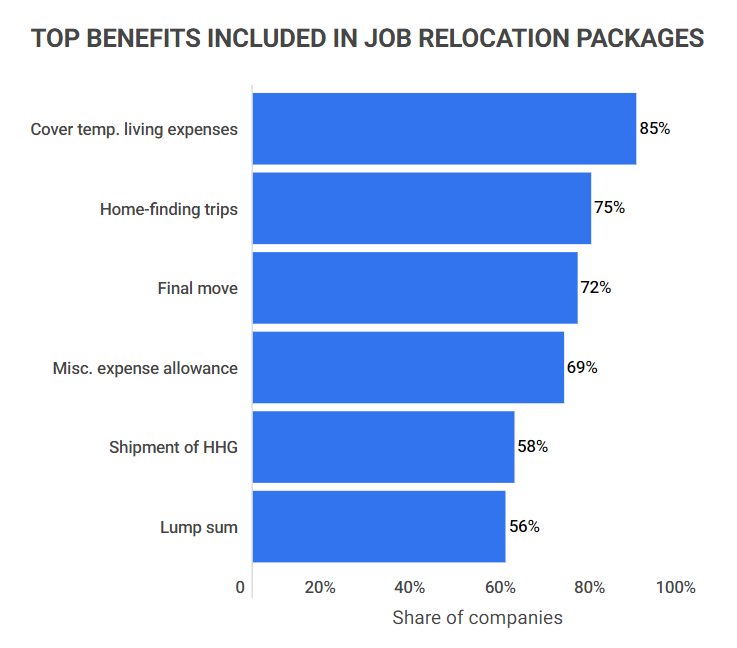
85% of companies will cover temporary living at the new location.
The most popular thing to be included in job relocation packages is an offer for temporary living. Other commonly offered perks include home-finding trips (75%), The final move (72%), and a miscellaneous expense allowance (69%)
Top Benefits Included In Job Relocation Packages
Benefit Share of companies Cover temporary living expenses 85% Home-finding trips 75% Final move 72% Miscellaneous expense allowance 69% Shipment of HHG 58% Lump sum 56%
Employee Opinions on Job Relocation
Employees often have many reasons for either wanting to or not wanting to relocate. Depending on the distance, relocating can be a huge step for many. With that in mind, here are some examples of employee opinions on the matter:
-
On average, 26% of Americans who moved in 2021 did so for job-related reasons.
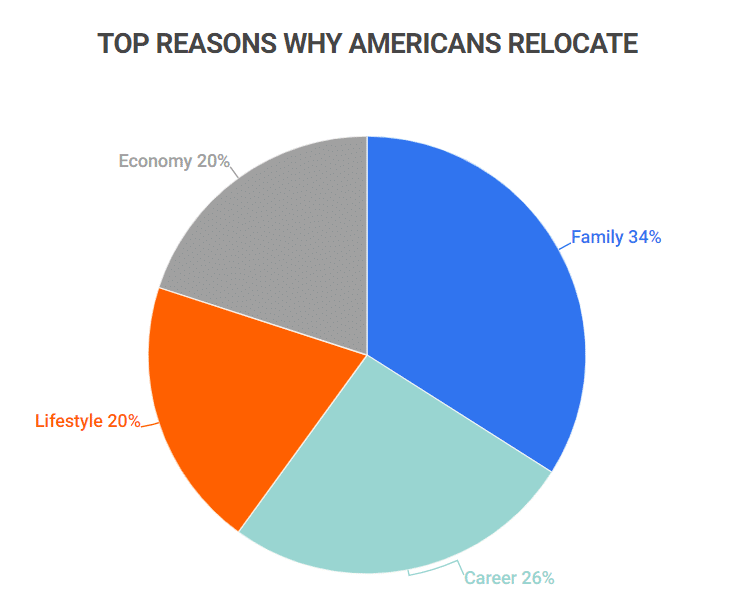
The most popular reason for moving is family reasons, such as marriage, starting a family, or being closer to family. However, there are other reasons why someone might move as well. For example:
Top Reasons Why Americans Relocate
Reason Share of movers Family 34% Career 26% Lifestyle 20% Economy 20% -
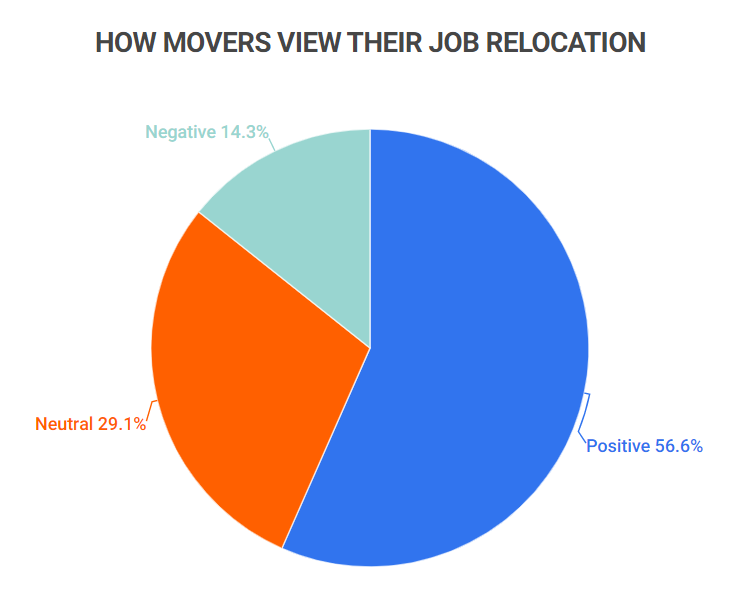
56.64% of Americans have a positive sentiment toward their job relocation.
While 29.07% are neutral about their job relocation, and 14.29% have a negative outlook on it.
How Movers View Their Job Relocation
Outlook Share of movers Positive 56.64% Neutral 29.07% Negative 14.29% -
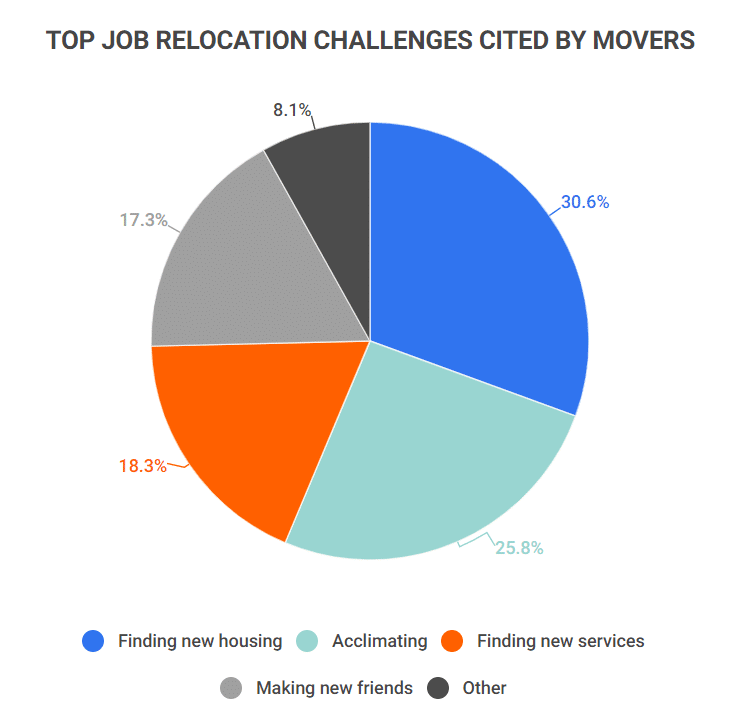
30.57% of movers say finding new housing is the most challenging part of job relocation.
There are many challenges that come with job relocation, and finding a house is the number one concern for most. Other challenges cited by movers include acclimating to a new community (25.77%) and finding new services in the area (18.28%).
Top Job Relocation Challenges Cited By Movers
Challenge Share of movers Finding new housing 30.57% Acclimating to a new community 25.77% Finding new services in the area 18.28% Making new friends 17.28% Other 8.09%
Job Relocation FAQ
-
How much do companies usually offer for relocation?
Companies will offer employees anywhere from $2,000 to $100,000 for relocation. In general, companies will offer more to current employees when compared to new employees and offer more to homeowners over renters.
For example, a renter can expect a job relocation package between $19,000-$24,000, depending on whether or not they’re a current or new employee, while homeowners can expect a job relocation package between $72,000-$97,000.
Employers are also more likely to cover moving expenses for current employees over new employees. 66% of those who are already employed have their moving expenses covered, and only 38% of new employees have their expenses covered.
-
Is job relocation worth it?
Job relocation can be worth it, but it’s not a decision to be taken lightly. Here are some pros and cons to consider when you receive a job relocation offer:
Pros
-
Job relocation packages
-
Higher salaries
-
More opportunity
-
Personal growth and independence
Cons
-
Leaving behind friends and family
-
Acclimating to a new community
-
Finding new services in the area
-
-
How long do most companies give you to relocate?
Typically, companies will give you four weeks (about a month) to relocate. This follows an average of two weeks to decide whether or not you want the job, which realistically gives you six weeks to move.
However, it is worth mentioning that sometimes companies will need to expedite the hiring process if filling the position is urgent. In these cases, you might have only a few weeks to move at most.
-
Why do companies ask if you are willing to relocate?
Companies ask if you’re willing to relocate to test how committed you are to your new role. After all, hiring a candidate that needs to relocate, only to find out afterward that they’re unwilling to, would be a huge waste of everyone’s time.
Therefore, any company that might require you to relocate will often ask you if you’re willing to do so, and it’s important that you answer honestly.
Conclusion
Job relocation has been at the back of everyone’s mind ever since millions of Americans shifted to remote work in 2020. However, while 62% of Americans claim they’re willing to relocate for career advancement or an opportunity to make more money, only 1.6% actually made the move in 2022.
Realistically, companies have to sweeten the deal in order to convince employees to uproot their lives, which is why they offer generous job relocation packages. These packages are more generous for current employees and homeowners but can be a huge factor in whether or not someone decides to move either way.
Overall, while not every American is interested in a job relocation, the majority who have relocated (over 56%) say it was a positive change, likely because it’s helped them earn more and advance their careers.
References
-
Glasshammer – Why Relocating Can Boost Your Career—And How to Make It Work For You
-
UrbanBound – What Is the Average Relocation Package for 2022?
-
Bloomberg – Americans Have Never Been So Unwilling to Relocate for a New Job
-
Dellworks – What is a Reasonable Relocation Package?

Author

Jack Flynn is a writer for Zippia. In his professional career he’s written over 100 research papers, articles and blog posts. Some of his most popular published works include his writing about economic terms and research into job classifications. Jack received his BS from Hampshire College.