What does an anesthesia assistant do?
Anesthesia assistant responsibilities
Here are examples of responsibilities from real anesthesia assistant resumes:
- Manage medical records and document examination notes, prescriptions, and procedure details in EMR.
- Monitor patients under anesthesia and assist with minor surgical procedures.
- Maintain all confidential personnel files, licensing and CPR compliancerecords.
- Check airway, intubation and malignant hypothermia carts, and help in sterileprocessing.
- Anticipate and meet the needs of the anesthesiologists and CRNA s. Maintains adequate inventory of equipment, supplies and medications.
- Assist anesthesiologists with swan catheter placement.
- Assist in anesthesia, intubation, monitoring and transferring patient ..
- Maintain proper insurance documentation on all current and previous surgical patients.
- Provide patient with positive/negative pathology results, pre-op, assist, post-op and provide patient education regarding their procedures.
- Insert peripherally insert central catheters.
- Certify surgical technologist in Gi department and front desk receptionist.
Anesthesia assistant skills and personality traits
We calculated that 25% of Anesthesia Assistants are proficient in Patients, Surgery, and Surgical Procedures. They’re also known for soft skills such as Compassion, Emotional stability, and Problem-solving skills.
We break down the percentage of Anesthesia Assistants that have these skills listed on their resume here:
- Patients, 25%
Maintained proper insurance documentation on all current and previous surgical patients.
- Surgery, 16%
Provide anesthesia services to a full array of surgical disciplines- Orthopedics, General Surgery,
- Surgical Procedures, 13%
Worked as first assist during surgical procedures in the operating room.
- Patient Care, 6%
Maintained composure in stressful situations and took a proactive approach in helping with patient care.
- Vital Signs, 4%
Monitored vital signs, fluid intake/loss.
- BLS, 4%
Maintained compliance with hospital training requirements and BLS certification.
Most anesthesia assistants use their skills in "patients," "surgery," and "surgical procedures" to do their jobs. You can find more detail on essential anesthesia assistant responsibilities here:
Compassion. To carry out their duties, the most important skill for an anesthesia assistant to have is compassion. Their role and responsibilities require that "physician assistants deal with patients who are sick or injured and who may be in extreme pain or distress." Anesthesia assistants often use compassion in their day-to-day job, as shown by this real resume: "delivered high-quality and compassionate treatment to preoperative patients in collaboration with anesthesia team. "
Emotional stability. Many anesthesia assistant duties rely on emotional stability. "physician assistants, particularly those working in surgery or emergency medicine, should work well under pressure," so an anesthesia assistant will need this skill often in their role. This resume example is just one of many ways anesthesia assistant responsibilities rely on emotional stability: "responded appropriately to the physical, emotional and medical needs of patients. "
Problem-solving skills. Another skill that relates to the job responsibilities of anesthesia assistants is problem-solving skills. This skill is critical to many everyday anesthesia assistant duties, as "physician assistants need to evaluate patients’ symptoms and administer the appropriate treatments." This example from a resume shows how this skill is used: "set up iv solutions and related equipment; i.e., a-lines, cvp lines, etc. "
Detail oriented. anesthesia assistant responsibilities often require "detail oriented." The duties that rely on this skill are shown by the fact that "physician assistants should be observant and have a strong ability to focus when evaluating and treating patients." This resume example shows what anesthesia assistants do with detail oriented on a typical day: "keep detailed and organized records of equipment maintenance needs and any machinery inspections that must be performed on a regular basis. "
The three companies that hire the most anesthesia assistants are:
- Hackensack Meridian Health4 anesthesia assistants jobs
- Northside Hospital2 anesthesia assistants jobs
- Brigham and Women's Hospital2 anesthesia assistants jobs
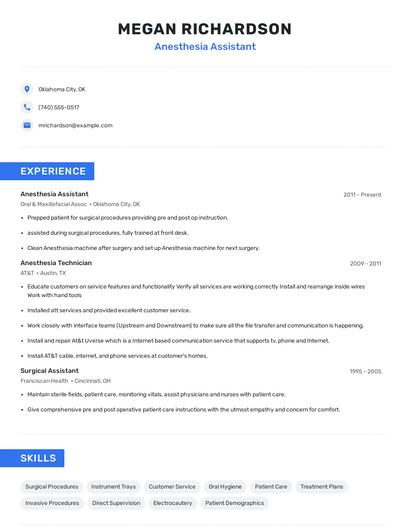
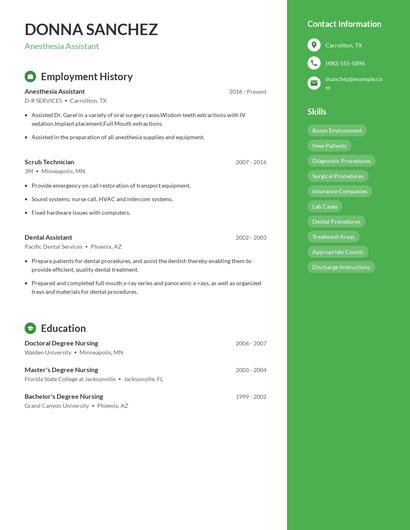
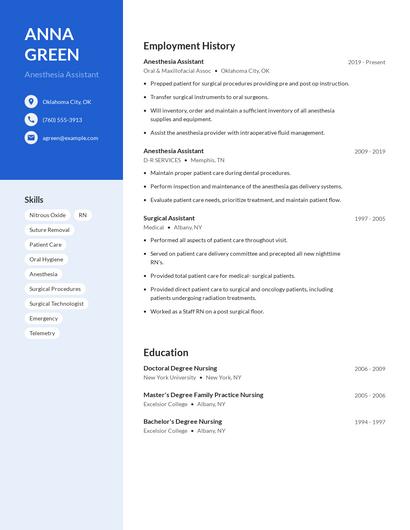
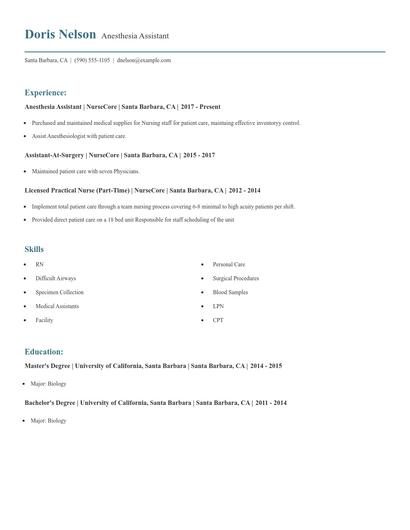
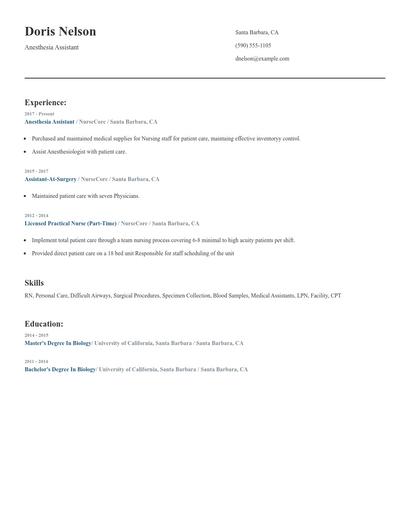
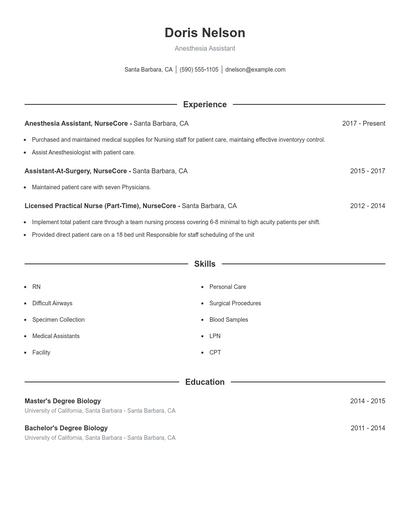
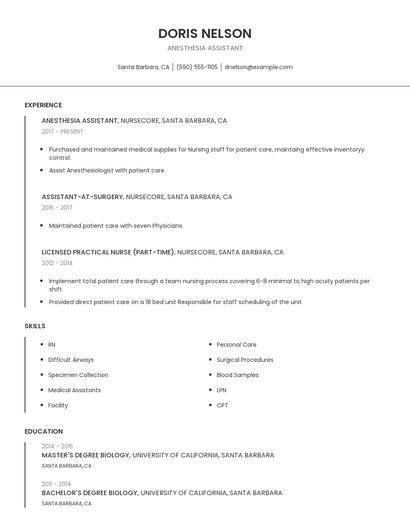
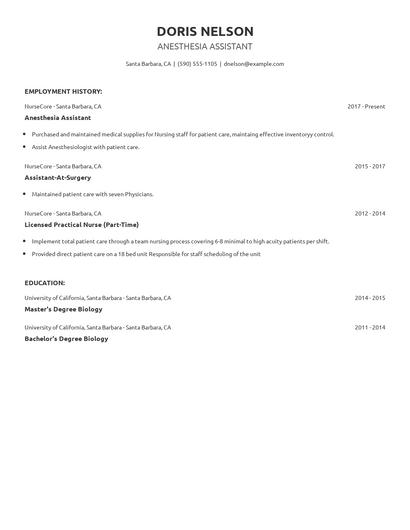
Choose from 10+ customizable anesthesia assistant resume templates
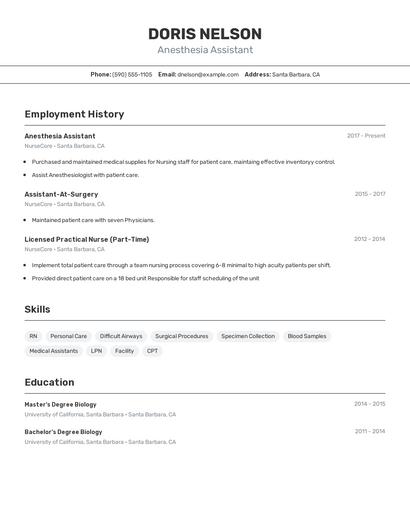
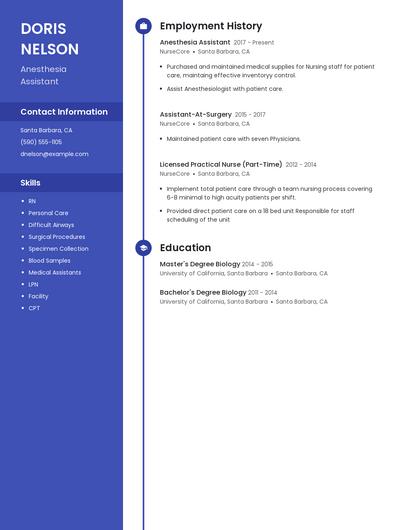
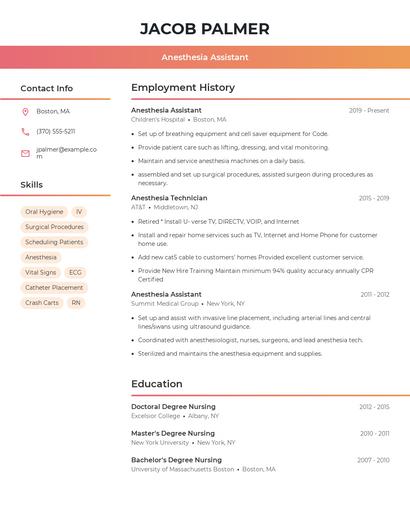
Build a professional anesthesia assistant resume in minutes. Our AI resume writing assistant will guide you through every step of the process, and you can choose from 10+ resume templates to create your anesthesia assistant resume.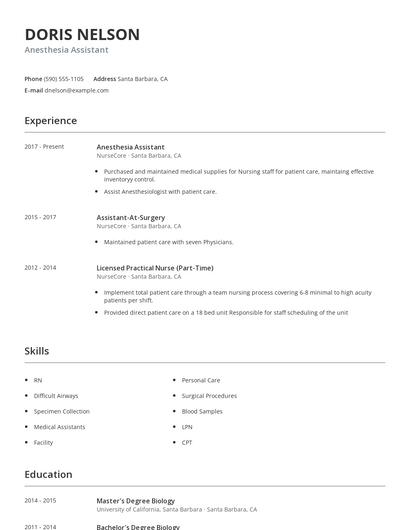
Compare different anesthesia assistants
Anesthesia assistant vs. Oral surgery assistant-clinical coordinator
An Oral Surgery Assistant prepares patients for surgery and provides them with needed care. They also make notes about performed procedures, progress, recommendations, and other subjects in the patient's charts.
There are some key differences in the responsibilities of each position. For example, anesthesia assistant responsibilities require skills like "patients," "surgery," "surgical procedures," and "vital signs." Meanwhile a typical oral surgery assistant-clinical coordinator has skills in areas such as "data entry," "schedule appointments," "dental terminology," and "front desk." This difference in skills reveals the differences in what each career does.
Oral surgery assistant-clinical coordinators tend to reach similar levels of education than anesthesia assistants. In fact, oral surgery assistant-clinical coordinators are 4.7% less likely to graduate with a Master's Degree and 0.8% less likely to have a Doctoral Degree.Anesthesia assistant vs. Oral surgery assistant
A Surgical Assistant provides assistance during an operation by performing a wide range of crucial tasks. They cover patients with surgical drapes to create and maintain a sterile operative field and adjust and maintain operating room parameters according to the surgeon's specifications.
While some skills are similar in these professions, other skills aren't so similar. For example, resumes show us that anesthesia assistant responsibilities requires skills like "surgery," "bls," "airway management," and "intubation." But an oral surgery assistant might use other skills in their typical duties, such as, "dental care," "chair side," "root canals," and "iv."
Oral surgery assistants earn similar levels of education than anesthesia assistants in general. They're 2.2% less likely to graduate with a Master's Degree and 0.8% more likely to earn a Doctoral Degree.Anesthesia assistant vs. Surgical assistant
Some important key differences between the two careers include a few of the skills necessary to fulfill the responsibilities of each. Some examples from anesthesia assistant resumes include skills like "surgery," "bls," "airway management," and "medical terminology," whereas a surgical assistant is more likely to list skills in "insurance verification," "general anesthesia," "dr," and "aseptic technique. "
Surgical assistants earn the highest salary when working in the utilities industry, where they receive an average salary of $72,838. Comparatively, anesthesia assistants have the highest earning potential in the health care industry, with an average salary of $199,995.When it comes to education, surgical assistants tend to earn similar degree levels compared to anesthesia assistants. In fact, they're 0.3% less likely to earn a Master's Degree, and 4.1% less likely to graduate with a Doctoral Degree.Anesthesia assistant vs. Anesthesiologist assistant-certified
Types of anesthesia assistant
Updated January 8, 2025
