
Automatically apply for jobs with Zippia
Upload your resume to get started.
Application manager skills for your resume and career
15 application manager skills for your resume and career
1. Customer Service
Customer service is the process of offering assistance to all the current and potential customers -- answering questions, fixing problems, and providing excellent service. The main goal of customer service is to build a strong relationship with the customers so that they keep coming back for more business.
- Provide customer service to outside departments, manage escalated requests and perform root cause analysis to identify areas of improvement.
- Implemented Applications Team HelpDesk ticketing process for accountability, workload balancing, management reporting, and expedited customer service.
2. Project Management
- Directed management and non-management employees providing technical and programming support and project management for multiple software applications and over 300 users.
- Accomplished a step change in the BI/data warehouse team's project execution by improving the project management capability/discipline including status reporting.
3. Application Development
- Managed all aspects of application development, selected computer equipment and peripherals required for specific projects, and project estimation.
- Initiated and implemented Business Process Improvement study and subsequent application development effort resulting in annual operations saving of $450,000.
4. Architecture
- Partnered with Business Analysts, Enterprise Architecture, infrastructure teams and other groups in requirements gathering and documenting potential company-wide solutions.
- Managed teams of internal and external consultants to develop new Architecture Delivery Process to facilitate migration to Service Oriented Architecture.
5. Infrastructure
Infrastructure includes the organizational and physical structures needed to run an area or a society smoothly. It is a group of basic facilities required for any society or firm to run sustainably and efficiently. The infrastructural system is a high investing area and helps majorly in flourishing the economy and prosperity of a country. It is an underlying system needed for ensuring the safety and comfort of the public and to run a country smoothly. All the tasks needed to be performed for a flourishing economy and a happy and healthy public are included in infrastructure.
- Coordinated institutional involvement in community-wide information systems and infrastructure
- Developed communications infrastructure logical diagrams, relocation plans and migration strategy for 64 applications as part of major agency consolidation effort.
6. Software Development
Software development is the mechanism by which programmers create computer programs. The Software Development Life Cycle (SDLC) is a framework for developing applications that follow technological needs and consumer requirements. It consists of many stages. The SDLC establishes an international standard that software developers can use to enhance and create their programs. It provides a well-defined framework for software developers to pursue in the production, maintenance, and design of premium quality software. The aim of the software development process is to create high-quality software on time and within budget.
- Manage and coordinate staff of business systems analysts and contracted development, database administration, and vendor software development resources.
- Developed specifications for software releases and coordinated design and implementation efforts with 5 functional groups including Software Development.
Choose from 10+ customizable application manager resume templates
Build a professional application manager resume in minutes. Our AI resume writing assistant will guide you through every step of the process, and you can choose from 10+ resume templates to create your application manager resume.7. Java
Java is a widely-known programming language that was invented in 1995 and is owned by Oracle. It is a server-side language that was created to let app developers "write once, run anywhere". It is easy and simple to learn and use and is powerful, fast, and secure. This object-oriented programming language lets the code be reused that automatically lowers the development cost. Java is specially used for android apps, web and application servers, games, database connections, etc. This programming language is closely related to C++ making it easier for the users to switch between the two.
- Developed and supported our PowerBuilder and Java frameworks used as a foundation for applications across multiple lines of business.
- Deployed large-scale warehouse management system that uses Java applications running remotely on Java activated devices.
8. Application Support
The efficient operation of an application needs day to day maintenance that is done through application support. It assists users to manage any queries or errors they may face in the daily use of the application as well as provide a contact that users can reach for assistance. It may include a service desk and backups.
- Provided oversight for all phases of application support and development, including coordination of cross-functional teams and upgrades of software/equipment.
- Led an Engineering, Database and Application Support team providing real-time, enterprise-level support for custom-developed, mission-critical.
9. Business Processes
- Provided resources to appropriately manage new implementations, upgrade outdated systems while also supporting current applications to maintain business processes efficiently.
- Served as business liaison between cross-functional business teams and IT application team to identify improvement opportunities and problem-solve business processes.
10. SDLC
- Developed and implemented SDLC procedures and policies to manage product development (B2C and Legacy) that improved quality.
- Manage the scope, schedule and budget for projects with downstream impact to supported systems using SDLC methodology.
11. Ongoing Development
- Plan, coordinate, and provide input towards the ongoing development of the contact center telecommunications systems and services.
12. Scrum
Scrum is a lean structure for communicating, designing, and promoting complex products, with a focus on programming development. It has been applied to a variety of areas, including manufacturing, testing, new technology, and marketing techniques. Scrum is a simple framework that helps people, organizations, and teams generate value by providing many solutions to complicated problems.
- Managed projects using a variety of methodologies; serving as a Scrum Master, Co-Scrum, and Agile project manager.
- Served as Scrum Master and Agile coach for designated teams in Huntington IT Shared Services.
13. Technical Support
Technical support or tech support are the services provided by any hardware or software company to users. They help in solving the technical difficulties the customers face with their products or services. Moreover, the tech support employees maintain, manage, and repair the IT faults. They are also responsible for resolving the network problems, installing and configuring hardware and software.
- Provided technical support to account team members on pagination system applications and internal information network usage.
- Managed a group of programmer/analysts and technical support staff supporting relational databases for multiple directory products.
14. Data Integrity
Data integrity denotes the consistency or accuracy validation of data in the whole lifecycle of data. It ensures the security of traceability and search-ability of all data in a person's device to the source.
- Created auditing system that enforced data integrity across several integration points and streamlined processes to minimize issues.
- Ensured data integrity by reviewing application reports and corrected any processing deviations.
15. CRM
CRM stands for Customer relationship management and it is a complete process through which a business or organization monitors and administers its interactions with the customers. A process in which large amounts of data are collected through marketing via a company's website, polls, surveys, and other social media applications. The basic goal of CRM is to target the right audience for their product, and then fulfill their needs, to increase the sales and revenue of the company.
- Managed multiple major enterprise wide CRM (Customer Relationship Management) system consolidation/integration due to merger & acquisitions.
- Helped implement multiple enterprise-level CRM projects.
5 Application Manager resume examples
Build a professional application manager resume in minutes. Browse through our resume examples to identify the best way to word your resume. Then choose from 5+ resume templates to create your application manager resume.

What skills help Application Managers find jobs?
Tell us what job you are looking for, we’ll show you what skills employers want.
List of application manager skills to add to your resume
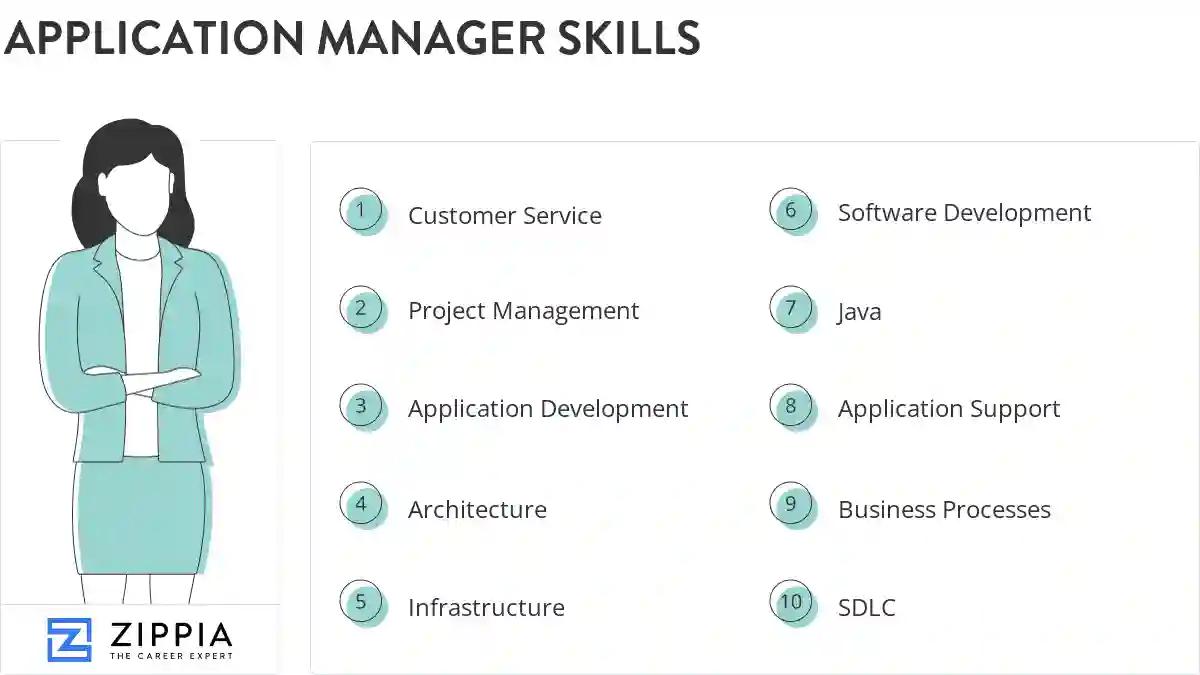
The most important skills for an application manager resume and required skills for an application manager to have include:
- Customer Service
- Project Management
- Application Development
- Architecture
- Infrastructure
- Software Development
- Java
- Application Support
- Business Processes
- SDLC
- Ongoing Development
- Scrum
- Technical Support
- Data Integrity
- CRM
- HR
- Windows
- Level Agreements
- ERP
- SQL Server
- SharePoint
- Web Application
- Customer Satisfaction
- ITIL
- BI
- Fixed Assets
- Direct Reports
- Oracle Ebs
- Management System
- Sarbanes-Oxley
- JavaScript
- Payroll
- Cash Management
- End-To-End Testing
- Software Applications
- End Testing
- Jenkins
- Enterprise Applications
- QA
- Process Improvement
- EMR
- Data Warehouse
- Financial Applications
- SLA
- Customer Support
- Clinical Applications
Updated January 8, 2025
