What does an assembler/packager do?
Assembler/packager responsibilities
Here are examples of responsibilities from real assembler/packager resumes:
- Create, customize, automate software installation of applications using WiseStudio / InstallShield by VMware.
- Ensure all files, folders, and registry keys of the application would be remove on uninstall.
- Create (MST), patches (MSP) and write custom action according to the package requirement.
- Ensure all files, folders, and registry keys of the application to remove on uninstall for a clean uninstall.
- Excel in interpreting detail aligning units using jigs and fixtures, and inspecting complete components to ensure conformance to specifications.
- Manufacture automobile air conditioner compressors for Honda
Assembler/packager skills and personality traits
We calculated that 19% of Assembler/Packagers are proficient in Basic Math, Defective Products, and Hand Tools. They’re also known for soft skills such as Customer-service skills, Hand-eye coordination, and Listening skills.
We break down the percentage of Assembler/Packagers that have these skills listed on their resume here:
- Basic Math, 19%
Execute tasks such as manual lifting, packaging, taping, labeling operations and sorting, and have basic mathematical skills.
- Defective Products, 15%
Completed paper work describing any defective product problems and how many pieces were done/scrapped.
- Hand Tools, 14%
Job responsibilities include: assembling small parts together with hand tools and packing finished products for shipping.
- Assembly Line, 11%
Packaged bumpers in containers Worked assembly line assembling pieces of bumper for the automotive industry
- Quality Checks, 5%
Run 2 bagging machines, pick my parts to run jobs from work orders, quality checks on parts of product.
- Warehouse Environment, 5%
Worked in a warehouse environment to ensure quality assurance before assembly and shipment.
Most assembler/packagers use their skills in "basic math," "defective products," and "hand tools" to do their jobs. You can find more detail on essential assembler/packager responsibilities here:
Customer-service skills. The most essential soft skill for an assembler/packager to carry out their responsibilities is customer-service skills. This skill is important for the role because "hand laborers and material movers who work with the public, such as grocery baggers or carwash attendants, must be pleasant and courteous to customers." Additionally, an assembler/packager resume shows how their duties depend on customer-service skills: "pack inspected products in containers according to customer specifications and stocking product to storage areas. "
Hand-eye coordination. Many assembler/packager duties rely on hand-eye coordination. "most hand laborers and material movers use their arms and hands to manipulate objects or move objects into specific positions.," so an assembler/packager will need this skill often in their role. This resume example is just one of many ways assembler/packager responsibilities rely on hand-eye coordination: "required dexterity's of both hands, hand and eye coordination and speed. "
Listening skills. assembler/packagers are also known for listening skills, which are critical to their duties. You can see how this skill relates to assembler/packager responsibilities, because "hand laborers and material movers follow instructions that a supervisor gives them." An assembler/packager resume example shows how listening skills is used in the workplace: "maintain a clean work station work well in groups/teams surpass daily work goals effectively listen to safety procedures"
Physical stamina. For certain assembler/packager responsibilities to be completed, the job requires competence in "physical stamina." The day-to-day duties of an assembler/packager rely on this skill, as "hand laborers and material movers need the endurance to perform strenuous tasks, such as moving or cleaning objects, throughout the day." For example, this snippet was taken directly from a resume about how this skill applies to what assembler/packagers do: "butcher - concentration, dexterity, customer service and stamina. "
Physical strength. A commonly-found skill in assembler/packager job descriptions, "physical strength" is essential to what assembler/packagers do. Assembler/packager responsibilities rely on this skill because "some hand laborers and material movers must be able to lift and carry heavy objects." You can also see how assembler/packager duties rely on physical strength in this resume example: "build cases using hand tools, very physical job. "
The three companies that hire the most assembler/packagers are:
- Masco7 assembler/packagers jobs
- Award Staffing
7 assembler/packagers jobs
- Bausch + Lomb6 assembler/packagers jobs
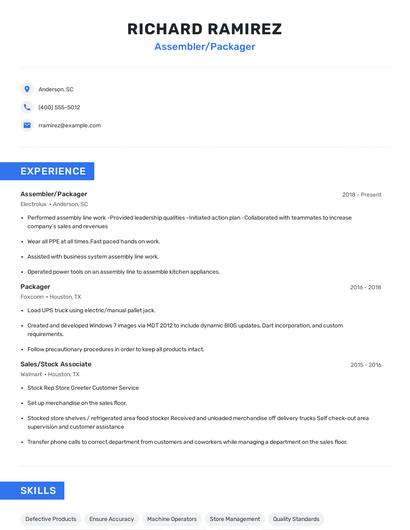
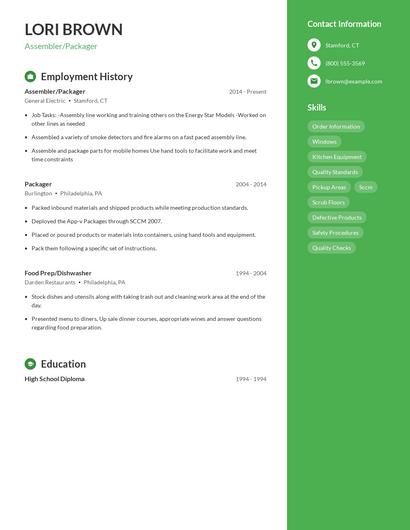
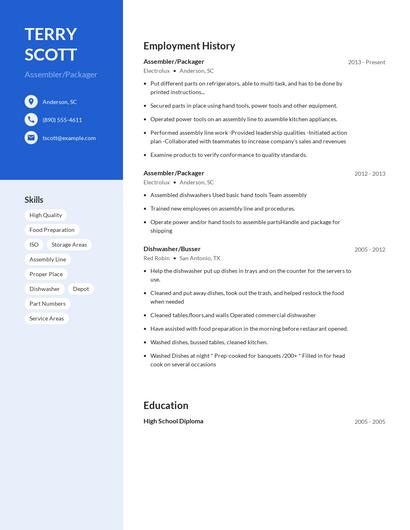
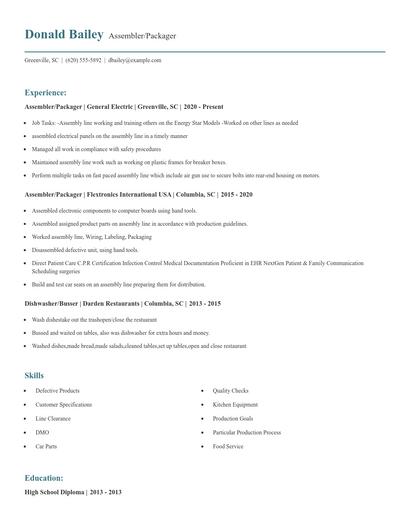
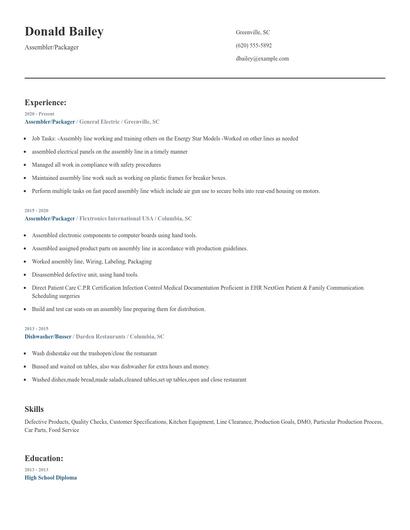
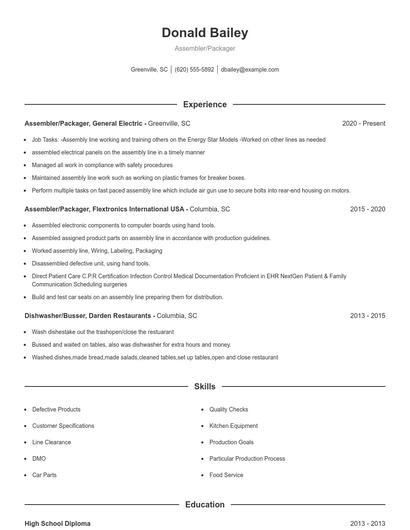
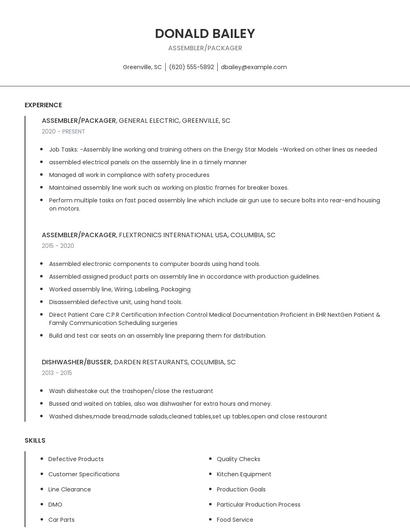
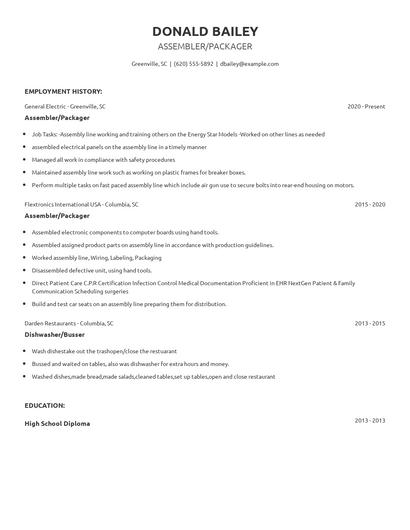
Choose from 10+ customizable assembler/packager resume templates
Build a professional assembler/packager resume in minutes. Our AI resume writing assistant will guide you through every step of the process, and you can choose from 10+ resume templates to create your assembler/packager resume.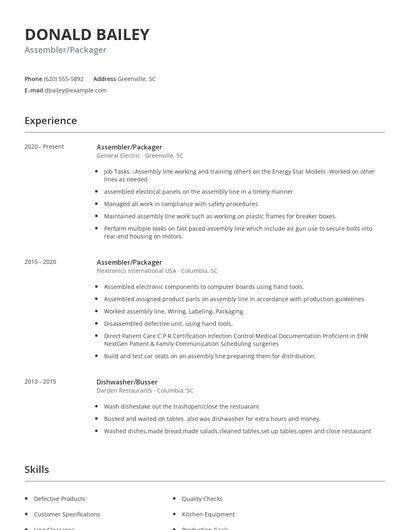
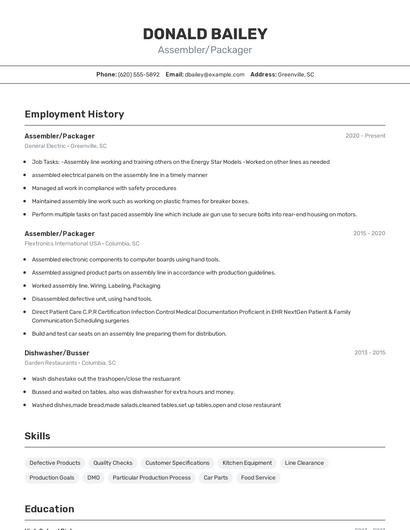
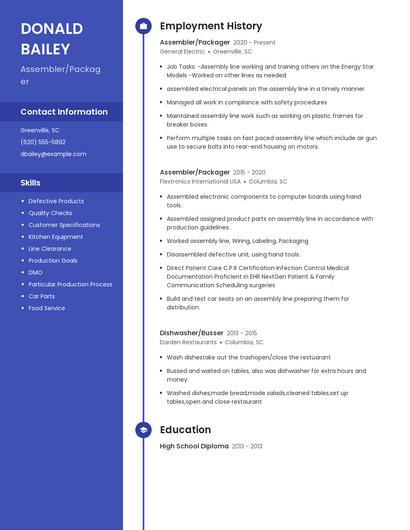
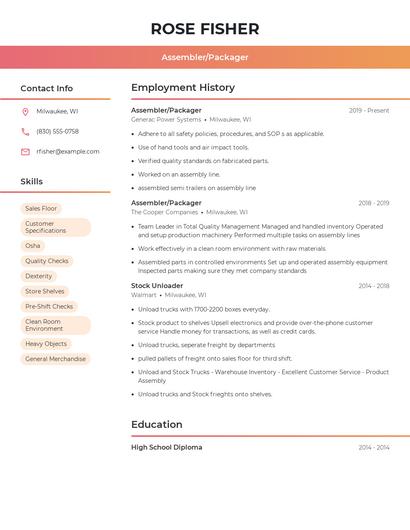
Compare different assembler/packagers
Assembler/packager vs. Manufacturing team member
Manufacturing team members are employees who are part of the group or department that fulfills the manufacturing need of the company or plant. They are trained workers who are familiar with the needs of the organization. They may handle machines or may also be assigned to work on their own using manual tools or their own hands, especially if such activities are not possible to do with a machine. Manufacturing team members work within manufacturing deadlines and ensure that products are made within the agreed timeline.
There are some key differences in the responsibilities of each position. For example, assembler/packager responsibilities require skills like "defective products," "hand tools," "quality checks," and "warehouse environment." Meanwhile a typical manufacturing team member has skills in areas such as "customer service," "cleanliness," "guest service," and "safety standards." This difference in skills reveals the differences in what each career does.
Manufacturing team members tend to make the most money working in the retail industry, where they earn an average salary of $38,845. In contrast, assembler/packagers make the biggest average salary, $32,905, in the manufacturing industry.manufacturing team members tend to reach similar levels of education than assembler/packagers. In fact, manufacturing team members are 2.9% more likely to graduate with a Master's Degree and 0.5% more likely to have a Doctoral Degree.Assembler/packager vs. Production team member
A production team member is responsible for performing duties in manufacturing and industrial processes, conducting quality check procedures for the outputs, and inspecting the efficiency of items before distribution. Production team members operate various equipment and machinery, requiring them to ensure that the equipment works in the best state to avoid potential hazards and delay in operations. They also maintain the cleanliness and orderliness of the production area, escalate any defects and malfunctioning components, and coordinating with the whole team to reach production goals and objectives.
In addition to the difference in salary, there are some other key differences worth noting. For example, assembler/packager responsibilities are more likely to require skills like "defective products," "assembly line," "warehouse environment," and "clean room environment." Meanwhile, a production team member has duties that require skills in areas such as "work ethic," "strong work ethic," "customer service," and "cleanliness." These differences highlight just how different the day-to-day in each role looks.
Production team members earn a lower average salary than assembler/packagers. But production team members earn the highest pay in the transportation industry, with an average salary of $36,333. Additionally, assembler/packagers earn the highest salaries in the manufacturing with average pay of $32,905 annually.production team members earn similar levels of education than assembler/packagers in general. They're 0.2% more likely to graduate with a Master's Degree and 0.5% more likely to earn a Doctoral Degree.Assembler/packager vs. Support team member
A support team member is responsible for assisting and connecting with the whole department group in meeting the company's goals and exceeding performance expectations. Support team members' duties generally include performing administrative tasks, familiarizing and adhering to the company's policies and procedures, providing recommendations for improving customer's experience, developing strategies to increase the company's revenue and profitability, and maintaining a positive work ethic. A support team member needs to have a strong organization and time-management skills to support daily operations and do extra tasks as needed.
Some important key differences between the two careers include a few of the skills necessary to fulfill the responsibilities of each. Some examples from assembler/packager resumes include skills like "defective products," "hand tools," "assembly line," and "quality checks," whereas a support team member is more likely to list skills in "safety standards," "dexterity," "manual dexterity," and "cleanliness. "
Support team members make a very good living in the technology industry with an average annual salary of $34,517. On the other hand, assembler/packagers are paid the highest salary in the manufacturing industry, with average annual pay of $32,905.support team members typically earn similar educational levels compared to assembler/packagers. Specifically, they're 4.9% more likely to graduate with a Master's Degree, and 0.7% more likely to earn a Doctoral Degree.Assembler/packager vs. Assembly line technician
Types of assembler/packager
Updated January 8, 2025
