What does an associate tester do?
An associate tester is in charge of performing quality assurance tests on materials, ensuring the quality adheres to the company's standards and regulations. In the information technology industry, it is their duty to develop software test structures, maintain records of all results, gather and analyze data, review documents, troubleshoot issues, and prepare comprehensive reports according to the company's protocols. Furthermore, an associate tester must maintain an active communication line with teams, coordinating for a smooth and efficient workflow.
Associate tester responsibilities
Here are examples of responsibilities from real associate tester resumes:
- Train and lead a team of 3+ testers in support of compatibility testing.
- Manage departmental inventory and troubleshoot testing, reporting and inventory issues.
- Train new hires on testing PC titles for compatibility issues.
- Analyze defects for AAA gaming software for Xbox and PC.
- Test on the following platforms: Wii, DS, PS2, PSP, and PS3.
- Proofread HTML and test merchant sites for reliability.
- Have done both system testing and UAT testing on projects.
- Exchange hardware in PCs to find minimum/recommend PC requirements for products.
- Debug and troubleshot complex analog, digital, and RF circuits.
- Extend extensive support to the UAT team for detail acceptance testing.
- Work on extensive data validation using SQL queries and back-end testing.
- Used multiple windows base programs to find glitches/ bugs in game programs.
- Analyze and identify test coverage gaps by reviewing system test cases and traceability matrix.
- Involve in providing high level & detail estimates for the QA efforts in testing applications.
- Used PCs to report bugs and used the PSP to test every functionality of the hardware.
Associate tester skills and personality traits
We calculated that 12% of Associate Testers are proficient in Test Results, Test Data, and Java.
We break down the percentage of Associate Testers that have these skills listed on their resume here:
- Test Results, 12%
Documented test results in formal test reports detailing software and hardware defects.
- Test Data, 10%
Build and troubleshoot various test setups for environmental testing; conduct, gather and analyze test data for presentation to customers.
- Java, 10%
Smoke Test and Acceptance Testing with Selenium in Java platform.
- Test Procedures, 8%
Prepare Test Cases and Test procedures based on Business Requirements Document and executed them accordingly.
- Jira, 6%
Monitored all defects in the environment through HP ALM Test Director, Microsoft Test Manager, Bugzilla and JIRA.
- QA, 5%
Partner with the QA Lead to determine the most effective way to test each new build received.
Most associate testers use their skills in "test results," "test data," and "java" to do their jobs. You can find more detail on essential associate tester responsibilities here:
The three companies that hire the most associate testers are:
- Pearson51 associate testers jobs
- JPMorgan Chase & Co.14 associate testers jobs
- Honeywell11 associate testers jobs
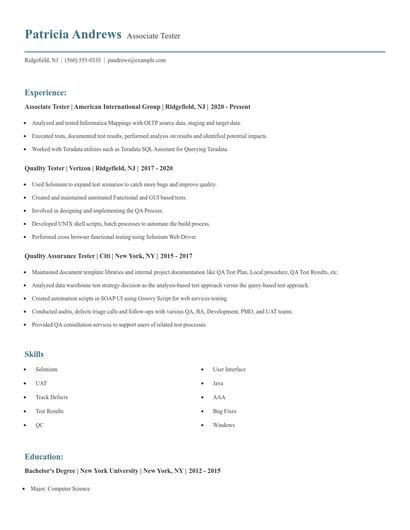
Choose from 10+ customizable associate tester resume templates
Build a professional associate tester resume in minutes. Our AI resume writing assistant will guide you through every step of the process, and you can choose from 10+ resume templates to create your associate tester resume.




Compare different associate testers
Associate tester vs. Senior quality analyst
A senior quality assurance analyst specializes in inspecting and assessing the quality of software and systems in a company, ensuring efficiency and smooth workflow. Their responsibilities include developing specific test structures, coordinating with different departments to gather data, troubleshooting, and studying client complaints to prevent issues from happening again. They may also perform regular maintenance checks, recommending solutions as needed. Furthermore, as a senior quality assurance analyst, it is essential to lead the quality assurance efforts on systems, all while serving as a mentor and role model to junior analysts.
These skill sets are where the common ground ends though. The responsibilities of an associate tester are more likely to require skills like "test procedures," "bug reports," "pc," and "system test cases." On the other hand, a job as a senior quality analyst requires skills like "data analysis," "test cases," "test scripts," and "patients." As you can see, what employees do in each career varies considerably.
Senior quality analysts earn the highest salaries when working in the finance industry, with an average yearly salary of $93,397. On the other hand, associate testers are paid more in the technology industry with an average salary of $88,285.The education levels that senior quality analysts earn slightly differ from associate testers. In particular, senior quality analysts are 12.2% more likely to graduate with a Master's Degree than an associate tester. Additionally, they're 0.1% less likely to earn a Doctoral Degree.Associate tester vs. Quality analyst
Pumpers are individuals who take responsibility for setting the pumping system controls for product maximization. Their job requires them to set density, concentration, rate, and pressure. They do the operation and maintenance of the auxiliary equipment pumping oil. It is their duty to set the wells so they will function based on the production schedules and switch the oil flow between tanks. They even install the pumping systems.
Each career also uses different skills, according to real associate tester resumes. While associate tester responsibilities can utilize skills like "bug reports," "pc," "system test cases," and "rf," quality analysts use skills like "customer service," "patients," "data analysis," and "corrective action."
Quality analysts may earn a lower salary than associate testers, but quality analysts earn the most pay in the finance industry with an average salary of $77,710. On the other hand, associate testers receive higher pay in the technology industry, where they earn an average salary of $88,285.In general, quality analysts achieve similar levels of education than associate testers. They're 3.5% more likely to obtain a Master's Degree while being 0.1% more likely to earn a Doctoral Degree.Associate tester vs. Test analyst
The duties of a test analyst depend on one's line of work or industry of employment. In the information technology setting, a test analyst is responsible for testing computer software or hardware to ensure its quality before being released in the market. They participate in the development process to monitor the product specifications, review and analyze documentation, and create test systems, implementing them promptly and efficiently. As a test analyst, it is essential to produce progress reports, prepare presentations, and even give recommendations.
Some important key differences between the two careers include a few of the skills necessary to fulfill the responsibilities of each. Some examples from associate tester resumes include skills like "bug reports," "pc," "system test cases," and "rf," whereas a test analyst is more likely to list skills in "test scripts," "test plan," "selenium webdriver," and "test execution. "
Test analysts earn the highest salary when working in the finance industry, where they receive an average salary of $74,197. Comparatively, associate testers have the highest earning potential in the technology industry, with an average salary of $88,285.Most test analysts achieve a higher degree level compared to associate testers. For example, they're 6.0% more likely to graduate with a Master's Degree, and 0.4% more likely to earn a Doctoral Degree.Associate tester vs. Test specialist
A test specialist is responsible for evaluating and running diagnostic tests for system networks and applications to ensure stability and efficiency according to the quality standards. Test specialists analyze the system's features and write findings reports for improvement and technical resolutions. They also help system engineers in developing infrastructures and designing servers to support business operations and maximize productivity. A test specialist must have excellent communication and organizational skills, especially in identifying malfunctions and inconsistencies before the actual launch of deliverables.
Even though a few skill sets overlap between associate testers and test specialists, there are some differences that are important to note. For one, an associate tester might have more use for skills like "bug reports," "pc," "system test cases," and "functional specifications." Meanwhile, some responsibilities of test specialists require skills like "test cases," "test scripts," "test equipment," and "troubleshoot. "
Test specialists reach similar levels of education compared to associate testers, in general. The difference is that they're 0.5% more likely to earn a Master's Degree, and 0.3% more likely to graduate with a Doctoral Degree.Types of associate tester
Updated January 8, 2025
