What does an automation lead do?
An Automation Lead is primarily in charge of testing and operating automated machinery in manufacturing facilities. They typically work together with automation teams, adhere to guidelines and protocols, meet project requirements, and produce progress reports. There are also instances when an automation lead may participate in conceptualizing machinery, conducting research and analyses, and addressing issues and concerns. Moreover, an Automation Lead usually works in a team setting, which requires an active communication line for a smooth and efficient workflow.
Automation lead responsibilities
Here are examples of responsibilities from real automation lead resumes:
- Help manage and keep track of products through entire SDLC.
- Manage coding of automate tests including unit, code UI and load testing.
- Perform inter-departmental audits documenting ISO compliant results with associate corrective action requests in order to achieve company-wide certification.
- Execute the regression scripts and send the HTML reports for functional team in each sprint cycle.
- Work with Html results with snapshots.
- Install devices and PLC on salt water disposals.
- Provide the automation solutions for the java applications using the tool selenium java framework.
- Design, implement, and programe HMI and PLC platforms for multiple water treatment plants in Texas.
- Create, maintain and execute automated test scripts to support testing at various levels of the SDLC.
- Automate flex base application which acts as a front end for document viewer from the buyer side using BDD.
- Execute those plans, working with QA staff in the department, ultimately letting them carry on the process independently.
- Develop and test an external scripting system utilizing JavaScript.
- Develop scheduler for auto triggering of automate regression suite.
- Implement a comprehensive QA strategy for a new development organization.
- Develop automated test scripts using UFT for functional and regression testing for data synchronization ensuring pub/sub model verification.
Automation lead skills and personality traits
We calculated that 10% of Automation Leads are proficient in Java, Python, and C++.
We break down the percentage of Automation Leads that have these skills listed on their resume here:
- Java, 10%
Developed SAP-related Java components for a performance metrics monitoring application framework.
- Python, 9%
Developed various python scripts for different module automation.
- C++, 4%
Involved in writing optimization techniques for more accuracy of Macros in C/C++, C++ routines and Oracle SQL, PL/SQL.
- C #, 4%
Executed Automated Test Scripts using Selenium RC and C #.
- Automation Framework, 4%
Designed the Automation framework for the web-based application.
- Jenkins, 4%
Used Jenkins for continuous Integration.
Most automation leads use their skills in "java," "python," and "c++" to do their jobs. You can find more detail on essential automation lead responsibilities here:
The three companies that hire the most automation leads are:
- MITRE125 automation leads jobs
- ICF51 automation leads jobs
- Lawrence Livermore National Laboratory10 automation leads jobs
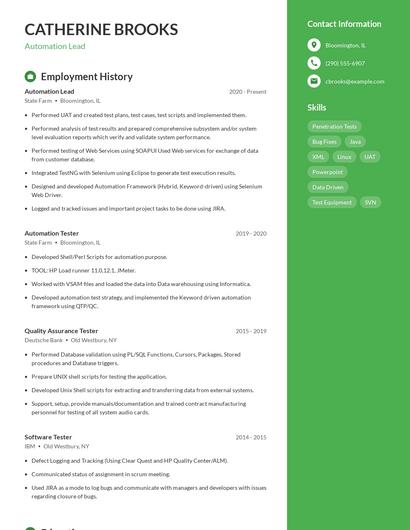
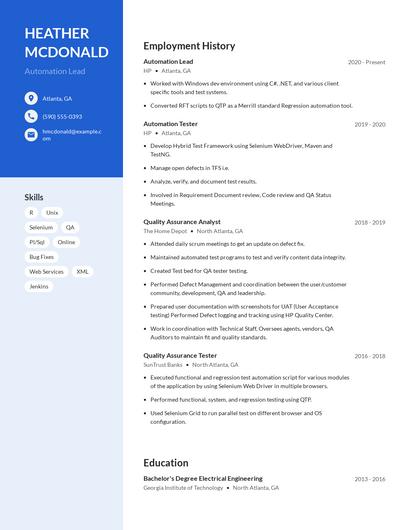
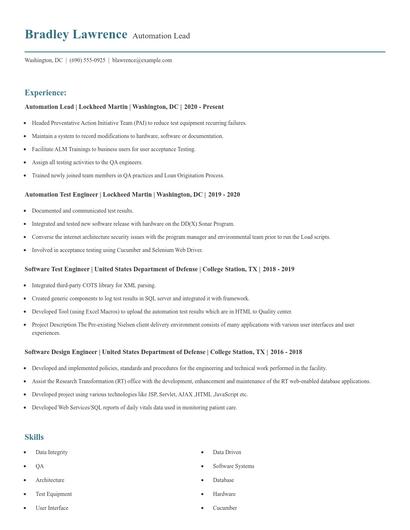
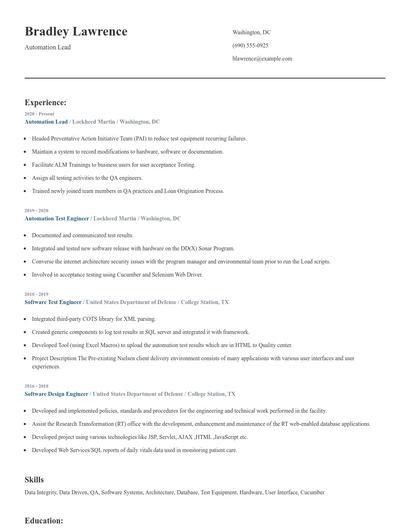
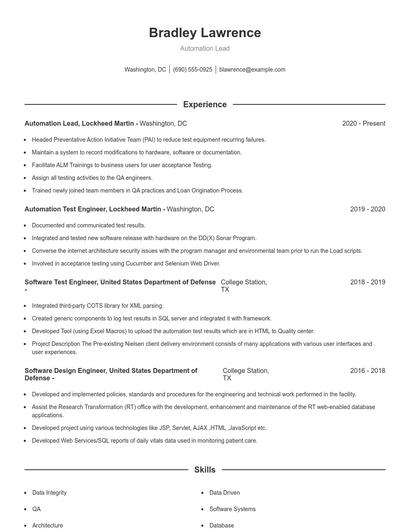
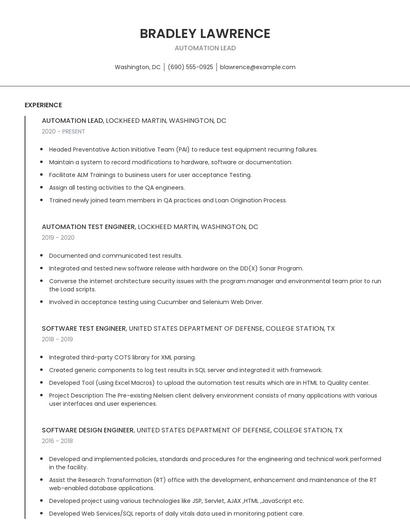
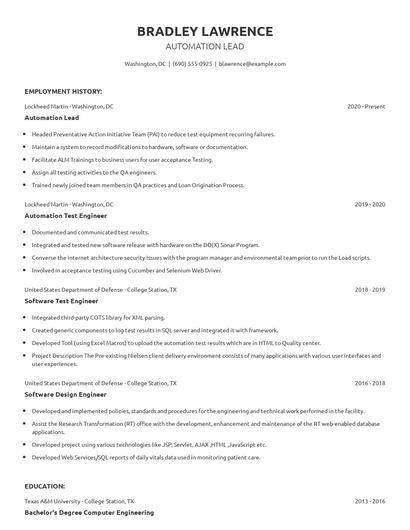
Choose from 10+ customizable automation lead resume templates
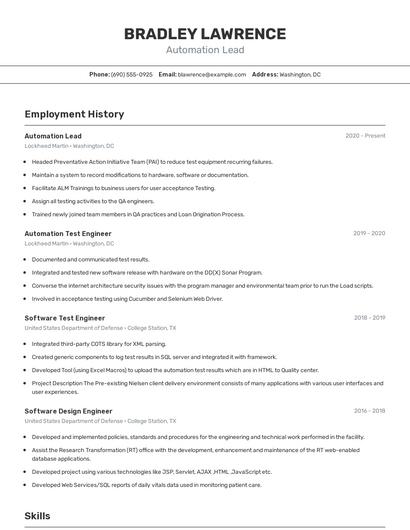
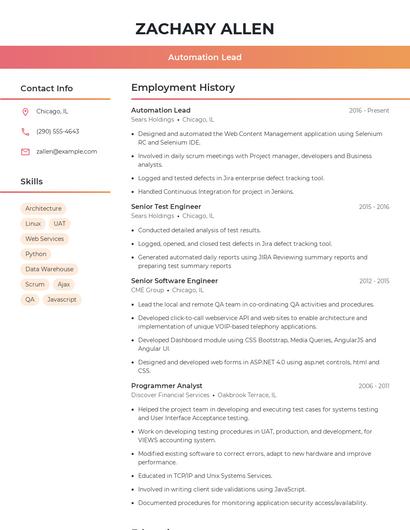
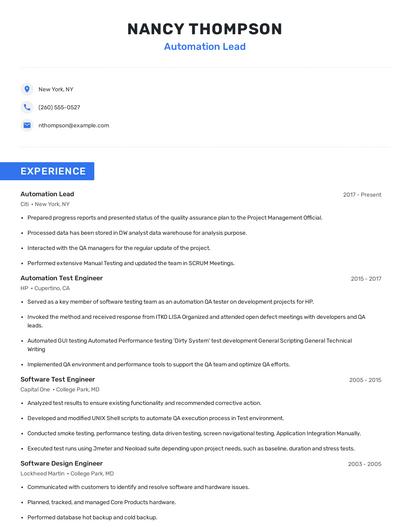
Build a professional automation lead resume in minutes. Our AI resume writing assistant will guide you through every step of the process, and you can choose from 10+ resume templates to create your automation lead resume.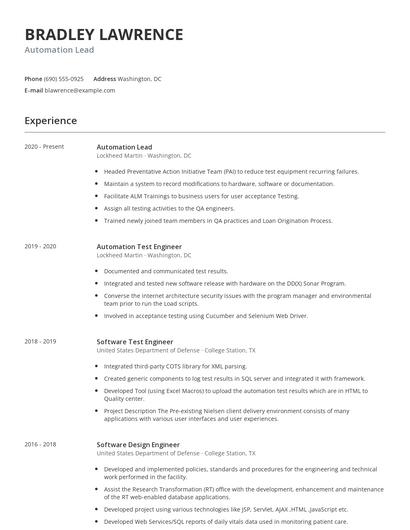

Compare different automation leads
Automation lead vs. Test analyst
The duties of a test analyst depend on one's line of work or industry of employment. In the information technology setting, a test analyst is responsible for testing computer software or hardware to ensure its quality before being released in the market. They participate in the development process to monitor the product specifications, review and analyze documentation, and create test systems, implementing them promptly and efficiently. As a test analyst, it is essential to produce progress reports, prepare presentations, and even give recommendations.
There are some key differences in the responsibilities of each position. For example, automation lead responsibilities require skills like "python," "c++," "c #," and "automation framework." Meanwhile a typical test analyst has skills in areas such as "test scripts," "status reports," "selenium webdriver," and "strong problem-solving." This difference in skills reveals the differences in what each career does.
Test analysts tend to make the most money working in the finance industry, where they earn an average salary of $74,197. In contrast, automation leads make the biggest average salary, $110,654, in the retail industry.On average, test analysts reach lower levels of education than automation leads. Test analysts are 5.5% less likely to earn a Master's Degree and 0.5% less likely to graduate with a Doctoral Degree.Automation lead vs. Quality assurance analyst
Quality Administrators are responsible for managing the quality processes of an organization. Their duties include creating data collection processes, conducting data cleansing, tracks quality milestones, and develop training programs for internal teams. They undertake daily audits, work with the quality coordinator to determine root cause, and assist with feedback and complaints. Quality administrators also write daily reports for purchase orders that are overdue, open service jobs, quotations needing to follow up, unconfirmed hires, and processed sales orders.
While some skills are similar in these professions, other skills aren't so similar. For example, resumes show us that automation lead responsibilities requires skills like "python," "c++," "automation framework," and "emerging technologies." But a quality assurance analyst might use other skills in their typical duties, such as, "test scripts," "selenium webdriver," "status reports," and "pl/sql."
Quality assurance analysts may earn a lower salary than automation leads, but quality assurance analysts earn the most pay in the retail industry with an average salary of $82,227. On the other hand, automation leads receive higher pay in the retail industry, where they earn an average salary of $110,654.quality assurance analysts earn lower levels of education than automation leads in general. They're 7.0% less likely to graduate with a Master's Degree and 0.5% less likely to earn a Doctoral Degree.Automation lead vs. Senior quality assurance engineer
A senior quality assurance engineer oversees the testing procedures conducted in software development, ensuring technical accuracy and efficiency. They are primarily responsible for working alongside software designers and quality engineers, reviewing quality control reports, inspecting specifications, and devising particular test procedures. Moreover, it is also essential to troubleshoot issues and identify any inconsistencies or bugs. As someone with more experience in the team, they must supervise and serve as a mentor to the younger quality assurance engineers in the joint effort to develop efficient software.
The required skills of the two careers differ considerably. For example, automation leads are more likely to have skills like "emerging technologies," "javascript," "continuous integration," and "business process." But a senior quality assurance engineer is more likely to have skills like "test automation," "test scripts," "git," and "linux."
Senior quality assurance engineers make a very good living in the telecommunication industry with an average annual salary of $112,284. On the other hand, automation leads are paid the highest salary in the retail industry, with average annual pay of $110,654.senior quality assurance engineers typically earn similar educational levels compared to automation leads. Specifically, they're 2.2% less likely to graduate with a Master's Degree, and 0.1% less likely to earn a Doctoral Degree.Automation lead vs. Senior quality assurance analyst
Senior quality assurance analysts are responsible for developing and implementing quality assurance standards within an organization. They collect and analyze data to reinforce proposed projects, systems requirements, and business cases. These will include writing scripts and test plans to monitor errors and fixes in product and software development, operational systems, and information systems. Besides, they are also responsible for several tasks, including preparing reports and recommendations, communicating with suppliers and vendors in assessing applications, and conducting internal audits.
Even though a few skill sets overlap between automation leads and senior quality assurance analysts, there are some differences that are important to note. For one, an automation lead might have more use for skills like "python," "c++," "automation framework," and "emerging technologies." Meanwhile, some responsibilities of senior quality assurance analysts require skills like "test scripts," "status reports," "pl/sql," and "data warehouse. "
The finance industry tends to pay the highest salaries for senior quality assurance analysts, with average annual pay of $99,710. Comparatively, the highest automation lead annual salary comes from the retail industry.In general, senior quality assurance analysts hold similar degree levels compared to automation leads. Senior quality assurance analysts are 0.0% less likely to earn their Master's Degree and 0.1% less likely to graduate with a Doctoral Degree.Types of automation lead
Updated January 8, 2025
