What does a building attendant do?
A building attendant is responsible for performing various maintenance and building management tasks in an organization. Their duties usually include opening buildings, preparing facilities for the staff's arrival, cleaning floors and windows, arranging furniture, and replenishing supplies such as drinking water, snacks, napkins, and toiletries. They can also replace fixtures such as light bulbs and conduct maintenance checks, reporting to the managers should there be any issues. Moreover, as a building attendant, they are also responsible for monitoring supply inventories and storing cleaning equipment according to protocols.
Building attendant responsibilities
Here are examples of responsibilities from real building attendant resumes:
- Operate POS cash register to manage cash, credit, and debit card transactions for sell items.
- Clean spills and other hazards using sponges and squeegees.
- Sanitize handrails using sponges and rags.
- Clean and disinfect bathrooms, including showers, toilets, urinals, sinks, towel dispensers, and mirrors.
- Operate and utilize a variety of custodial equipment including vacuum cleaner, small power and hand tools, various ladders.
- Keep records on individual pet, including daily observations and information activities perform, meals sever, and medication administer.
- Used hand and power tools such as dollies, floor polishers, vacuum cleaners, mops, floor strippers.
Building attendant skills and personality traits
We calculated that 12% of Building Attendants are proficient in Custodial Maintenance, Scrubbers, and OSHA. They’re also known for soft skills such as Interpersonal skills, Mechanical skills, and Physical strength.
We break down the percentage of Building Attendants that have these skills listed on their resume here:
- Custodial Maintenance, 12%
Perform routine and comprehensive custodial maintenance of assigned facilities including classrooms and laboratories.
- Scrubbers, 7%
Experienced in operating custodial equipment such as hall vacuums, carpet shampooers, and floor wax strippers, and scrubbers.
- OSHA, 7%
Operate under OSHA standards, rules and regulations for safety and PPE.
- Patrol, 6%
Patrol Airport to maintain an environment free of foreign objects and debris.
- CPR, 6%
Ice Maintenance Customer Service Learned POS basics Learned CPR Building Maintenance
- Patient Rooms, 6%
clean patient rooms, hallways,offices, restrooms.
"custodial maintenance," "scrubbers," and "osha" are among the most common skills that building attendants use at work. You can find even more building attendant responsibilities below, including:
Interpersonal skills. The most essential soft skill for a building attendant to carry out their responsibilities is interpersonal skills. This skill is important for the role because "janitors and building cleaners must interact well other cleaners and the people who live or work in the buildings they service." Additionally, a building attendant resume shows how their duties depend on interpersonal skills: "provide guest services to our park visitors through the use of strong interpersonal communication skills. "
Mechanical skills. Another essential skill to perform building attendant duties is mechanical skills. Building attendants responsibilities require that "janitors and building cleaners need to understand general building operations and should be able to make routine repairs, such as to leaky faucets." Building attendants also use mechanical skills in their role according to a real resume snippet: "operate under the supervision of the building maintenance manager serviced and repaired mechanical, electrical and steam equipment. "
Physical strength. This is an important skill for building attendants to perform their duties. For an example of how building attendant responsibilities depend on this skill, consider that "janitors and building cleaners often must lift and move heavy cleaning materials and equipment." This excerpt from a resume also shows how vital it is to everyday roles and responsibilities of a building attendant: "provide excellent customer service perform daily physical tasks to ensure all conference room are prepared as planned".
The three companies that hire the most building attendants are:
- The University of Texas at San Antonio7 building attendants jobs
- Univ. Of Texas Cancer Ctr.6 building attendants jobs
- Rochester Regional Health4 building attendants jobs
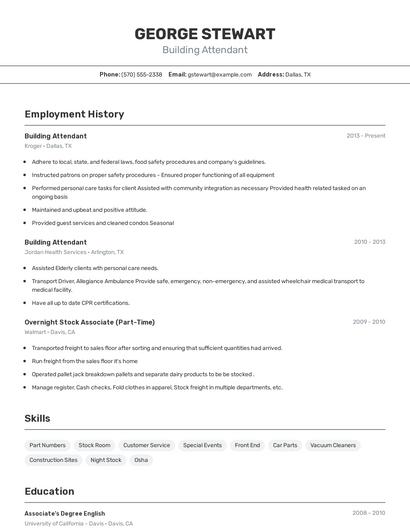
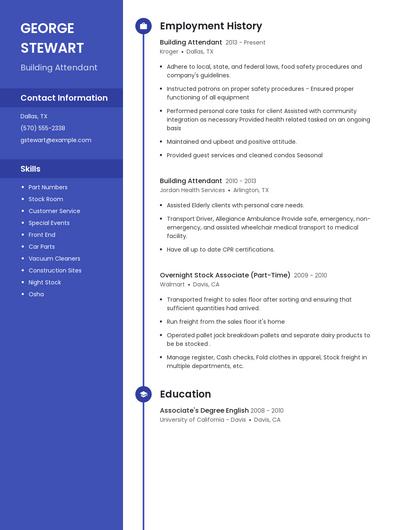
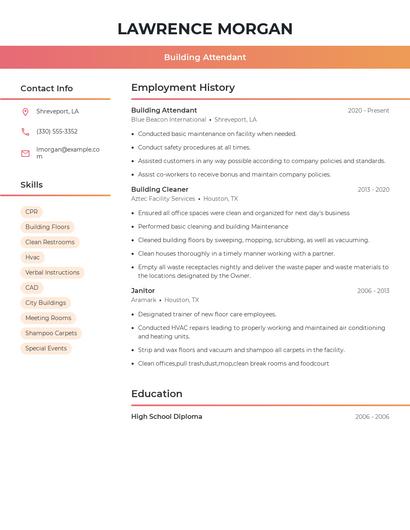
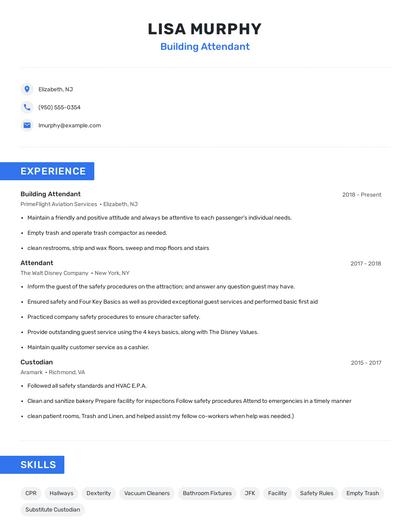
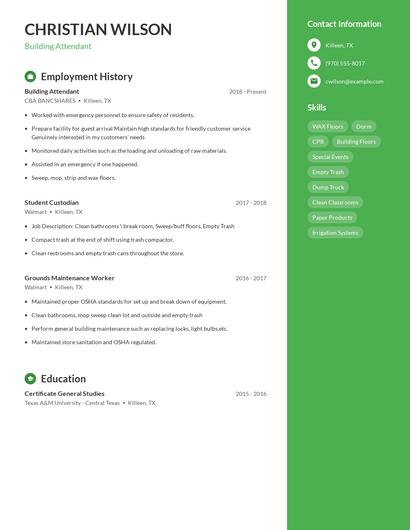
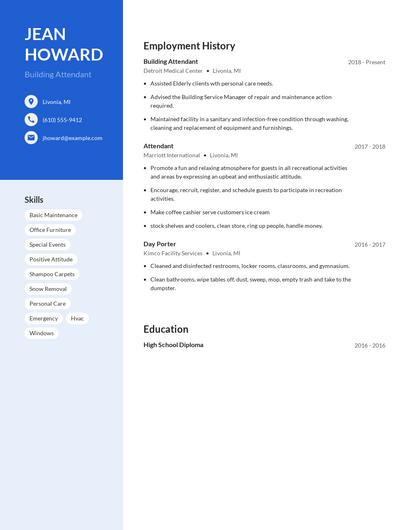
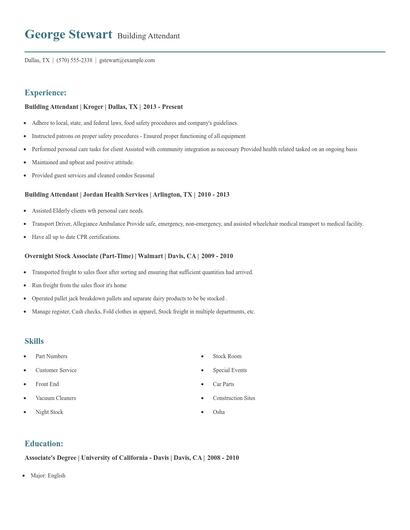
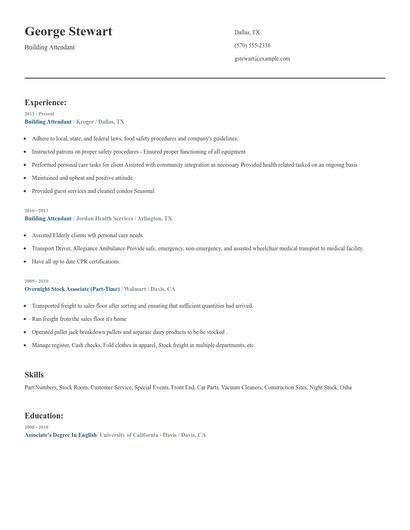
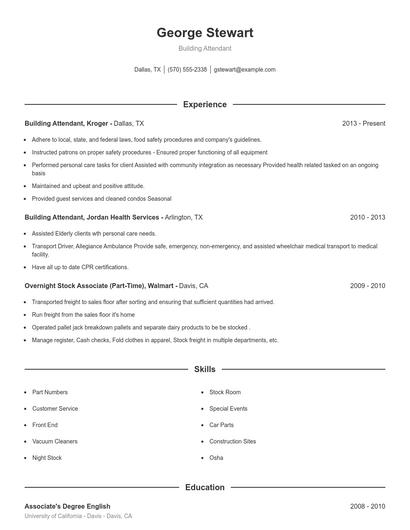
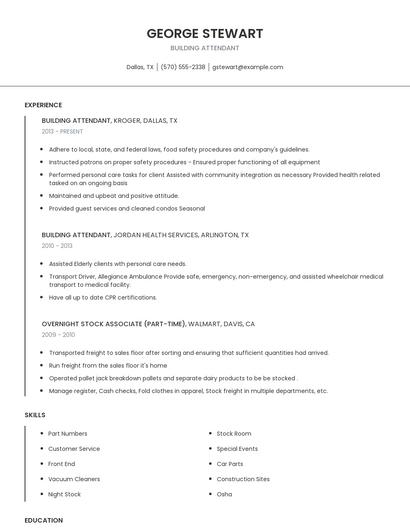
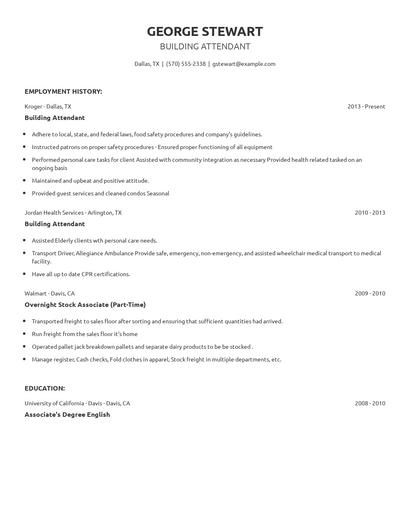
Choose from 10+ customizable building attendant resume templates
Build a professional building attendant resume in minutes. Our AI resume writing assistant will guide you through every step of the process, and you can choose from 10+ resume templates to create your building attendant resume.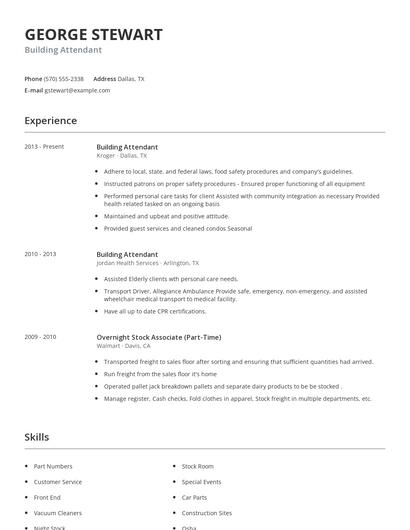
Compare different building attendants
Building attendant vs. Porter
A porter is responsible for managing the building's cleanliness and orderliness, together with the cleaning maintenance team. Duties of a porter include ensuring the premises' safety, operating cleaning tools and equipment, and performing basic troubleshooting for defective machines. Other tasks include assisting visitors with their inquiries, leading clients to the appropriate departments, adhering to the highest safety standards and procedures, and answering maintenance calls. A porter must have excellent time-management and multi-tasking skills to ensure daily smooth operations.
While similarities exist, there are also some differences between building attendants and porter. For instance, building attendant responsibilities require skills such as "patrol," "cpr," "patient rooms," and "ladders." Whereas a porter is skilled in "excellent guest," "dexterity," "manual dexterity," and "good communication." This is part of what separates the two careers.
Porters earn the highest salaries when working in the retail industry, with an average yearly salary of $30,781. On the other hand, building attendants are paid more in the government industry with an average salary of $28,890.porters tend to reach similar levels of education than building attendants. In fact, porters are 0.7% less likely to graduate with a Master's Degree and 0.5% more likely to have a Doctoral Degree.Building attendant vs. Sanitation worker
A sanitation worker is employed to carry out valuable community tasks like garbage collection, hauling, and disposal. Sanitation workers take responsibility for the cleanliness and maintenance of the community. They ride or drive garbage trucks to collect trash from businesses and residents every day. They may work within companies as well following their respective corporate policies. One can become a sanitation worker if they have a college degree, high school degree, or any relevant job experience.
While some skills are similar in these professions, other skills aren't so similar. For example, resumes show us that building attendant responsibilities requires skills like "custodial maintenance," "osha," "patrol," and "cpr." But a sanitation worker might use other skills in their typical duties, such as, "pallet jack," "food safety," "safety standards," and "production equipment."
On average, sanitation workers earn a higher salary than building attendants. Some industries support higher salaries in each profession. Interestingly enough, sanitation workers earn the most pay in the government industry with an average salary of $38,278. Whereas building attendants have higher pay in the government industry, with an average salary of $28,890.In general, sanitation workers achieve similar levels of education than building attendants. They're 1.7% less likely to obtain a Master's Degree while being 0.5% more likely to earn a Doctoral Degree.Building attendant vs. Floor care specialist
A floor care specialist is in charge of the maintenance of floors in public or private establishments. They typically ensure the cleanliness of floors by sweeping, dry and wet mopping, disinfecting areas, extracting or sanitizing carpets, vacuuming, and scrubbing bathroom floors. They may also participate in installing or refinishing floor tiles, preparing facilities, and re-arranging furniture. Moreover, a floor care specialist must maintain the cleanliness of floors while maintaining an active communication line with co-workers and managers for a smooth and efficient workflow.
Some important key differences between the two careers include a few of the skills necessary to fulfill the responsibilities of each. Some examples from building attendant resumes include skills like "custodial maintenance," "osha," "patrol," and "patient rooms," whereas a floor care specialist is more likely to list skills in "patients," "home health," "rehabilitation," and "patient care. "
Floor care specialists earn the highest salary when working in the manufacturing industry, where they receive an average salary of $34,345. Comparatively, building attendants have the highest earning potential in the government industry, with an average salary of $28,890.floor care specialists typically earn similar educational levels compared to building attendants. Specifically, they're 4.7% more likely to graduate with a Master's Degree, and 0.5% more likely to earn a Doctoral Degree.Building attendant vs. Day porter
Day porters are skilled employees who are responsible for conducting daily building maintenance at a facility to ensure it looks neat and presentable to the public. These porters are required to clean all common room areas such as the kitchen, cafeteria, and lobby as well as prepare conference rooms before and after meetings. They must complete minor repairs and place safety hazard signs in the building to warn customers and employees. Day porters must also provide service washrooms while responding to major spills or other cleaning crises.
Types of building attendant
Updated January 8, 2025
