What does a building cleaner do?
Building cleaner responsibilities
Here are examples of responsibilities from real building cleaner resumes:
- Maintain cleanliness of all floors in apartment building, sweeping and mopping.
- Respond appropriately to the physical, emotional and developmental needs of patients.
- Disinfect equipment and supplies, using germicides or steam-operate sterilizers.
Building cleaner skills and personality traits
We calculated that 14% of Building Cleaners are proficient in Polish Furniture, Clean Bathrooms, and Cleanliness. They’re also known for soft skills such as Interpersonal skills, Mechanical skills, and Physical strength.
We break down the percentage of Building Cleaners that have these skills listed on their resume here:
- Polish Furniture, 14%
Dust and polish furniture and equipment, kept storage areas and carts well-stocked, clean, and tidy.
- Clean Bathrooms, 13%
Clean bathrooms, kitchen area and dust each night.
- Cleanliness, 13%
Maintain cleanliness of facility* Ability to easily move to other buildings/routes without delay
- Clean Windows, 11%
Sweep, mop, dust, vacuum, take out trash, clean windows, strip and wax floors
- Hot Water, 7%
Mixed bleaching agents with hot water in vats, and soak material until it is bleached.
- Bathroom Fixtures, 7%
Sterilized bathroom fixtures and replaced hygiene products.
"polish furniture," "clean bathrooms," and "cleanliness" are among the most common skills that building cleaners use at work. You can find even more building cleaner responsibilities below, including:
Interpersonal skills. To carry out their duties, the most important skill for a building cleaner to have is interpersonal skills. Their role and responsibilities require that "janitors and building cleaners must interact well other cleaners and the people who live or work in the buildings they service." Building cleaners often use interpersonal skills in their day-to-day job, as shown by this real resume: "general maintenance of grounds other routine maintenance duties as assigned skills used good communication and interpersonal skills. "
Mechanical skills. Another essential skill to perform building cleaner duties is mechanical skills. Building cleaners responsibilities require that "janitors and building cleaners need to understand general building operations and should be able to make routine repairs, such as to leaky faucets." Building cleaners also use mechanical skills in their role according to a real resume snippet: "perform preventative and general maintenance and may assist with minor repairs to building and mechanical operating systems. "
Physical strength. This is an important skill for building cleaners to perform their duties. For an example of how building cleaner responsibilities depend on this skill, consider that "janitors and building cleaners often must lift and move heavy cleaning materials and equipment." This excerpt from a resume also shows how vital it is to everyday roles and responsibilities of a building cleaner: "performed routine maintenance to ensure the efficiency of machinery operations, and quality of the physical condition of the building. ".
Time-management skills. building cleaner responsibilities often require "time-management skills." The duties that rely on this skill are shown by the fact that "janitors and building cleaners must plan and complete tasks in a timely manner." This resume example shows what building cleaners do with time-management skills on a typical day: "maintain time deadlines while still providing excellent customer service. "
The three companies that hire the most building cleaners are:
- Robbinsdale Area Schools6 building cleaners jobs
- ABM Industries4 building cleaners jobs
- Fred's3 building cleaners jobs
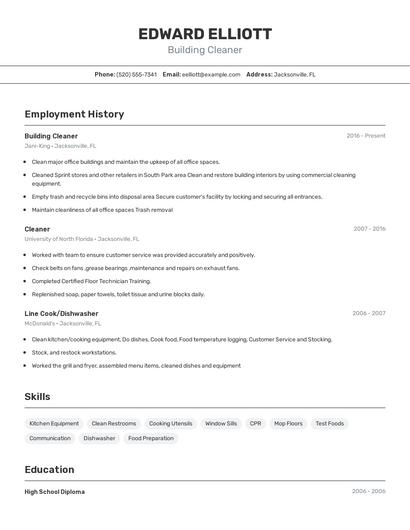
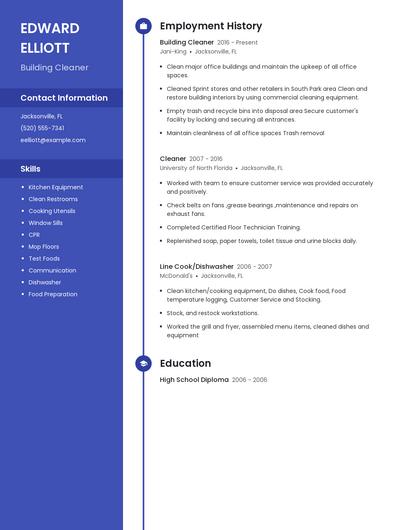
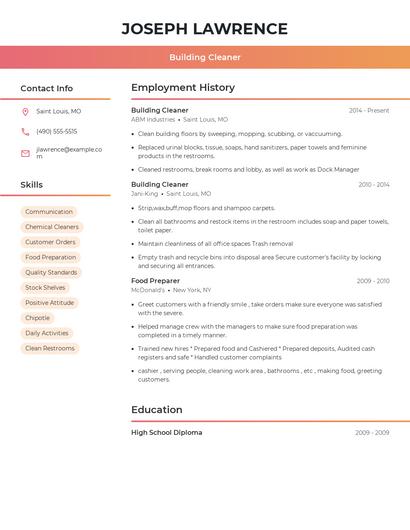
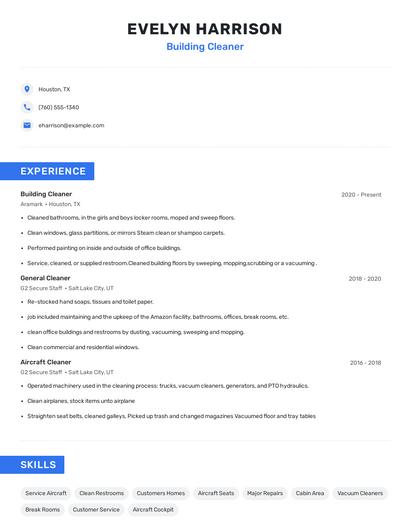
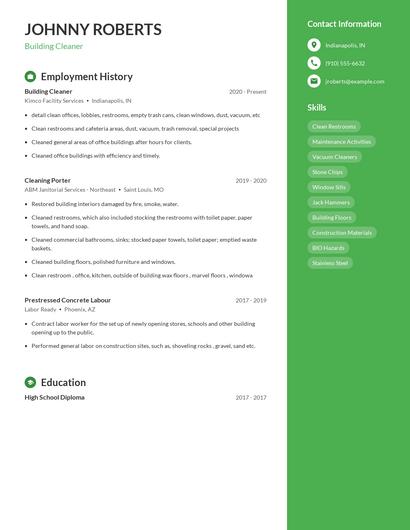
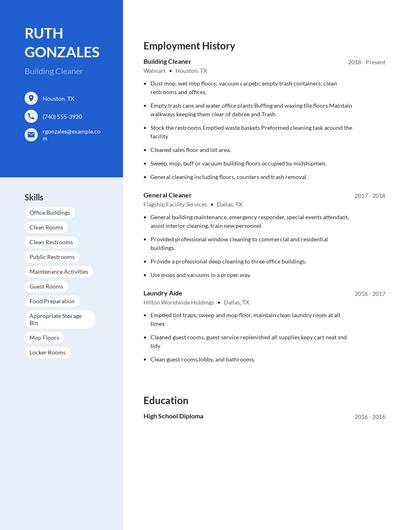
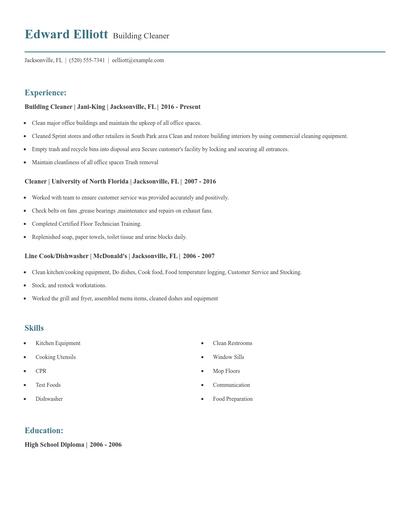
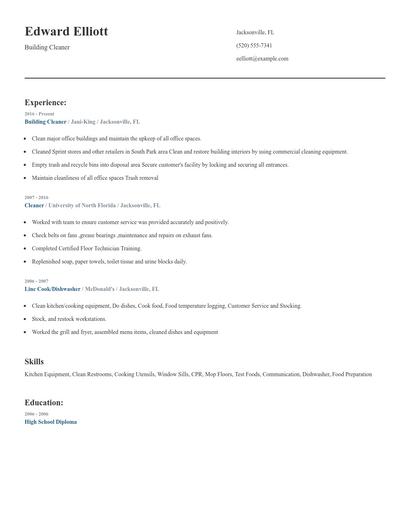
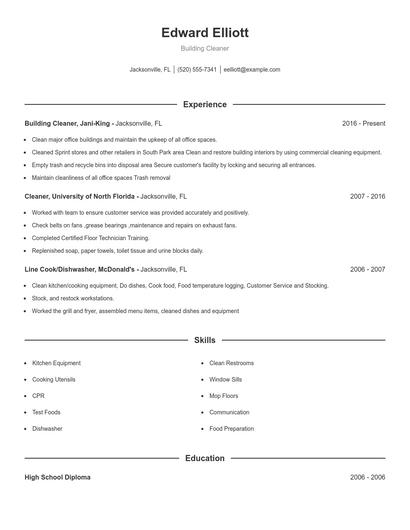
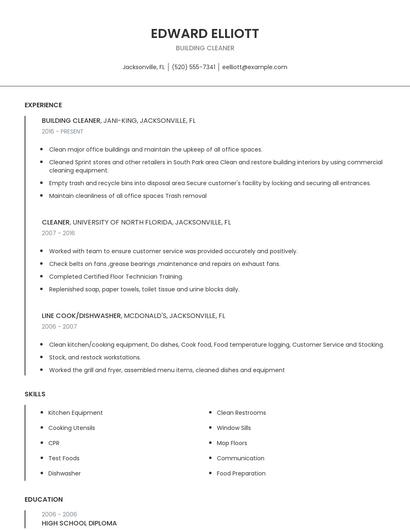
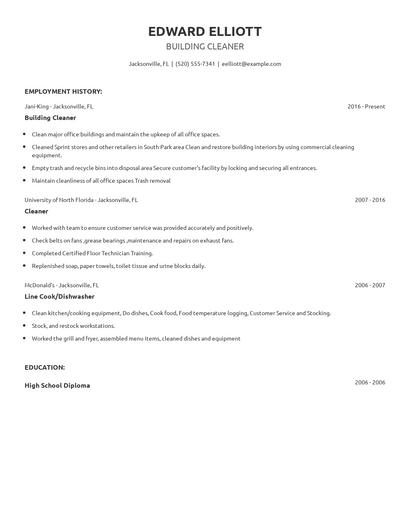
Choose from 10+ customizable building cleaner resume templates
Build a professional building cleaner resume in minutes. Our AI resume writing assistant will guide you through every step of the process, and you can choose from 10+ resume templates to create your building cleaner resume.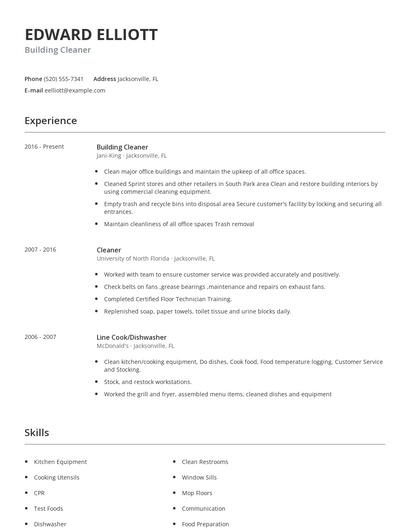
Compare different building cleaners
Building cleaner vs. Porter
A porter is responsible for managing the building's cleanliness and orderliness, together with the cleaning maintenance team. Duties of a porter include ensuring the premises' safety, operating cleaning tools and equipment, and performing basic troubleshooting for defective machines. Other tasks include assisting visitors with their inquiries, leading clients to the appropriate departments, adhering to the highest safety standards and procedures, and answering maintenance calls. A porter must have excellent time-management and multi-tasking skills to ensure daily smooth operations.
While similarities exist, there are also some differences between building cleaners and porter. For instance, building cleaner responsibilities require skills such as "polish furniture," "hot water," "bathroom fixtures," and "office buildings." Whereas a porter is skilled in "excellent guest," "dexterity," "manual dexterity," and "customer service." This is part of what separates the two careers.
Porters tend to make the most money working in the retail industry, where they earn an average salary of $30,781. In contrast, building cleaners make the biggest average salary, $30,230, in the technology industry.porters tend to reach similar levels of education than building cleaners. In fact, porters are 0.0% less likely to graduate with a Master's Degree and 0.4% less likely to have a Doctoral Degree.Building cleaner vs. Floor care specialist
A floor care specialist is in charge of the maintenance of floors in public or private establishments. They typically ensure the cleanliness of floors by sweeping, dry and wet mopping, disinfecting areas, extracting or sanitizing carpets, vacuuming, and scrubbing bathroom floors. They may also participate in installing or refinishing floor tiles, preparing facilities, and re-arranging furniture. Moreover, a floor care specialist must maintain the cleanliness of floors while maintaining an active communication line with co-workers and managers for a smooth and efficient workflow.
Each career also uses different skills, according to real building cleaner resumes. While building cleaner responsibilities can utilize skills like "polish furniture," "clean bathrooms," "clean windows," and "hot water," floor care specialists use skills like "patients," "home health," "floor care," and "rehabilitation."
On average, floor care specialists earn a higher salary than building cleaners. Some industries support higher salaries in each profession. Interestingly enough, floor care specialists earn the most pay in the manufacturing industry with an average salary of $34,345. Whereas building cleaners have higher pay in the technology industry, with an average salary of $30,230.Average education levels between the two professions vary. Floor care specialists tend to reach higher levels of education than building cleaners. In fact, they're 5.3% more likely to graduate with a Master's Degree and 0.4% less likely to earn a Doctoral Degree.Building cleaner vs. Floor staff
The duties of floor staff depend on their line of work or industry of employment. In restaurants and similar establishments, floor staff is in charge of performing support tasks for the wait staff. They typically serve food to patrons, clean and set tables, help in processing payments, monitor the supplies, and maintain the cleanliness of different areas. They may also assist customers by escorting them to their tables, answering inquiries, and delivering their bills. Furthermore, should there be any problems, the floor staff must report to the manager right away.
There are many key differences between these two careers, including some of the skills required to perform responsibilities within each role. For example, a building cleaner is likely to be skilled in "polish furniture," "clean bathrooms," "clean windows," and "hot water," while a typical floor staff is skilled in "pos," "phone calls," "math," and "emergency situations."
Floor staff typically earn similar educational levels compared to building cleaners. Specifically, they're 0.4% more likely to graduate with a Master's Degree, and 0.7% more likely to earn a Doctoral Degree.Building cleaner vs. Sanitation worker
A sanitation worker is employed to carry out valuable community tasks like garbage collection, hauling, and disposal. Sanitation workers take responsibility for the cleanliness and maintenance of the community. They ride or drive garbage trucks to collect trash from businesses and residents every day. They may work within companies as well following their respective corporate policies. One can become a sanitation worker if they have a college degree, high school degree, or any relevant job experience.
Types of building cleaner
Updated January 8, 2025
