What does a business/applications analyst do?
A business applications analyst is responsible for designing system applications according to the clients' specifications and business requirements within budget limitations and timetables. Business application analysts evaluate the clients' needs and create programs through data analysis and statistical methods to promote brand image on various digital media platforms. They also coordinate with the clients and management for progress updates and informing them of any adjustments to improve features and navigations structures. A business application analyst must have excellent knowledge of the technology industry to translate data, as well as a strong command of the programming language and codes.
Business/applications analyst responsibilities
Here are examples of responsibilities from real business/applications analyst resumes:
- Coordinate UAT testing and manage metrics for all testing outcomes including execute, pass, fail, block and defect.
- Conduct interviews and lead JAD sessions with stakeholders and users enterprise-wide to gather requirements.
- Create several Java classes for system objects.
- Experience in working with Microsoft windows registry system, ODBC settings.
- Interact on a daily basis with Java, C++, and .NET developers.
- Research and elicit user requirements to upgrade Lawson ERP application from an older version to the current.
- Develop and maintain knowledge base tools, data mapping structures and VISIO for diagramming used to help support customers.
- Modify existing CRM programs as part of software upgrade project to improve sales processes and increase sales force productivity.
- Create and execute plans for QA testing and coordinate with the relevant user groups for acceptance prior to production release.
- Maintain documentation need to satisfy SDLC compliance.
- Coordinate departmental transition from standard SDLC methodology.
- Co-developed UI design requirements with product managers.
- Install and upgrade windows base applications on workstations.
- Perform and develop extensive QA testing and facilitate UAT training and certification.
- Facilitate daily scrum meetings to identify, track and escalate development roadblocks.
Business/applications analyst skills and personality traits
We calculated that 8% of Business/Applications Analysts are proficient in Customer Service, Project Management, and Business Processes. They’re also known for soft skills such as Interpersonal skills, Problem-solving skills, and Time-management skills.
We break down the percentage of Business/Applications Analysts that have these skills listed on their resume here:
- Customer Service, 8%
Revised training and educational materials; verified all areas of customer service consistently provided quality service as set up by corporate.
- Project Management, 8%
Lead the post acquisition technology integration including infrastructure, cost reductions, project management and business applications.
- Business Processes, 6%
Interviewed business clients to analyze their business requirements and recommend and design technological improvements to their business processes and operational procedures.
- Troubleshoot, 3%
Identified and troubleshoot system malfunctions during system testing and coordinated change requests for system functional enhancements.
- Test Scripts, 3%
Executed and maintained hundreds of additional evergreen/regression test scripts.
- Technical Support, 3%
Provide technical support and assistance to customers using various computer hardware, desktop applications or Cardinal Health applications.
Common skills that a business/applications analyst uses to do their job include "customer service," "project management," and "business processes." You can find details on the most important business/applications analyst responsibilities below.
Interpersonal skills. The most essential soft skill for a business/applications analyst to carry out their responsibilities is interpersonal skills. This skill is important for the role because "management analysts work with managers and other employees of the organizations for which they provide consulting services." Additionally, a business/applications analyst resume shows how their duties depend on interpersonal skills: "maximize the organization's sharepoint capabilities through hands on coaching and training exercises utilizing strong written and interpersonal communication skills. "
Problem-solving skills. Another essential skill to perform business/applications analyst duties is problem-solving skills. Business/applications analysts responsibilities require that "management analysts must be able to think creatively to solve clients’ problems." Business/applications analysts also use problem-solving skills in their role according to a real resume snippet: "work daily with application support teams to help establish collaborative relationship and mitigate resolution of issues. "
Time-management skills. Another skill that relates to the job responsibilities of business/applications analysts is time-management skills. This skill is critical to many everyday business/applications analyst duties, as "management analysts often work under tight deadlines and must use their time efficiently to complete projects on schedule." This example from a resume shows how this skill is used: "managed internal software development project list insuring work completed successfully and on time. "
Analytical skills. business/applications analyst responsibilities often require "analytical skills." The duties that rely on this skill are shown by the fact that "management analysts must be able to interpret information and use their findings to make proposals." This resume example shows what business/applications analysts do with analytical skills on a typical day: "supported analysis for applications utilizing web services, java, ab initio, and pl/sql technologies"
Communication skills. Another crucial skill for a business/applications analyst to carry out their responsibilities is "communication skills." A big part of what business/applications analysts relies on this skill, since "management analysts must be able to convey information clearly in both writing and speaking." How this skill relates to business/applications analyst duties can be seen in an example from a business/applications analyst resume snippet: "provided project management documents such as requirements, solution specification, risk analysis and status communications. "
The three companies that hire the most business/applications analysts are:
- USAA42 business/applications analysts jobs
- FedEx33 business/applications analysts jobs
- Rehabilitation Institute of Michigan
5 business/applications analysts jobs
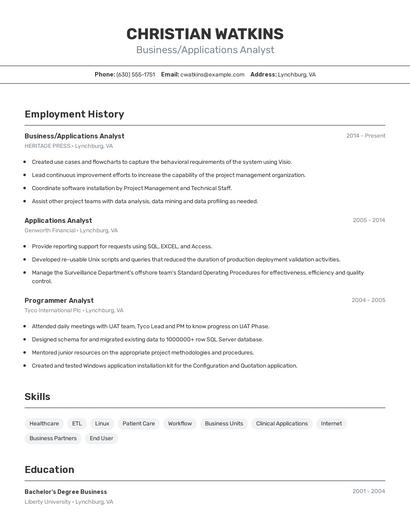
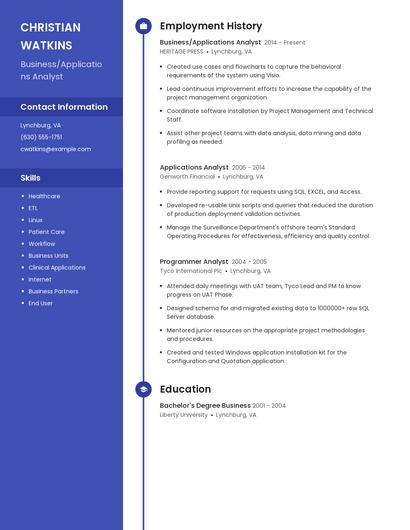
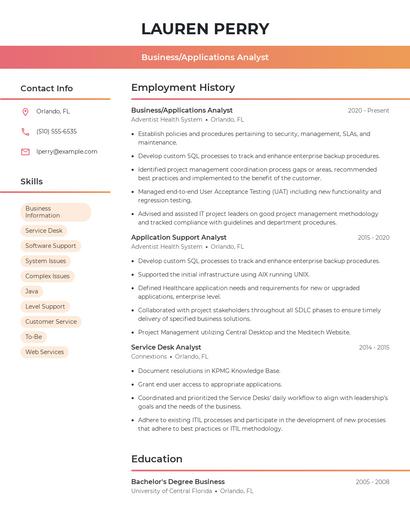
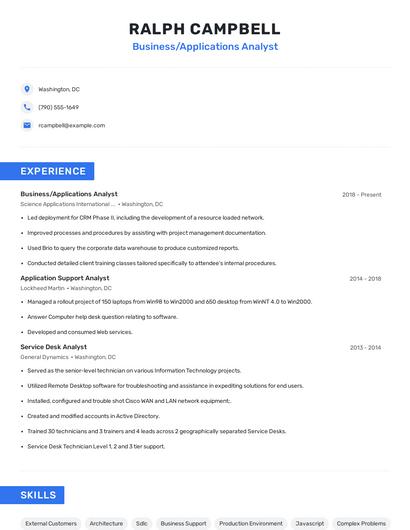
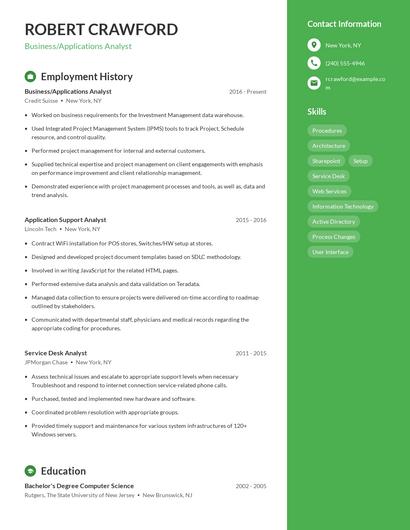
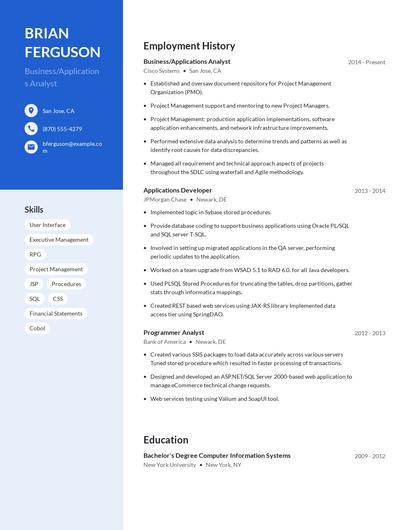
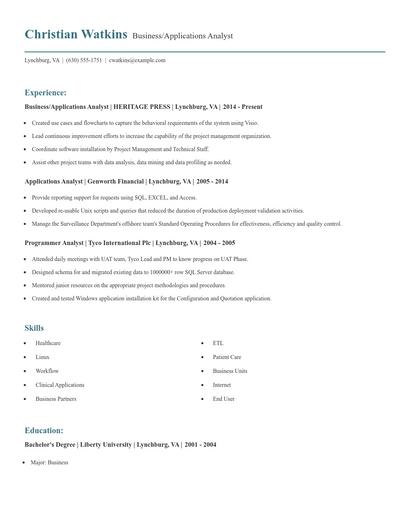
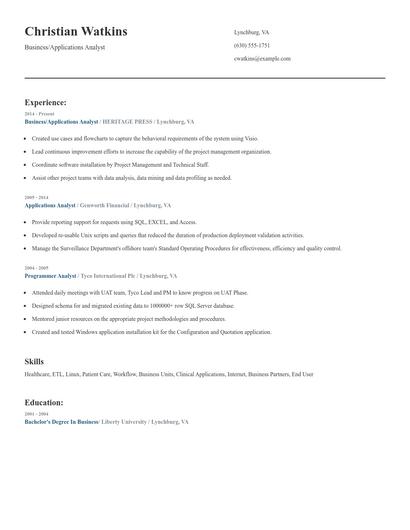
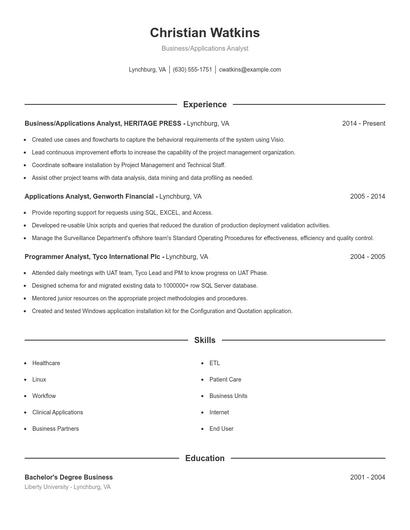
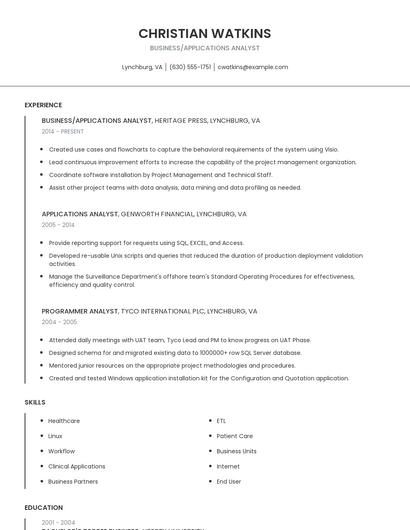
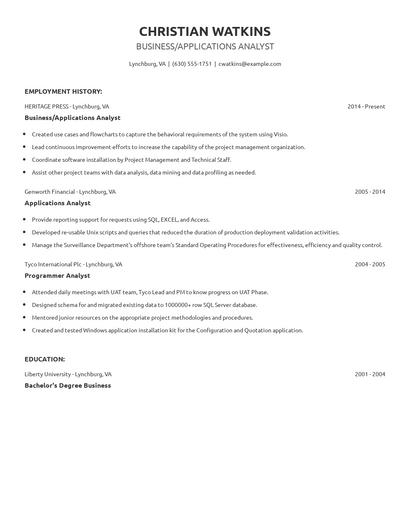
Choose from 10+ customizable business/applications analyst resume templates
Build a professional business/applications analyst resume in minutes. Our AI resume writing assistant will guide you through every step of the process, and you can choose from 10+ resume templates to create your business/applications analyst resume.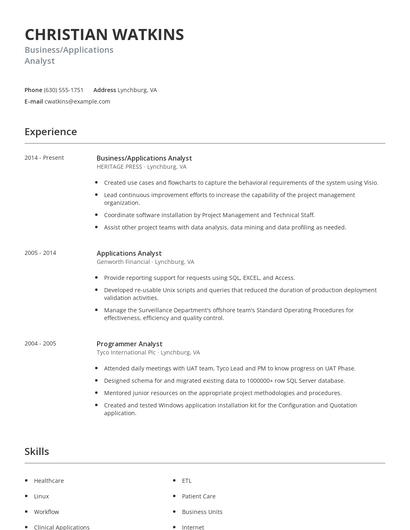
Compare different business/applications analysts
Business/applications analyst vs. Analyst
Analysts are employees or individual contributors with a vast experience in a particular field that help the organization address challenges. They help the organization improve processes, policies, and other operations protocol by studying the current processes in place and determining the effectiveness of those processes. They also research industry trends and data to make sound inferences and recommendations on what the company should do to improve their numbers. Analysts recommend business solutions and often help the organization roll out these solutions. They ensure that the proposed action plans are effective and produce the desired results.
There are some key differences in the responsibilities of each position. For example, business/applications analyst responsibilities require skills like "technical support," "business applications," "business analysis," and "application development." Meanwhile a typical analyst has skills in areas such as "digital transformation," "data entry," "excellent interpersonal," and "work ethic." This difference in skills reveals the differences in what each career does.
Analysts earn the highest salaries when working in the technology industry, with an average yearly salary of $79,330. On the other hand, business/applications analysts are paid more in the automotive industry with an average salary of $105,493.On average, analysts reach similar levels of education than business/applications analysts. Analysts are 2.2% less likely to earn a Master's Degree and 0.9% more likely to graduate with a Doctoral Degree.Business/applications analyst vs. Program analyst
The job of program analysts is to plan, manage, and evaluate a company's computer programs. They usually perform different tasks, including researching and analyzing complex data to identify trends and offer the best recommendations for improvements. Other duties for this position may include creating policies and procedures, monitoring and evaluating program performance, and resolving any issues. This role's skills and requirements include a bachelor's degree in computer science, business, or related field. Previous work experience as a program analyst and critical thinking skills are also valued.
In addition to the difference in salary, there are some other key differences worth noting. For example, business/applications analyst responsibilities are more likely to require skills like "troubleshoot," "test scripts," "business applications," and "application development." Meanwhile, a program analyst has duties that require skills in areas such as "veterans," "program management," "logistics," and "dod." These differences highlight just how different the day-to-day in each role looks.
Program analysts earn a lower average salary than business/applications analysts. But program analysts earn the highest pay in the professional industry, with an average salary of $79,942. Additionally, business/applications analysts earn the highest salaries in the automotive with average pay of $105,493 annually.Average education levels between the two professions vary. Program analysts tend to reach similar levels of education than business/applications analysts. In fact, they're 3.5% more likely to graduate with a Master's Degree and 0.9% more likely to earn a Doctoral Degree.What technology do you think will become more important and prevalent for business/applications analysts in the next 3-5 years?
Erik Johnson Ph.D.
Assistant Professor of Economics, Carthage College
Business/applications analyst vs. Staff analyst
Staff Analysts are employees who oversee the activities related to the employees. They monitor the performance of the employees and assess whether particular employees suit the role they have. They also assess the current roles in the company to see if those roles are really needed. Staff Analysts ensure that the manpower allocation in the company is efficient. They analyze staff-related data to check whether there are more areas for improvement. Staff Analysts may also be assigned to come up with projects related to improving productivity.
Some important key differences between the two careers include a few of the skills necessary to fulfill the responsibilities of each. Some examples from business/applications analyst resumes include skills like "customer service," "troubleshoot," "test scripts," and "business applications," whereas a staff analyst is more likely to list skills in "sql," "logistics," "status reports," and "analyze data. "
Staff analysts earn the best pay in the technology industry, where they command an average salary of $107,444. Business/applications analysts earn the highest pay from the automotive industry, with an average salary of $105,493.staff analysts typically earn similar educational levels compared to business/applications analysts. Specifically, they're 0.7% more likely to graduate with a Master's Degree, and 1.2% more likely to earn a Doctoral Degree.Business/applications analyst vs. Process analyst
A process analyst is also known as an operations research analyst, who evaluates in detail the steps in producing products and making important decisions as well as providing recommendations on how to enhance them. They are IT specialists that analyze the business process and workflows to determine how they can be computerized and improved. Responsibilities include identifying problems and risks as well as engaging in problem resolution. Important skills to consider for applicants include being innovative thinkers and goal-oriented.
Even though a few skill sets overlap between business/applications analysts and process analysts, there are some differences that are important to note. For one, a business/applications analyst might have more use for skills like "technical support," "business applications," "business analysis," and "application development." Meanwhile, some responsibilities of process analysts require skills like "continuous improvement," "sigma," "lean six sigma," and "sql. "
Process analysts enjoy the best pay in the finance industry, with an average salary of $93,338. For comparison, business/applications analysts earn the highest salary in the automotive industry.In general, process analysts hold similar degree levels compared to business/applications analysts. Process analysts are 1.7% less likely to earn their Master's Degree and 0.3% more likely to graduate with a Doctoral Degree.Types of business/applications analyst
Updated January 8, 2025
