What does a certifying scientist do?
A certifying scientist works at laboratories where they conduct regular evaluations to ensure that operations adhere to standards and regulations. Although their duties may vary upon their company or institution of employment, it usually includes conducting data reviews and assessments, facilitating quality control procedures, and developing strategies to optimize operations. They can also take part in processing samples through various laboratory procedures, conducting experiments, maintaining records, and interpreting analysis results. When it comes to employment, a certifying scientist may work at government agencies, private laboratories, or even become an instructor at universities or colleges.
Certifying scientist responsibilities
Here are examples of responsibilities from real certifying scientist resumes:
- Manage study protocols and study conduct, intimately involve in the toxicology and pharmacokinetic study protocol development process.
- Review and report screening and confirmation data from GC/MS, and ELISA instruments in AlereApp (LIMS).
- Back up extractions department when need, completing all procedures for SPE extractions and ELISA.
- Maintain information input in to the ALERE App (LIMS) system and maintain instrument reports.
- Perform supervisory role over extraction technicians.
- Research and development of extraction and analysis methodologies.
- Conduct urine drug screening utilizing AU400 and BS-200 immunoassay chemistry analyzers.
- Review immunoassay data including negative and presumptive positive results as well as specimen validity.
- Execute and document all laboratory and analytical testing activities as required by good documentation practices and ICH guidelines.
- Key activities include process chemistry development, synthesis of intermediates, compound purification and structure identification, and comprehensive scientific documentation.
- Evaluate patient samples to identify biomarkers providing the development of asthma patient stratification methods.
Certifying scientist skills and personality traits
We calculated that 22% of Certifying Scientists are proficient in Ms, Test Results, and LC.
We break down the percentage of Certifying Scientists that have these skills listed on their resume here:
- Ms, 22%
Prepared solvents and performed daily maintenance on AB Sciex 4500 MS and Shimadzu LC systems in preparation of daily runs.
- Test Results, 13%
Evaluated substance abuse testing data, and interpreted negative test results
- LC, 8%
Develop LC and LCMS analytical methods for Nucleic Acid Technology and product characterization, in compliant of ISO 2000 requirement.
- GC, 7%
Performed organic synthesis and instrumental analysis using GC
- CLIA, 5%
Maintain safe working environment by having knowledge of and following all CAP, CLIA, OSHA & Toxicology Laboratory safety policies.
- Samhsa, 4%
Ensured compliance with regulations from SAMHSA, NLCP and CAP to maintain credibility and maintain laboratory certification.
Most certifying scientists use their skills in "ms," "test results," and "lc" to do their jobs. You can find more detail on essential certifying scientist responsibilities here:
Communication skills. To carry out their duties, the most important skill for a certifying scientist to have is communication skills. Their role and responsibilities require that "medical scientists must be able to explain their research in nontechnical ways." Certifying scientists often use communication skills in their day-to-day job, as shown by this real resume: "coordinate biopsy and clinical studies to support technical claims substantiation and communication. "
Observation skills. Another soft skill that's essential for fulfilling certifying scientist duties is observation skills. The role rewards competence in this skill because "medical scientists conduct experiments that require monitoring samples and other health-related data." According to a certifying scientist resume, here's how certifying scientists can utilize observation skills in their job responsibilities: "address internal and external audit concerns within the laboratory and ensure laboratory compliance to produce minimal safety and gmp regulation observations. "
The three companies that hire the most certifying scientists are:
- Quest Diagnostics7 certifying scientists jobs
- Laboratory Corporation of America Holdings6 certifying scientists jobs
- Cordant Health Solutions6 certifying scientists jobs
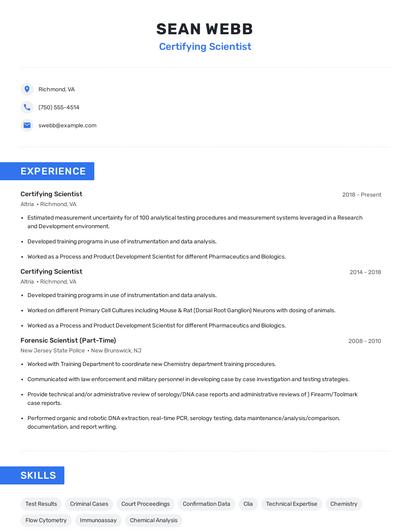
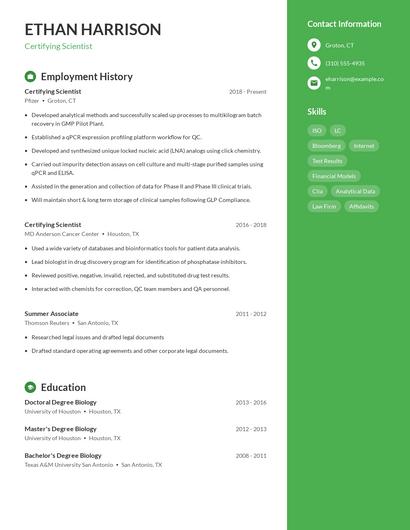
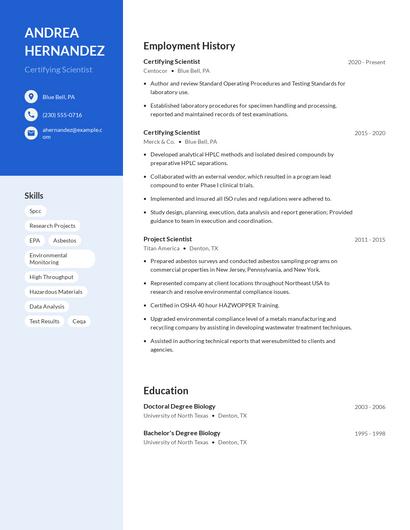
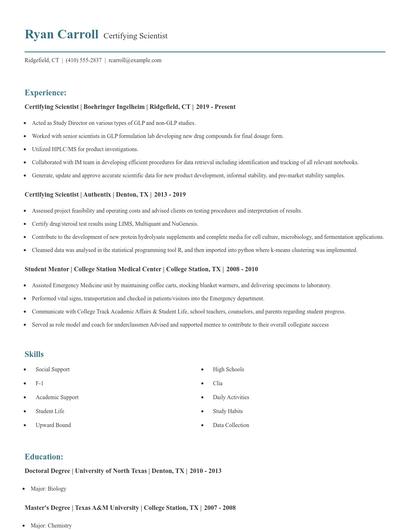
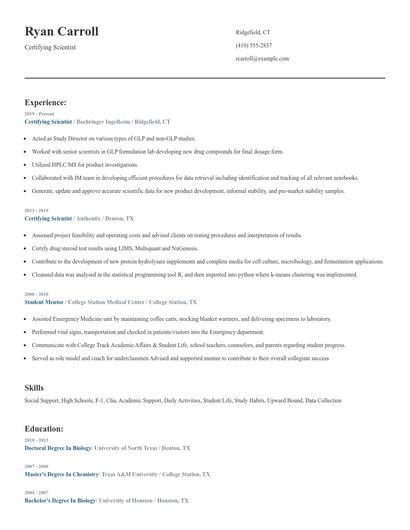
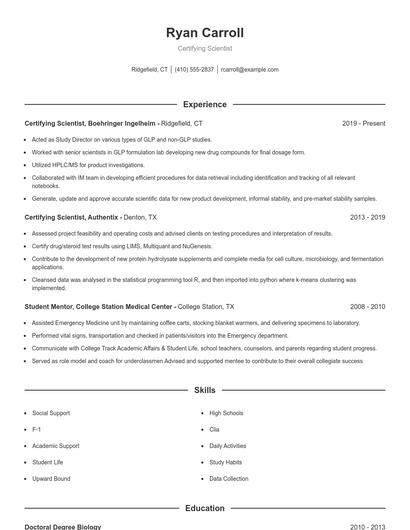
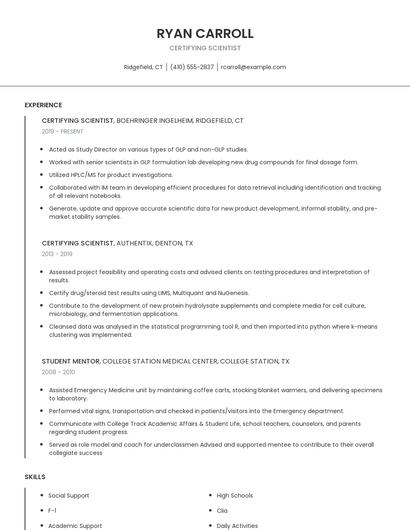
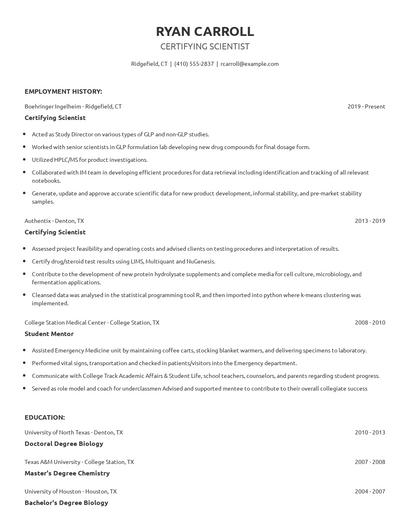
Choose from 10+ customizable certifying scientist resume templates
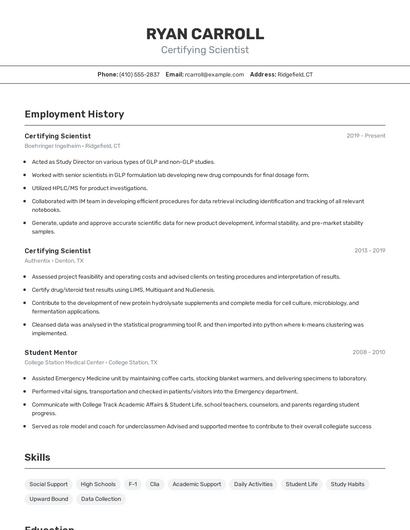
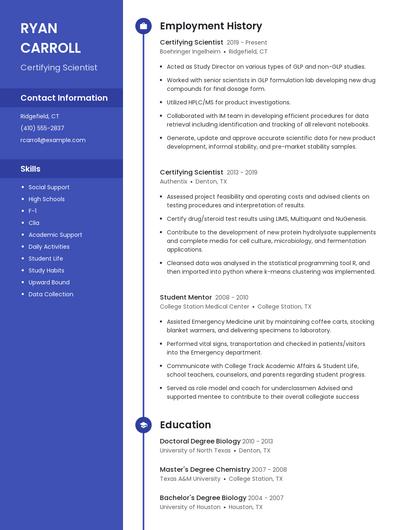
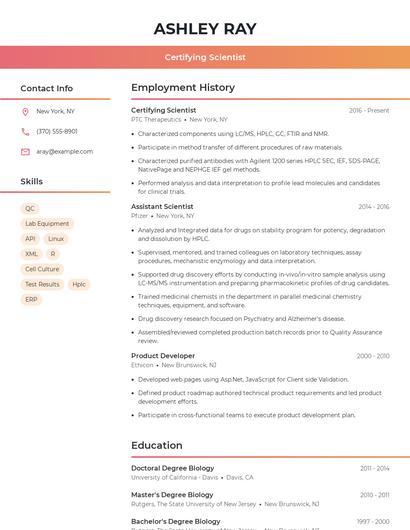
Build a professional certifying scientist resume in minutes. Our AI resume writing assistant will guide you through every step of the process, and you can choose from 10+ resume templates to create your certifying scientist resume.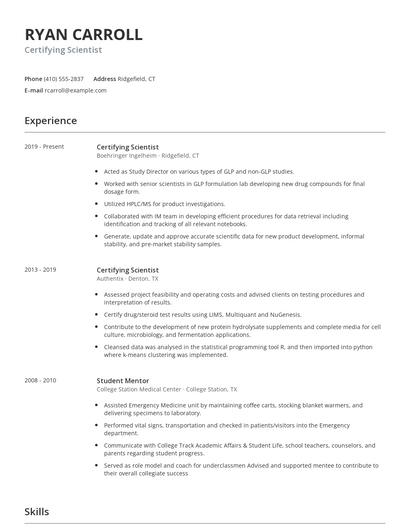
Compare different certifying scientists
Certifying scientist vs. Quality control
As the name entails, the job of a quality control inspector is to inspect, maintain, and improve the quality and standard of products. They are responsible for ensuring the company's reputation is not damaged due to defective products or inferior manufacturing processes. This can be done by detecting and resolving the problem early on, and returning the product for repair. A quality control inspector should also notify the supervisors immediately when issues arise and coordinate with them to address the problem.
These skill sets are where the common ground ends though. The responsibilities of a certifying scientist are more likely to require skills like "ms," "lc," "clia," and "samhsa." On the other hand, a job as a quality control requires skills like "quality checks," "product quality," "safety standards," and "quality standards." As you can see, what employees do in each career varies considerably.
Quality controls tend to make the most money working in the technology industry, where they earn an average salary of $36,096. In contrast, certifying scientists make the biggest average salary, $94,834, in the health care industry.The education levels that quality controls earn slightly differ from certifying scientists. In particular, quality controls are 8.0% less likely to graduate with a Master's Degree than a certifying scientist. Additionally, they're 2.1% less likely to earn a Doctoral Degree.Certifying scientist vs. Chemistry laboratory assistant
Chemical Laboratory Assistants are professionals who help researchers and scientists in performing lab experiments and tests. Their tasks involve the maintenance, cleanliness, or sterilization of laboratory equipment or instruments. They perform physical or chemical laboratory tests assisting scientists in the quantitative or qualitative analyses of liquids, gaseous materials, and solids. The necessary skills and knowledge for this job include chemistry, lab reporting, chemical solutions, and safety procedures.
In addition to the difference in salary, there are some other key differences worth noting. For example, certifying scientist responsibilities are more likely to require skills like "ms," "test results," "lc," and "gc." Meanwhile, a chemistry laboratory assistant has duties that require skills in areas such as "lab equipment," "lab safety," "chemistry lab," and "lab experiments." These differences highlight just how different the day-to-day in each role looks.
Chemistry laboratory assistants may earn a lower salary than certifying scientists, but chemistry laboratory assistants earn the most pay in the education industry with an average salary of $37,906. On the other hand, certifying scientists receive higher pay in the health care industry, where they earn an average salary of $94,834.chemistry laboratory assistants earn lower levels of education than certifying scientists in general. They're 9.0% less likely to graduate with a Master's Degree and 2.1% less likely to earn a Doctoral Degree.What technology do you think will become more important and prevalent for certifying scientists in the next 3-5 years?
Scott Johnson
Professor and Director, University of Maine
Certifying scientist vs. Quality control analyst
Quality assurance representatives are professionals who are responsible for ensuring the quality of units produced or manufactured is following the standards set by the industry. These representatives supervise the entire production process to identify erroneous methods or tools being used by workers and observing produced for visible defects. They are required to perform various tests to check for the durability of the product and other desirable characteristics. Quality assurance representatives must also collaborate with the manufacturing engineer to implement quality control programs and preparing training manuals and quality guidelines.
The required skills of the two careers differ considerably. For example, certifying scientists are more likely to have skills like "ms," "lc," "clia," and "samhsa." But a quality control analyst is more likely to have skills like "qc," "lab equipment," "microbiology," and "test methods."
Quality control analysts earn the highest salary when working in the manufacturing industry, where they receive an average salary of $62,870. Comparatively, certifying scientists have the highest earning potential in the health care industry, with an average salary of $94,834.When it comes to education, quality control analysts tend to earn similar degree levels compared to certifying scientists. In fact, they're 3.7% less likely to earn a Master's Degree, and 2.0% less likely to graduate with a Doctoral Degree.Certifying scientist vs. Quality control assistant
Quality assurance technicians work as testers, samplers, and inspectors of quality control in the organizations. They are equipped with skills in visual inspection, written and verbal communication, and active listening. In carrying out their jobs, they are expected to work well and be detail-oriented. Working as a quality assurance technician involves problem-solving, decision making, and creative thinking. They see to it that products and services meet the quality standards for the entire organization.
Even though a few skill sets overlap between certifying scientists and quality control assistants, there are some differences that are important to note. For one, a certifying scientist might have more use for skills like "ms," "lc," "clia," and "samhsa." Meanwhile, some responsibilities of quality control assistants require skills like "product quality," "quality checks," "lab equipment," and "safety standards. "
In general, quality control assistants earn the most working in the construction industry, with an average salary of $41,154. The highest-paying industry for a certifying scientist is the health care industry.quality control assistants reach lower levels of education compared to certifying scientists, in general. The difference is that they're 7.1% more likely to earn a Master's Degree, and 2.7% less likely to graduate with a Doctoral Degree.Types of certifying scientist
Updated January 8, 2025
