What does a chemist lead do?
A Chemist Lead is responsible for conducting qualitative and quantitative chemical analyses and experiments. They generally work in laboratories.
Chemist lead responsibilities
Here are examples of responsibilities from real chemist lead resumes:
- Manage an analytical laboratory, which include SEM-EDS, GC-MS, GPC, FT-IR, ICP-MS, TGA and DSC equipment.
- Ensure FDA and ISO certification due to attention to detail.
- Prepare testing protocols for raw materials, finish products, and APIs utilizing classical wet chemistry and HPLC techniques.
- Use LIMS system to input data.
- Learned how to troubleshoot/maintain ICP-MS instruments.
- Evaluate and propose changes to existing USP test methodologies.
- Change columns on GC's base on the requirements of different blends.
- Create a method for analyzing HBED and iron compound in animal urine via HPLC.
- Follow all procedures and maintain documentation for all pharmaceuticals in compliance with FDA regulations.
- Perform routine maintenance/troubleshooting on 5890 GC's with FID, PID, and ECD detectors.
- Assess updates to various analytical and microbiological procedures base on current USP and EP rules.
- Implement LIMS QA system in organic chemistry division and are the first person to learn it.
- Review, report and ensure that all laboratory tests are properly perform and report in accordance to laboratory and ISO specifications.
- Participate in the company wide effort to promote quality assurance in compliance with ISO 9001, ISO 14001 and OHSA 18001.
- Implement micro FTIR system to determine failures in electrical components due to micro-contamination.
Chemist lead skills and personality traits
We calculated that 13% of Chemist Leads are proficient in Laboratory Instruments, Analytical Methods, and R. They’re also known for soft skills such as Analytical skills, Communication skills, and Math skills.
We break down the percentage of Chemist Leads that have these skills listed on their resume here:
- Laboratory Instruments, 13%
Calibrate and perform Quality Control checks of laboratory instruments.
- Analytical Methods, 7%
Train chemists and laboratory technicians on analytical methods.
- R, 6%
Used R, SSL, and SQL programming to identify and fix multiple processing and GUI problems with StarLIMS v9.
- Method Development, 5%
Conducted GC and GC/MS troubleshooting, maintenance, and method development on a routine basis.
- Lab Equipment, 5%
Performed lab equipment maintenance, daily check and scheduled monthly and annual calibration.
- HPLC, 4%
Conducted over 250,000 analysis using HPLC, GC/MS, GC/ECD, NMR, and other advanced scientific equipment.
Common skills that a chemist lead uses to do their job include "laboratory instruments," "analytical methods," and "r." You can find details on the most important chemist lead responsibilities below.
Analytical skills. The most essential soft skill for a chemist lead to carry out their responsibilities is analytical skills. This skill is important for the role because "chemists and materials scientists need to evaluate the results of experiments to ensure accuracy in their research." Additionally, a chemist lead resume shows how their duties depend on analytical skills: "maintain data integrity and ensure compliance with company sops and specifications, fda, glp, qsr and cgmp regulations. "
Communication skills. Many chemist lead duties rely on communication skills. "chemists and materials scientists must be able to convey information clearly in reports and presentations for both technical and nontechnical audiences.," so a chemist lead will need this skill often in their role. This resume example is just one of many ways chemist lead responsibilities rely on communication skills: "conduct osha hazard communication and dot hazard materials training to all facility chemists. "
Math skills. chemist leads are also known for math skills, which are critical to their duties. You can see how this skill relates to chemist lead responsibilities, because "chemists and materials scientists regularly use calculus, algebra, statistics, and other math for calculations." A chemist lead resume example shows how math skills is used in the workplace: "prepared and executed study plans, sample preparation and quantitative analysis of air monitoring samples. "
Organizational skills. For certain chemist lead responsibilities to be completed, the job requires competence in "organizational skills." The day-to-day duties of a chemist lead rely on this skill, as "chemists and materials scientists must document processes carefully when conducting experiments, tracking outcomes, and analyzing results." For example, this snippet was taken directly from a resume about how this skill applies to what chemist leads do: "well versed in implementing standard operating procedures, organizational policies, and analytical methodologies accurately and consistently. "
Problem-solving skills. A commonly-found skill in chemist lead job descriptions, "problem-solving skills" is essential to what chemist leads do. Chemist lead responsibilities rely on this skill because "chemists’ and materials scientists’ work involves posing questions during research and finding answers through results." You can also see how chemist lead duties rely on problem-solving skills in this resume example: "provide analytical chemistry support and technical solutions to multiple departments. "
Time-management skills. Another skill commonly found on chemist lead job descriptions is "time-management skills." It can come up quite often in chemist lead duties, since "chemists and materials scientists usually need to meet deadlines and must be able to prioritize tasks while maintaining quality." Here's an example from a resume of how this skill fits into day-to-day chemist lead responsibilities: "interpret, quantify, and report data using lims system and coordinate with project managers to meet deadlines. "
The three companies that hire the most chemist leads are:
- Eurofins2 chemist leads jobs
- Henkel1 chemist leads jobs
- Food Safety Net Services1 chemist leads jobs
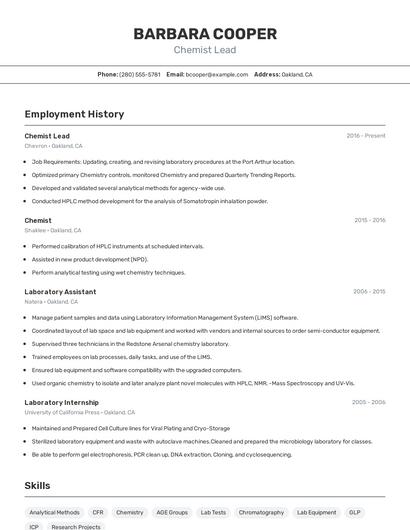
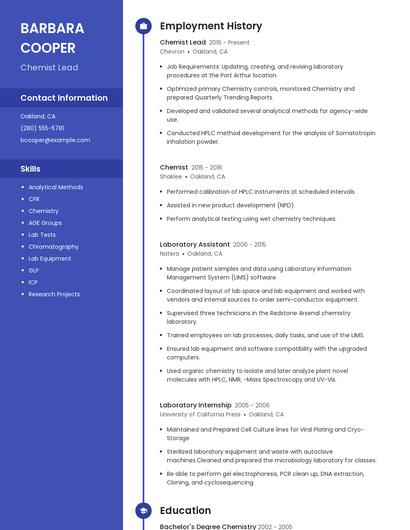
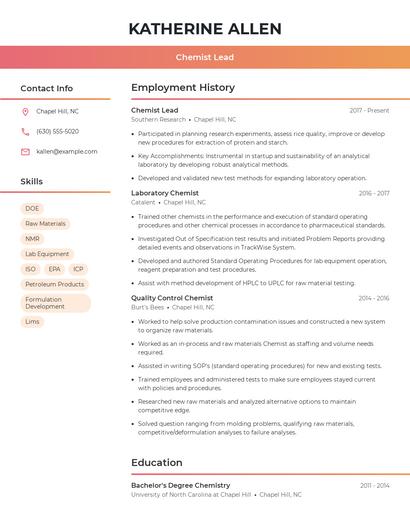
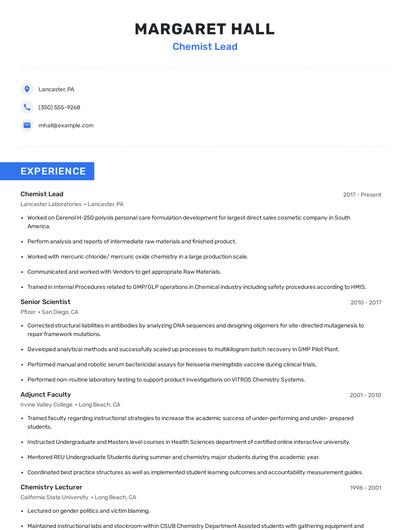
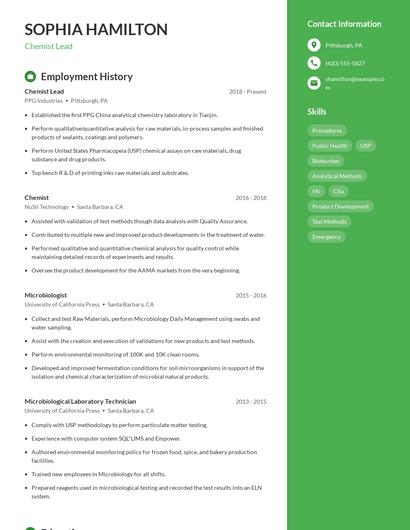
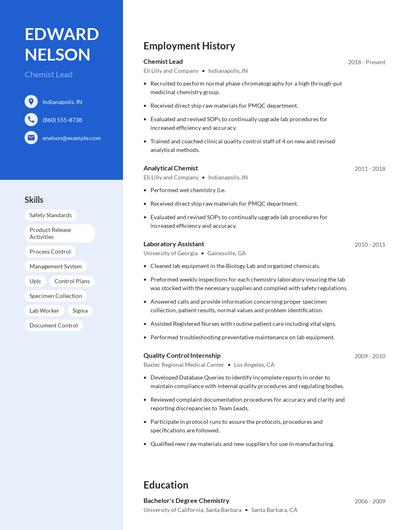
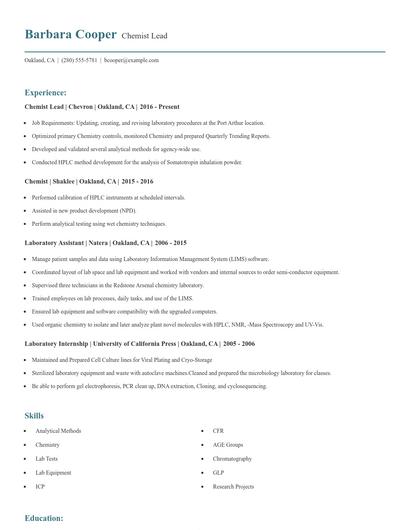
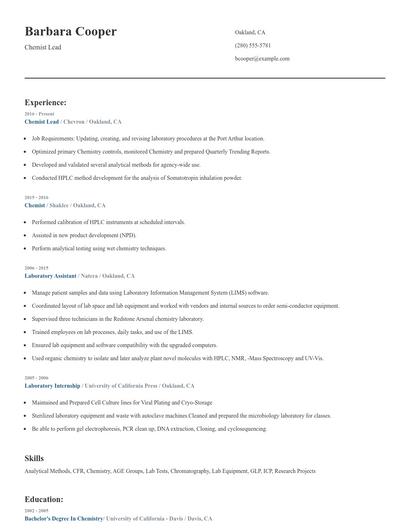
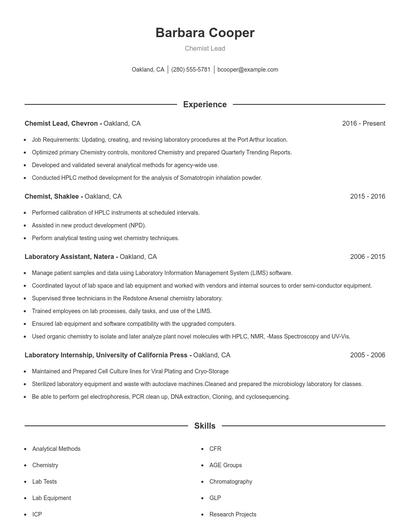
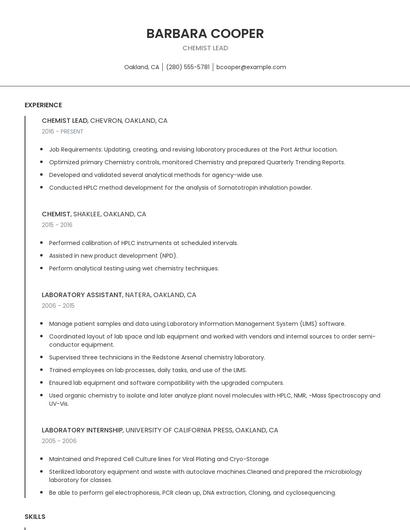
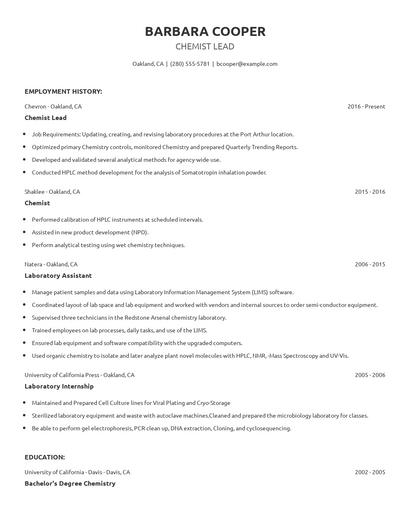
Choose from 10+ customizable chemist lead resume templates
Build a professional chemist lead resume in minutes. Our AI resume writing assistant will guide you through every step of the process, and you can choose from 10+ resume templates to create your chemist lead resume.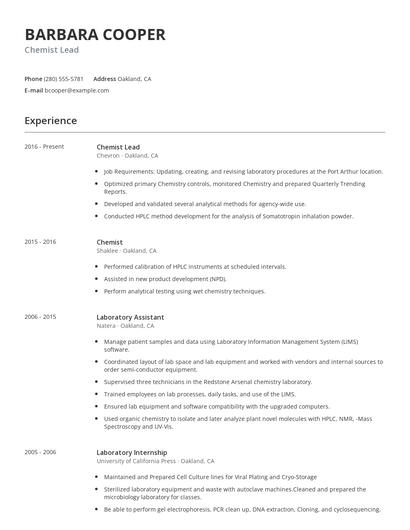
Compare different chemist leads
Chemist lead vs. Research and development chemist
A research and development chemist primarily works at laboratories to conduct extensive tests and experiments aiming to develop new products and technologies. Although the extent of their duties may vary, it typically revolves around conducting research and studies, observing chemical reactions, maintaining records and databases, collaborating with fellow experts, and identifying the strengths and weaknesses of existing components or mixtures. They can find employment in different areas, such as manufacturing companies, private laboratories, government agencies, and even education.
There are some key differences in the responsibilities of each position. For example, chemist lead responsibilities require skills like "laboratory instruments," "lab equipment," "analytical procedures," and "chemical analysis." Meanwhile a typical research and development chemist has skills in areas such as "product development," "laboratory equipment," "synthesis," and "d chemist." This difference in skills reveals the differences in what each career does.
Research and development chemists really shine in the health care industry with an average salary of $82,941. Comparatively, chemist leads tend to make the most money in the health care industry with an average salary of $96,666.research and development chemists tend to reach similar levels of education than chemist leads. In fact, research and development chemists are 4.8% more likely to graduate with a Master's Degree and 0.6% less likely to have a Doctoral Degree.Chemist lead vs. Product development chemist
An Analytical Research Chemist works on analyzing and interpreting data generated from experiments to aid other research. They organize and produce reports and findings, which scientists will use to create principles, ideas, and strategies in the scientific field. Included in a research chemist's primary responsibilities are the maintenance of the laboratory, organizing documents, and inventory of supplies and equipment.
While some skills are similar in these professions, other skills aren't so similar. For example, resumes show us that chemist lead responsibilities requires skills like "laboratory instruments," "analytical procedures," "gc," and "ms." But a product development chemist might use other skills in their typical duties, such as, "product development," "qc," "stability studies," and "icp."
Product development chemists earn a lower average salary than chemist leads. But product development chemists earn the highest pay in the manufacturing industry, with an average salary of $84,696. Additionally, chemist leads earn the highest salaries in the health care with average pay of $96,666 annually.In general, product development chemists achieve similar levels of education than chemist leads. They're 3.4% more likely to obtain a Master's Degree while being 0.6% less likely to earn a Doctoral Degree.What technology do you think will become more important and prevalent for chemist leads in the next 3-5 years?
Dr. Betsy Smith
Assistant Professor of Chemistry, Elmira College
Chemist lead vs. Analytical research chemist
Quality Assurance Chemists generally offer pay of around $54K per year and require strong skills in analysis and instrumentation and general knowledge of chemistry, attention to detail, and various organizational skills. Also, they must be able to investigate and analyze problems whenever they crop up. This career choice requires a bachelor's or advanced degree in chemistry, depending on the industry, and will often be offered in pharmaceutical fields, where standard duties consist of the measurement and testing of lab materials and products according to industry standards.
There are many key differences between these two careers, including some of the skills required to perform responsibilities within each role. For example, a chemist lead is likely to be skilled in "analytical methods," "method development," "lab equipment," and "analytical procedures," while a typical analytical research chemist is skilled in "analytical techniques," "product development," "lc-ms," and "technical reports."
When it comes to education, analytical research chemists tend to earn higher degree levels compared to chemist leads. In fact, they're 6.6% more likely to earn a Master's Degree, and 0.9% more likely to graduate with a Doctoral Degree.Chemist lead vs. Quality assurance chemist
Even though a few skill sets overlap between chemist leads and quality assurance chemists, there are some differences that are important to note. For one, a chemist lead might have more use for skills like "laboratory instruments," "analytical procedures," "analytical support," and "analytical chemistry." Meanwhile, some responsibilities of quality assurance chemists require skills like "test results," "icp," "food safety," and "corrective action. "
In general, quality assurance chemists earn the most working in the finance industry, with an average salary of $84,734. The highest-paying industry for a chemist lead is the health care industry.In general, quality assurance chemists hold similar degree levels compared to chemist leads. Quality assurance chemists are 0.7% more likely to earn their Master's Degree and 3.8% less likely to graduate with a Doctoral Degree.Types of chemist lead
Updated January 8, 2025
