What does a chemist scientist do?
The main role of chemist scientists is to investigate the properties of matter in terms of molecules and atoms. The scientists measure the reaction rates and proportions to have a better understanding of unfamiliar substances and their behavior. They study how these substances may create new compounds for various practical applications. Their job is to introduce the chemical catalysts for qualitative and quantitative analysis. Also, they write reports and technical papers.
Chemist scientist responsibilities
Here are examples of responsibilities from real chemist scientist resumes:
- Assume larger role in managing ELISA plate trials to establish optimal antigen dilutions for large-scale plate jobs.
- Continue role in managing ELISA plate trials to select proper antigen coating factors for large-scale plate jobs.
- Conduct testing on raw material and on in process samples by conducting IR, UV/VIS, KF moisture, quantitative titrations.
- Involve in several ongoing projects to develop methods for HPLC, GPC, GC, GC-MS, FT-IR and other techniques.
- Perform internal calibrations of HPLC, GC and lab instruments on a regular basis.
- Analyze raw materials, compatibility study samples, in process, finish products and analytical sample under GLP.
- Perform GMP pharmaceutical analysis on in-process, process validation, control substances, finish product and stability pharmaceutical drugs.
- Collaborate effectively with laboratory and manufacturing teams in properly reworking and adjusting OOS batches to bring them to specifications.
- Provide calculated electronic absorption (UV/Vis) spectra for molecular candidates suspect to be impurity chromophores in a commercial nylon process.
- Engage in detail sophisticated evaluations/examinations, identify compounds using infrare spectroscopy/gas chromatography.
- Engage in detail sophisticated evaluations/examinations, identify compounds using infrare spectroscopy/gas chromatography.
Chemist scientist skills and personality traits
We calculated that 8% of Chemist Scientists are proficient in HPLC, UV/Vis, and R. They’re also known for soft skills such as Analytical skills, Interpersonal skills, and Math skills.
We break down the percentage of Chemist Scientists that have these skills listed on their resume here:
- HPLC, 8%
Implemented established EPA, FDA and SSSA methods IR spectroscopy HPLC-MS HPLC GC Extensive field work -soil sampling.
- UV/Vis, 7%
Performed the potency studies, dissolution, and uniformity, by using HPLC, GC, and UV/VIS.
- R, 6%
Designed R-statistical algorithms and wrote R codes to develop numerical regression.
- FDA, 6%
Redesigned and validated an apparatus to improve the effectiveness of low dosage metered inhaler testing that received FDA approval in 2000
- NMR, 6%
Provided technical consultation/service/training regarding NMR analysis and data interpretation.
- Test Results, 5%
Conducted DNA extractions and staining from the tissues and analyzed the test results on a flowcytometer.
Most chemist scientists use their skills in "hplc," "uv/vis," and "r" to do their jobs. You can find more detail on essential chemist scientist responsibilities here:
Analytical skills. To carry out their duties, the most important skill for a chemist scientist to have is analytical skills. Their role and responsibilities require that "chemists and materials scientists need to evaluate the results of experiments to ensure accuracy in their research." Chemist scientists often use analytical skills in their day-to-day job, as shown by this real resume: "sample collection, cataloging, analysis and storage. "
Interpersonal skills. Many chemist scientist duties rely on interpersonal skills. "chemists and materials scientists typically work on teams and need to be cooperative," so a chemist scientist will need this skill often in their role. This resume example is just one of many ways chemist scientist responsibilities rely on interpersonal skills: "team oriented professional with excellent interpersonal and communication skills. "
Math skills. Another skill that relates to the job responsibilities of chemist scientists is math skills. This skill is critical to many everyday chemist scientist duties, as "chemists and materials scientists regularly use calculus, algebra, statistics, and other math for calculations." This example from a resume shows how this skill is used: "conducted testing on raw material and on in process samples by conducting ir, uv/vis, kf moisture, quantitative titrations. "
Organizational skills. For certain chemist scientist responsibilities to be completed, the job requires competence in "organizational skills." The day-to-day duties of a chemist scientist rely on this skill, as "chemists and materials scientists must document processes carefully when conducting experiments, tracking outcomes, and analyzing results." For example, this snippet was taken directly from a resume about how this skill applies to what chemist scientists do: "established multiple preclinical models to test new approaches to treat viral infections, including organizational design of experiments and data analysis. "
Problem-solving skills. Another common skill required for chemist scientist responsibilities is "problem-solving skills." This skill comes up in the duties of chemist scientists all the time, as "chemists’ and materials scientists’ work involves posing questions during research and finding answers through results." An excerpt from a real chemist scientist resume shows how this skill is central to what a chemist scientist does: "worked for impurities method development, dissolution -profile method, dissolution method, assay method and disintegration method of new consumer-product. "
Time-management skills. While "time-management skills" is last on this skills list, don't underestimate its importance to chemist scientist responsibilities. Much of what a chemist scientist does relies on this skill, seeing as "chemists and materials scientists usually need to meet deadlines and must be able to prioritize tasks while maintaining quality." Here is a resume example of how this skill is used in the everyday duties of chemist scientists: "achieved aggressive deadlines for compound synthesis to enable numerous biological assays and studies to be performed in an efficient manner. "
The three companies that hire the most chemist scientists are:
- Exponent2 chemist scientists jobs
- Dana-Farber Cancer Institute2 chemist scientists jobs
- Entegris1 chemist scientists jobs
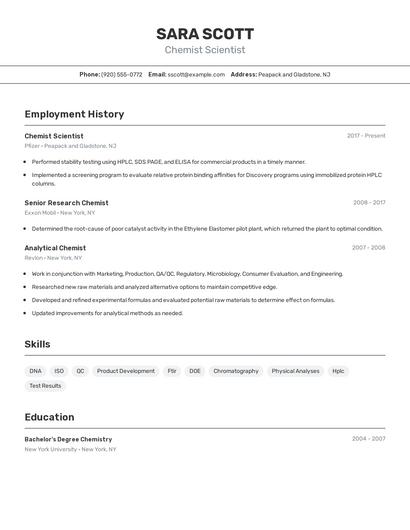
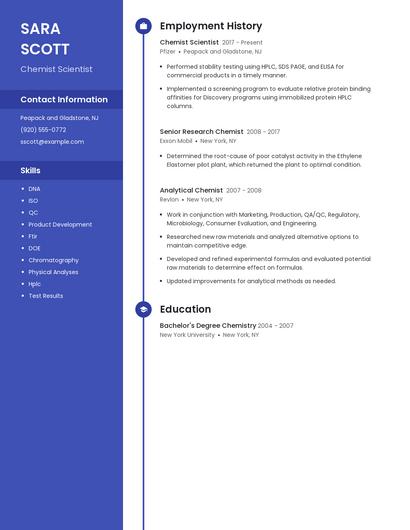
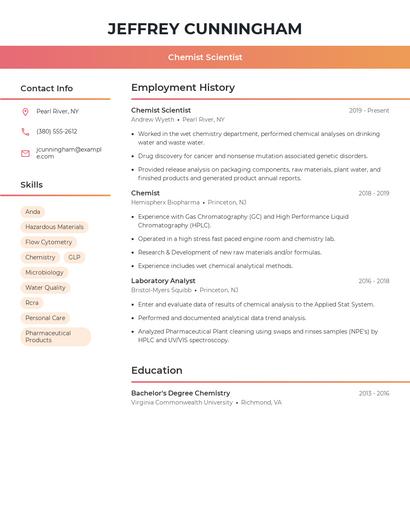
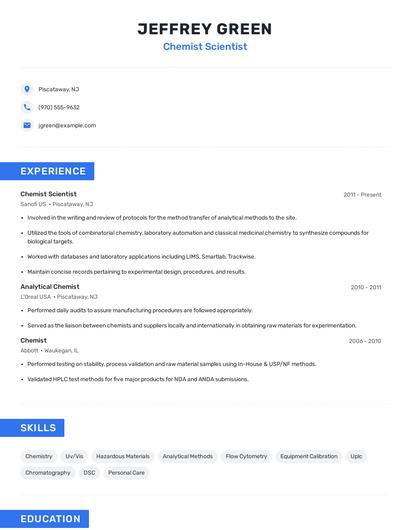
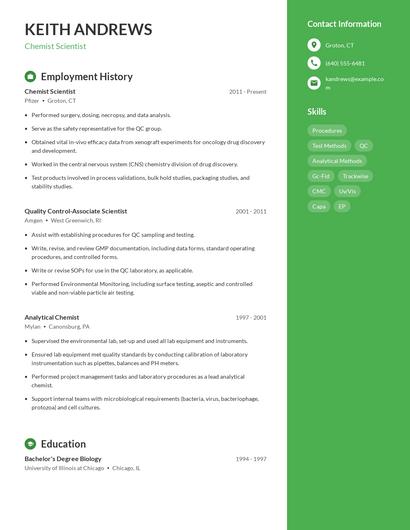
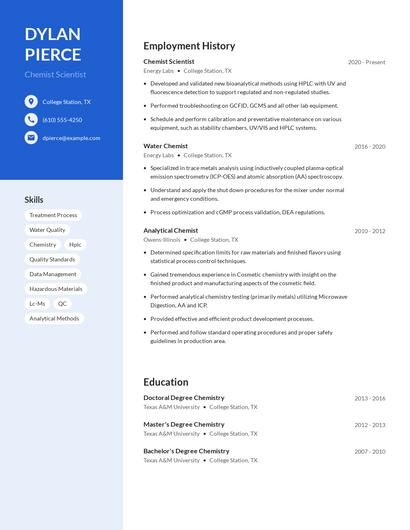
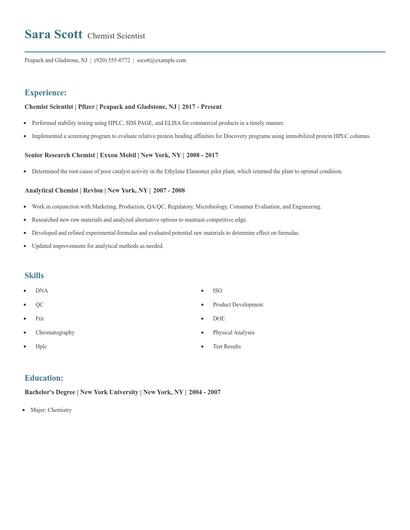
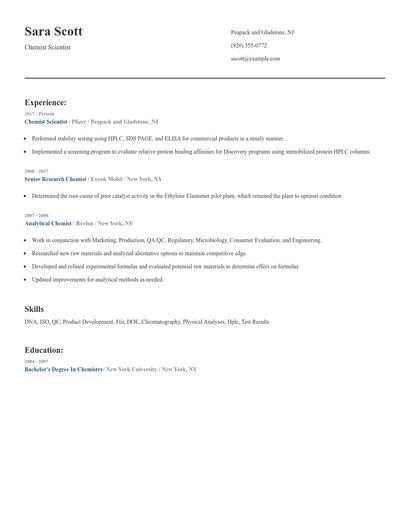
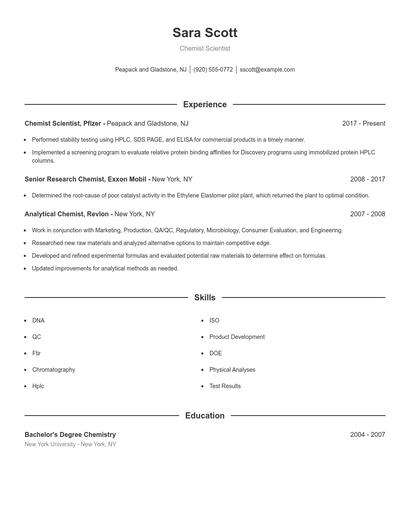
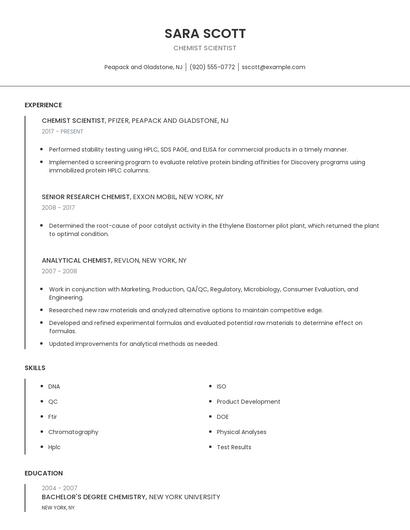
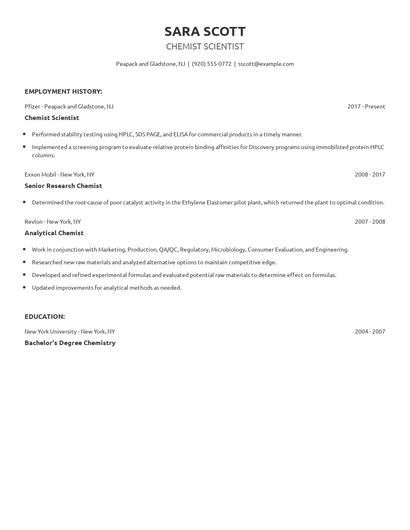
Choose from 10+ customizable chemist scientist resume templates
Build a professional chemist scientist resume in minutes. Our AI resume writing assistant will guide you through every step of the process, and you can choose from 10+ resume templates to create your chemist scientist resume.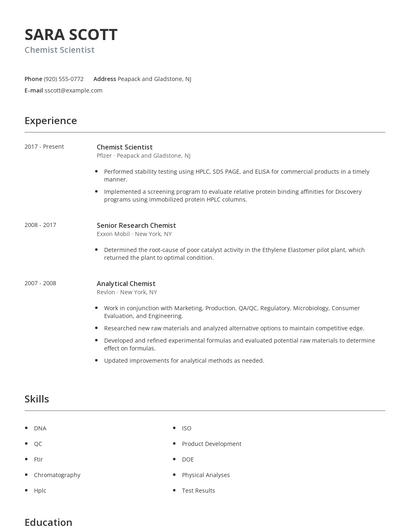
Compare different chemist scientists
Chemist scientist vs. Laboratory analyst
A Laboratory Analyst helps conduct experiments, run laboratory tests, and analyze results. They compile and record data for the documentation needed for testing and report preparation.
These skill sets are where the common ground ends though. The responsibilities of a chemist scientist are more likely to require skills like "laboratory practices," "nmr," "gc-ms," and "epa." On the other hand, a job as a laboratory analyst requires skills like "lab equipment," "laboratory procedures," "sample preparation," and "math." As you can see, what employees do in each career varies considerably.
Laboratory analysts earn the highest salaries when working in the pharmaceutical industry, with an average yearly salary of $47,806. On the other hand, chemist scientists are paid more in the technology industry with an average salary of $90,595.On average, laboratory analysts reach lower levels of education than chemist scientists. Laboratory analysts are 11.5% less likely to earn a Master's Degree and 5.3% less likely to graduate with a Doctoral Degree.Chemist scientist vs. Quality control
As the name entails, the job of a quality control inspector is to inspect, maintain, and improve the quality and standard of products. They are responsible for ensuring the company's reputation is not damaged due to defective products or inferior manufacturing processes. This can be done by detecting and resolving the problem early on, and returning the product for repair. A quality control inspector should also notify the supervisors immediately when issues arise and coordinate with them to address the problem.
While some skills are similar in these professions, other skills aren't so similar. For example, resumes show us that chemist scientist responsibilities requires skills like "laboratory practices," "uv/vis," "nmr," and "wet chemistry." But a quality control might use other skills in their typical duties, such as, "quality checks," "product quality," "safety standards," and "laboratory equipment."
Quality controls may earn a lower salary than chemist scientists, but quality controls earn the most pay in the technology industry with an average salary of $36,096. On the other hand, chemist scientists receive higher pay in the technology industry, where they earn an average salary of $90,595.quality controls earn lower levels of education than chemist scientists in general. They're 12.9% less likely to graduate with a Master's Degree and 5.3% less likely to earn a Doctoral Degree.What technology do you think will become more important and prevalent for chemist scientists in the next 3-5 years?
Dr. Betsy Smith
Assistant Professor of Chemistry, Elmira College
Chemist scientist vs. Microbiologist
Microbiologists are responsible for studying the microscopic organisms causing infections and environmental damage, including bacteria, viruses, and fungi. Their work focuses on the identification and growth of these microbes to better understand their characteristics that may help in the diagnosis, treatment, and prevention of infectious and bacterial diseases. They use sophisticated technologies and machinery to study microbes and perform their tasks. These scientists are also responsible for developing best practices and techniques for routine sampling and research. Microbiologists may work in various settings, including laboratories, research institutes, and hospitals.
Some important key differences between the two careers include a few of the skills necessary to fulfill the responsibilities of each. Some examples from chemist scientist resumes include skills like "laboratory practices," "uv/vis," "nmr," and "wet chemistry," whereas a microbiologist is more likely to list skills in "lab equipment," "microbiology lab," "environmental monitoring," and "laboratory procedures. "
Microbiologists earn the best pay in the pharmaceutical industry, where they command an average salary of $57,911. Chemist scientists earn the highest pay from the technology industry, with an average salary of $90,595.Most microbiologists achieve a lower degree level compared to chemist scientists. For example, they're 5.7% less likely to graduate with a Master's Degree, and 3.5% less likely to earn a Doctoral Degree.Chemist scientist vs. Quality control associate
In a manufacturing setting, a quality control associate is in charge of conducting various tests to ensure that the products meet the company's standard criteria. Their responsibilities revolve around inspecting the workforce and workload involved in the production process, identifying errors or inconsistencies, recommending solutions and alterations, and maintaining records and documentation. Furthermore, as a quality control associate, it is essential to coordinate with department staff and produce progress reports, all while adhering to the company's policies and regulations.
Types of chemist scientist
Updated January 8, 2025
