
Automatically apply for jobs with Zippia
Upload your resume to get started.
Children's service worker skills for your resume and career
15 children's service worker skills for your resume and career
2. Foster Care
- Managed foster Care caseload of approximately 30-40 cases consistently and ensured records were compliant with state regulation.
- Facilitated training for interested foster care providers and relative family members.
3. Law Enforcement
Law enforcement is the task of certain members of the community who work together to uphold the law by identifying, preventing, rehabilitating, or prosecuting others who break society's laws and norms. The phrase refers to the police, the judiciary, and the correctional system.
- Direct involvement with practitioners including educational staff, medical personnel, law enforcement, and judicial system.
- Investigated and determined, in conjunction with law enforcement, incidents of child/adolescent physical/sexual abuse and neglect.
4. Community Resources
Community resources are a set of resources that are used in the day to day life of people which improves their lifestyle in some way. People, sites or houses, and population assistance can come under the services offered by community resources.
- Assist in the development and implementation of regional plan to recruit potential foster/adoptive families; identify additional community resources.
- Aided in the family-focused assessment process and identified community resources to help stabilize and strengthen families experiencing crisis.
5. Substance Abuse
- Make appropriate referrals to other service providers (i.e., psychological, domestic violence, and substance abuse services).
- Reunified multiple families with their children despite clients' mental health and substance abuse challenges.
6. Protective Services
Protective services are services offered to vulnerable individuals or legal representatives to protect them against potential abuse, violence, or negligence. Protective services are offered to ensure that an individual's safety stays intact and they don't fall victim to crime or exploitation. Such services include, social casework, stated appointed witness protection, home care, legal assistance, day-care etc.
- Deliver and coordinate protective services involving neglected, abused or exploited children.
- Investigate and evaluate allegations made in Protective Services Referrals.
Choose from 10+ customizable children's service worker resume templates
Build a professional children's service worker resume in minutes. Our AI resume writing assistant will guide you through every step of the process, and you can choose from 10+ resume templates to create your children's service worker resume.7. Crisis Intervention
- Investigated reports of abuse, neglect, and/or exploitation of children and delivered/coordinated protective and crisis intervention services.
- Assessed and assisted staff in clinical supervision to make difficult decisions including crisis interventions.
8. Court Reports
- Documented evidence, prepared court reports and presented testimony in Family Court.
- Experienced with writing court reports and extensive documentation.
10. Mental Health
Mental health is the state of wellbeing in which an individual can cope with the regular stresses and tensions of life, and can work productively without having any emotional or psychological breakdown. Mental health is essential for a person of any age and helps them make the right decisions in their life.
- Prepared successful agency grant application to provide innovative mental health services to the Hispanic community, specifically targeting migrant workers.
- Referred families to services-such as FAIR, mental health counseling, parenting training, and YWCA for domestic violence counseling.
11. Child Protective
- CONCORD, NH Child Protective Service Worker II * Investigation and treatment of child abuse and neglect reports.
- Employed at the Child Advocacy Center as a Child Protective Service Investigator of sex abuse allegations.
12. Sexual Abuse
- Conduct interviews with children and adults including forensic interviews concerning sexual abuse.
- Conduct validating interview of sexual abuse investigations.
13. Court Hearings
- Prepared necessary court documentation, filed petitions, testified in court hearings and discussed legal strategies with supervisor.
- Conducted routine home visitations, attended court hearings, and supervised family visitations.
14. Community Agencies
Community agencies stand for the organizations operated to provide human service in the community.
- Consulted with other community agencies and other interested parties to determine the validity of abuse/neglect complaints to determine service needs.
- Work collaboratively with community agencies to provide the supportive services needed for each individual case.
15. Juvenile Court
- Addressed Juvenile Court regarding case progress, advising Magistrates of needed services and recommendations from licensed clinicians.
- File petitions with the Juvenile Court regarding educational rights, termination of dependency, and psychotropic medication.
5 Children's Service Worker resume examples
Build a professional children's service worker resume in minutes. Browse through our resume examples to identify the best way to word your resume. Then choose from 5+ resume templates to create your children's service worker resume.

What skills help Children's Service Workers find jobs?
Tell us what job you are looking for, we’ll show you what skills employers want.
What skills stand out on children's service worker resumes?
Dr. Florence DiGennaro Reed Ph.D.
Associate Professor and Chairperson, Director of the Performance Management Laboratory, University of Kansas
What soft skills should all children's service workers possess?
Dr. Dianna Cooper
Associate Professor, Campbellsville University
What hard/technical skills are most important for children's service workers?
Dr. Dianna Cooper
Associate Professor, Campbellsville University
What children's service worker skills would you recommend for someone trying to advance their career?
Lillian Wichinsky Ph.D.
Associate Dean, University of Nevada - Reno
What type of skills will young children's service workers need?
M Elizabeth Bowman Ph.D.
Instructor, Gallaudet University
List of children's service worker skills to add to your resume
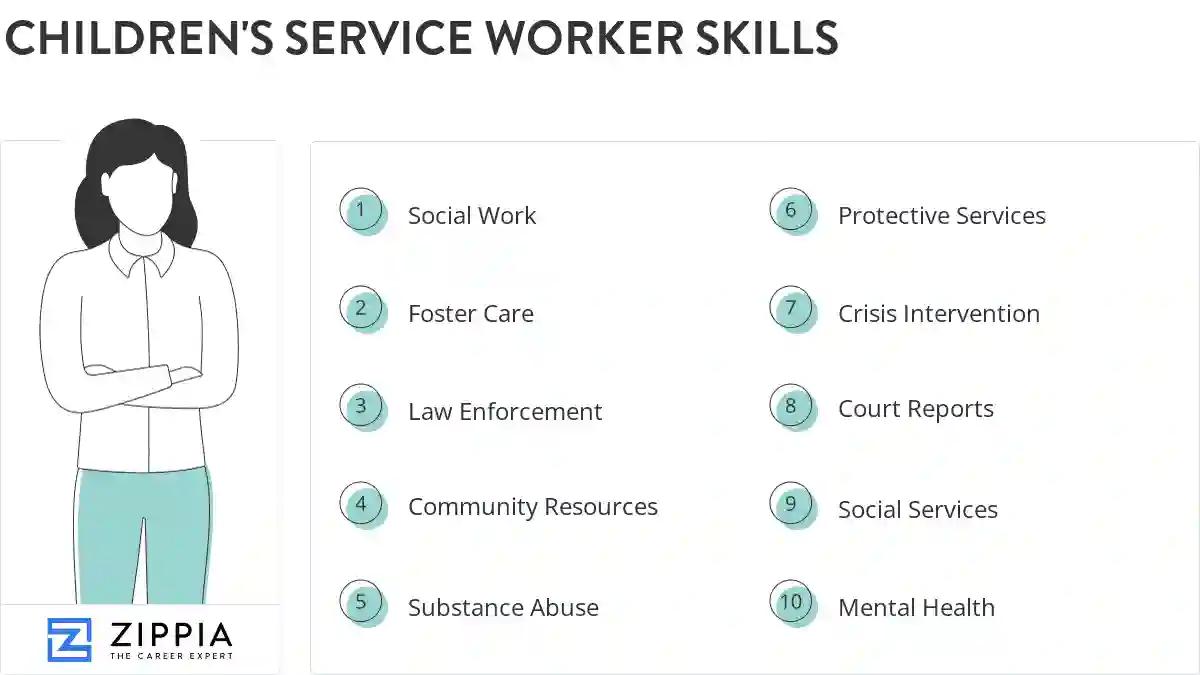
The most important skills for a children's service worker resume and required skills for a children's service worker to have include:
- Social Work
- Foster Care
- Law Enforcement
- Community Resources
- Substance Abuse
- Protective Services
- Crisis Intervention
- Court Reports
- Social Services
- Mental Health
- Child Protective
- Sexual Abuse
- Court Hearings
- Community Agencies
- Juvenile Court
- Community Organizations
- Family Services
- Domestic Violence
- Support Services
- Treatment Services
- Family Court
- Court Orders
- Behavioral Problems
- CPS
- Risk Assessments
- Biological Parents
- Community Services
- Family Care
- Risk Factors
- Neglect Cases
- Court System
- Home Management
- Medical Professionals
- Child Care
- Foster Children
- Client Homes
- Court Proceedings
- Protective Custody
- Family Assessments
- Adoptive Homes
- Family Reunification
- Physical Abuse
- Imminent Risk
- Court Officials
- Child Safety
- Court Testimony
- Court Intervention
Updated January 8, 2025

1. Social Work