
Automatically apply for jobs with Zippia
Upload your resume to get started.
Classification officer skills for your resume and career
15 classification officer skills for your resume and career
1. Telephone Inquiries
- Responded to inmate requests, correspondence and telephone inquiries from family, law enforcement and attorneys.
- Responded to inmate requests, correspondence and telephone inquiries.
2. Correctional Facilities
- Maintain the safety of inmates and staff at correctional facilities and detention centers.
3. Background Checks
- Performed approved criminal history background checks both inter and intrastate levels.
- Conduct interviews and background checks to facilitate decision-making process.
4. Mental Health
Mental health is the state of wellbeing in which an individual can cope with the regular stresses and tensions of life, and can work productively without having any emotional or psychological breakdown. Mental health is essential for a person of any age and helps them make the right decisions in their life.
- Coordinated security, medical, mental health, educational, religious, and work assignment issues with appropriate department personnel.
- Classify inmates as to custody, job assignments, mental health, technical and educational programs.
5. Classification System
- Assisted in the implementation of a new fact based classification system to house inmates more objectively.
- Prepared inmates for Status using the Objective Classification System, assigned Jobs and Transfers.
6. Law Enforcement Agencies
- Communicated effectively with federal, state, and local law enforcement agencies to verify pending and closed charges.
- Collaborate with legal staff, MD State's Attorney Office and other law enforcement agencies.
Choose from 10+ customizable classification officer resume templates
Build a professional classification officer resume in minutes. Our AI resume writing assistant will guide you through every step of the process, and you can choose from 10+ resume templates to create your classification officer resume.7. Classification Committee
- Prepare supporting documentation in order for the classification committee to determine custody requirements, living assignments and many other issues.
- Serve on classification/reclassification committees to determine living arrangements, security classification, & rehabilitation & educational needs of inmates.
8. Disciplinary Hearings
- Conducted inmate disciplinary hearings and determined outcomes/sanctions/restrictions.
- Conduct and investigate disciplinary hearings and determine what punishment is deemed necessary.
9. Court Hearings
- Transported inmates to and from Dr and court hearings.
- Network with programs that can help the inmates reentry back into society, setup out to court hearings.
11. Release Dates
- Processed warrant checks, photography, and documentation of inmate release dates.
- Determined work duties and calculated release dates for Orange County inmates.
12. Program Participation
- Interview inmates on what they want to achieve and help assist them in any and all program participation while institutionalized.
13. Classification Process
- Assured proper custody status assignment using Objective Classification process.
- Monitor all phases of the classification process to ensure compliance with applicable rules & regulation.
14. Direct Supervision
Direct supervision is a term used to indicate that a person is supervising a certain task or a certain person while being physically present or in close proximity. It refers to the presence of a person and the availability of their supervision in something if it is needed.
- Interview and classify inmates to direct supervision housing units based on past criminal and behavioral history.
- Protect the facility and citizens of Gwinnett County through reporting and watching over inmates via video and/or direct supervision.
15. Court Orders
- Interpreted and applied court orders and state codes; maintained and updated inmate records.
- Interpreted and applied court orders and state codes.
5 Classification Officer resume examples
Build a professional classification officer resume in minutes. Browse through our resume examples to identify the best way to word your resume. Then choose from 5+ resume templates to create your classification officer resume.

What skills help Classification Officers find jobs?
Tell us what job you are looking for, we’ll show you what skills employers want.
List of classification officer skills to add to your resume
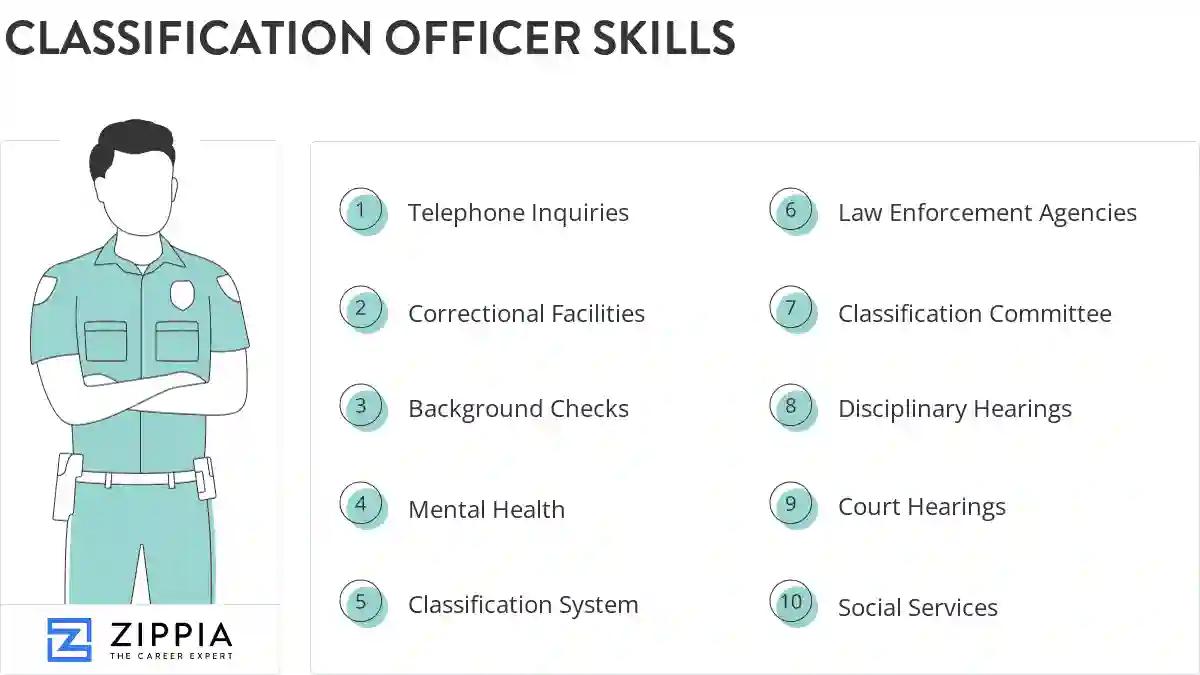
The most important skills for a classification officer resume and required skills for a classification officer to have include:
- Telephone Inquiries
- Correctional Facilities
- Background Checks
- Mental Health
- Classification System
- Law Enforcement Agencies
- Classification Committee
- Disciplinary Hearings
- Court Hearings
- Social Services
- Release Dates
- Program Participation
- Classification Process
- Direct Supervision
- Court Orders
- Public Officials
- Assess Risk
- Computer System
- Statistical Data
- CPR
- Head Counts
- ACA
- Rehabilitation Plans
- Protective Custody
Updated January 8, 2025

10. Social Services