
Automatically apply for jobs with Zippia
Upload your resume to get started.
Client support professional skills for your resume and career
15 client support professional skills for your resume and career
1. Support Professionals
- Mentored assigned team of Support Professionals.
- Provided coaching to other Support Professionals
2. Developmental Disabilities
- Support individuals with developmental disabilities living in a group apartment setting and working toward obtaining living independently in their own apartments.
- Provide support services and direct care to high functioning adults with developmental disabilities in an independent living environment.
3. Data Entry
Data entry means entering data into a company's system with the help of a keyboard. A person responsible for entering data may also be asked to verify the authenticity of the data being entered. A person doing data entry must pay great attention to tiny details.
- Provided data entry and other administrative support increasing positive customer experiences.
- Implement the data entry foundation of the Health Connect Mobile Application within my first 6 months on the job.
4. Physical Disabilities
- Provide quality supported living assistance to clients with mental and physical disabilities.
- Provide care for individuals with mental and/or physical disabilities.
5. PowerPoint
- Create Word, Excel and PowerPoint documents that include presentations, estimates/proposals and responses to requests for proposals.
- Utilize Word, Excel, Outlook, PowerPoint, Oracle and Agile and oracle logistical program.
6. Proofreading
- Performed administrative support tasks, such as proofreading, transcribing handwritten information and computer work with invoices or other documents.
Choose from 10+ customizable client support professional resume templates
Build a professional client support professional resume in minutes. Our AI resume writing assistant will guide you through every step of the process, and you can choose from 10+ resume templates to create your client support professional resume.7. Direct Care
Direct care is the act of identifying people with special needs and offering the necessary care for them.
- Trained and monitored the direct care staff/ Associate Professional and Para-Professional.
- Acted as direct care staff for overtime throughout the week, averaging a total of over 55 work-hours per week.
9. Mental Health
Mental health is the state of wellbeing in which an individual can cope with the regular stresses and tensions of life, and can work productively without having any emotional or psychological breakdown. Mental health is essential for a person of any age and helps them make the right decisions in their life.
- Provided direct mental health support services to individuals diagnosed with intellectual disabilities and/or serious mental illness.
- Worked extensively with mental health providers assisting in consumers' clinical assessments and reviews.
10. Rehabilitation
- Connected to community resources such as housing, vocational rehabilitation, psychosocial rehabilitation, and food and nutrition programs.
- Maintain a safe, supportive and therapeutic environment which fosters growth and rehabilitation.
11. CPR
Cardiopulmonary resuscitation or CPR is a medical procedure that involves chest compression to help a patient breathe. This artificial ventilation helps in keeping the brain function in place and regulates blood throughout the body. CPR is a lifesaving procedure that is used in emergencies.
- Received: Medication technician training, CPR, & First Aid.
- Certified in First Aid, CPR and MANDT.
12. Community Involvement
- Transported clients to desired destinations for community involvement.
- Work with individuals to help develope their skills and community involvement.
13. Adaptive
- Provided therapeutic interventions in order to promote adaptive skill learning.
- Ensured resident compliance with all safety standards, including the operation of agency vehicles, mobility devices and adaptive equipment.
14. Intellectual Disabilities
- Care for individuals with intellectual disabilities in their home, community and work environment as well as maintaining state and company documentation
- Provide vocational services to people with intellectual disabilities.
15. Mental Illness
- Completed one-on-one interventions to educate and assist individuals in coping with symptoms of mental illness.
- Provided a myriad of Community-based Supports to individual struggling to integrate in the community due to a variety of mental illnesses.
5 Client Support Professional resume examples
Build a professional client support professional resume in minutes. Browse through our resume examples to identify the best way to word your resume. Then choose from 5+ resume templates to create your client support professional resume.

What skills help Client Support Professionals find jobs?
Tell us what job you are looking for, we’ll show you what skills employers want.
List of client support professional skills to add to your resume
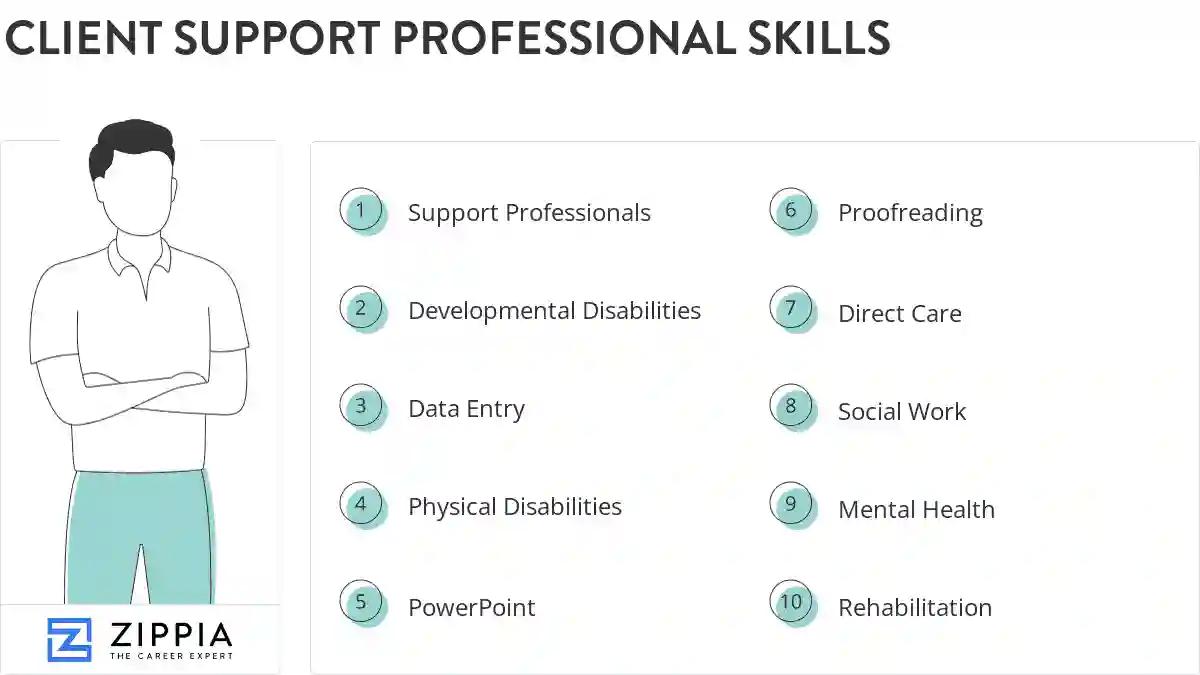
The most important skills for a client support professional resume and required skills for a client support professional to have include:
- Support Professionals
- Developmental Disabilities
- Data Entry
- Physical Disabilities
- PowerPoint
- Proofreading
- Direct Care
- Social Work
- Mental Health
- Rehabilitation
- CPR
- Community Involvement
- Adaptive
- Intellectual Disabilities
- Mental Illness
- Direct Support
- Autism
- ADL
- Community Support
- Money Management
- HR
- Behavioral Support
- Compassion
- Meal Preparation
- Medication Administration
- Technical Support
- Skill Development
- Substance Abuse
- Customer Satisfaction
- Foster Care
- Direct Training
- Community Resources
- Data Collection
- Customer Complaints
- One Support
- Groceries
- Medical Appointments
- Applied Behavior Analysis
- Community Integration
- Incident Reports
- Individual Strengths
- Inbound Calls
- Technical Issues
- Customer Issues
- Linux
- Crisis Situations
- Customer Support
Updated January 8, 2025

8. Social Work