
Automatically apply for jobs with Zippia
Upload your resume to get started.
Communications program manager skills for your resume and career
15 communications program manager skills for your resume and career
1. Project Management
- Provided project management support throughout plan design process.
- Initiated Project Management Community with grew to over 900 members worldwide.
2. Program Management
- Maintained coherency and consistency in overall HVS program management and maintenance.
- Acted as program management/logistics lead for staffing-wide and HR-wide events and programs, from the initiation phase through delivery.
3. PowerPoint
- Developed curriculum for basic computers, Internet, MS Word, MS Excel and MS PowerPoint 2007.
- Used MS Word, PowerPoint, Excel, Publisher to create flyers, sign in and roster sheets.
4. Public Health
- Researched and analyzed multiple subjects including restorative justice, human trafficking, and elder abuse as public health issues.
- Served on planning team and participated in state, regional level Public Health Emergency Preparedness drills and exercises.
5. Website Content
- Serve as member of Executive Communication Committee responsible for department's press releases, event planning and website content.
- Directed all website content and composed all social media strategies; tracks analytics.
6. HR
HR stands for human resources and is used to describe the set of people who work for a company or an organization. HR responsibilities revolve around updating employee records and carrying out management processes like planning, recruitment, evaluation, and selection processes. HR is a key contributor to any company or organization's growth as they are in charge of hiring the right employees, processing payrolls, conducting disciplinary actions, etc.
- Created concept and vision for an HR newsletter, which I've produced and delivered for the past six months.
- Worked directly with Senior HR management, employee relations, benefits administration, training, recruitment/employment/volunteers, and monitored performance evaluations.
7. Graphic Design
Graphic design is the art of making visual content to communicate messages. Designers apply different page layout methods and visual hierarchy by using letters and pictures to meet the need of end-users. Most companies use graphic design to sell their product or services and to convey complicated information by using infographics.
- Managed contracts and accounts with outside vendors including PR firm, graphic designers, ad agency and printers.
- Manage free-lance writing and graphic design resources Edit employee submissions of articles for publication on the Xerox intranet site.
8. Community Engagement
Community engagement is the process of working harmoniously with and through groups of people connected by geographic proximity, special interests, or similar situations to solve problems that affect the well-being of those people. Community engagement aims to better engage the community to achieve long-term sustainable results, processes, relationships, discourses, decision-making, or implementation for the benefit of the community.
- Managed community engagement initiative, Neighbor Circles
- Re-established Plain Talk brand recognition and community partnerships using social media platforms, mutli-media and community engagement activities.
9. Community Outreach
- Reported to the Vice President of Community Relations with responsibility for leading all community outreach programs and initiatives.
- Assist executive team with overall agency program development, visioning, community outreach, and program visibility.
10. Mental Health
Mental health is the state of wellbeing in which an individual can cope with the regular stresses and tensions of life, and can work productively without having any emotional or psychological breakdown. Mental health is essential for a person of any age and helps them make the right decisions in their life.
- Communicated with outside agencies including Department of Mental Health, medical and health professionals and other community resources.
- Coordinated the environmental health and community building-related work of the organization.
12. Facebook
- Contributed engaging and informative content for our national blood donor community page on Facebook.
- Launched the organization's use of new media, including Facebook, Twitter, YouTube and SMS Text.
13. Strategic Communications
Strategic communication is the conscious use of communication by an organization to fulfill its mission. It is a prerequisite and a tool for effective policymaking and public participation that facilitates the exchange of information and establishes consensus amongst different points of view and interests.
- Collaborated with global procurement operations team to design strategic communications program for tool outages, bug fixes and quarterly releases.
- Provide strategic communications to engage Global 1000 facilities management clients.
14. Professional Development
Professional development means to have the essential training certification or education with the purpose of earning and having a successful career. Every job requires a different set of skills. However, new skills may be needed in the future. Professional development, in this regard, helps people to develop and polish the skills and become efficient workers.
- Aligned leadership development with organizational goals by creating a streamlined, best-practice model of professional development across the organization.
- Facilitated professional development with staff through weekly supervision, guidance, and family/staff interaction.
15. Employee Engagement
- Developed and enhanced existing internal communications program to increase employee engagement.
- Increased employee engagement by creating an internal communications program.

What skills help Communications Program Managers find jobs?
Tell us what job you are looking for, we’ll show you what skills employers want.
What skills stand out on communications program manager resumes?
Dr. George Conrad
Associate Professor, Midland University
While difficult to reflect on a resume, finding ways to illustrate their dispositions is also important. Teaching is far more than skills. How does a candidate show that they have empathy or a desire to make a difference in their students' lives? Many school districts in Nebraska are familiar with the use of Gallup's CliftonStrengths (the new term for StrengthFinder). As a result, candidates who can provide their 5 top strengths on a resume, draws additional attention.
What soft skills should all communications program managers possess?
Hans Schmidt Ph.D.
Associate Professor of Communications, Coordinator, Schreyer and Cooper Honors Programs, Penn State University, Brandywine
What hard/technical skills are most important for communications program managers?
Hans Schmidt Ph.D.
Associate Professor of Communications, Coordinator, Schreyer and Cooper Honors Programs, Penn State University, Brandywine
What communications program manager skills would you recommend for someone trying to advance their career?
Jeyoung (Jenny) Oh Ph.D.
Assistant Professor of Communication, University of Michigan-Flint
Graduates can also enhance their skill sets and put them into practice by engaging in different experiences, such as volunteering with organizations in their field. With the ongoing pandemic, many organizations are seeking virtual help from volunteers. For example, if you volunteer in a social media marketing project for a nonprofit organization, you get to create a social media campaign to increase awareness of the initiatives of the organization. This experience can hone your skills in creating and managing online content. To search for these kinds of opportunities, you can use sites such as VolunteerMatch or AllForGood. It would be a great chance for you to apply what you have learned in class to make society better in this novel pandemic. You can also engage in a remote internship for a similar experience.
What type of skills will young communications program managers need?
Elizabeth B. Rogers
Academic Support Specialist and Instructor of Communication Studies, Huntingdon College
Teamwork. You must work as part of a team. However now, consider not only traditional teams but also virtual teams. I can tell you when my teaching and staff role got moved fully online last March, I relied on my team more than ever before. I work in a team environment every day, but when virtual was all we knew, teamwork became vital for not only my success but the success of my students, co-workers, and ultimately the institution. I know students hate group projects, but group projects are the closest things to the "real" workforce some students experience. Take group work seriously so you can learn how to excel in a group setting. How do you work in a team (both traditionally and virtually)? Are you reliable? Are you a leader or a follower (both are great)? Do you manage your time wisely so you can brainstorm, work, and revise? Being part of a team was always part of the workforce, so be ready to work in teams traditionally and virtually.
Technology skills. As I am sure many of you have seen, technology is becoming an extension of all work types now. It is not enough now to say you can work the Microsoft Office Suite and can type quickly. Companies need to know that you can manage technology in real ways, especially when you are not in the office. I would suggest students take an entry-level computer class at their organization as an elective, at the very least, to have some traditional training in all things tech. If your institution does not offer computer courses, I would suggest taking a free online course to earn a certificate of some kind. Students want to list real, tangible, and legitimate computer knowledge on their resumes to make them competitive.
What technical skills for a communications program manager stand out to employers?
Angela Sebby Ph.D.
Assistant Professor, Western Carolina University
List of communications program manager skills to add to your resume
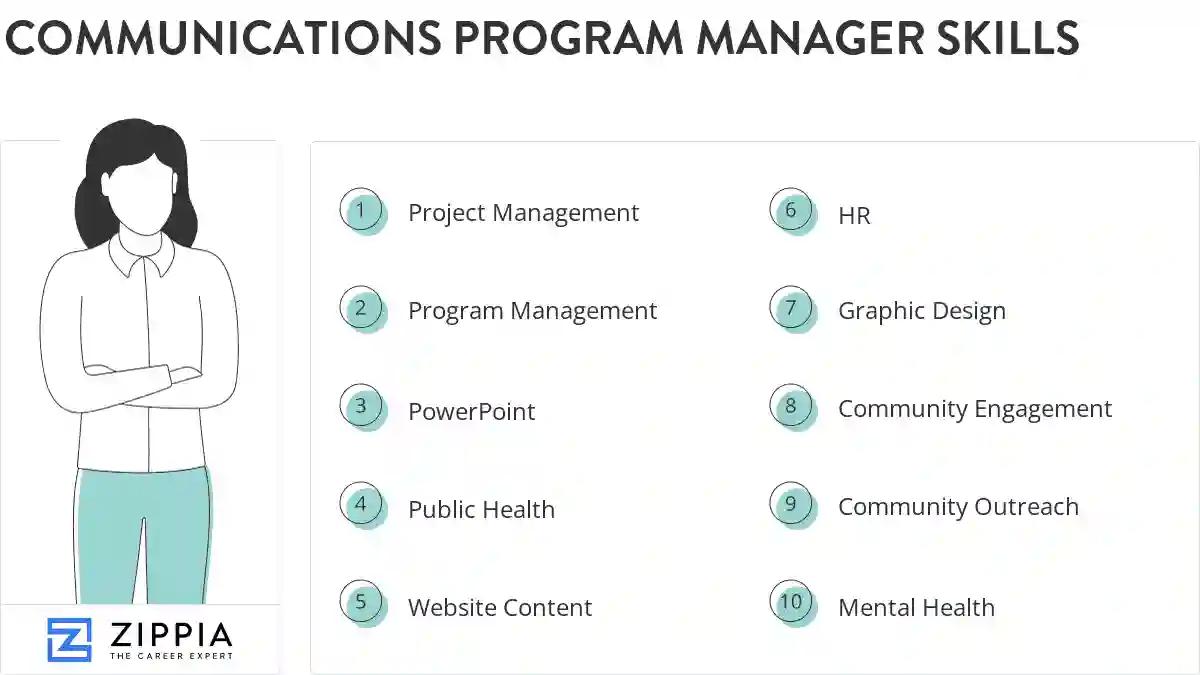
The most important skills for a communications program manager resume and required skills for a communications program manager to have include:
- Project Management
- Program Management
- PowerPoint
- Public Health
- Website Content
- HR
- Graphic Design
- Community Engagement
- Community Outreach
- Mental Health
- Social Work
- Strategic Communications
- Professional Development
- Employee Engagement
- External Stakeholders
- Program Development
- Executive Communications
- Event Planning
- Program Planning
- Community Resources
- External Communications
- Press Releases
- DOD
- Medicaid
- Crisis Intervention
- Community Organizations
- Substance Abuse
- Service Delivery
- Communications Plan
- Technical Assistance
- Subject Matter Experts
- Strategic Plan
- Community Events
- Program Budget
- SharePoint
- Strategic Direction
- Government Agencies
- Communications Materials
- Clinical Supervision
- Direct Reports
- Developmental Disabilities
- Outreach Efforts
- Community Health Programs
- Sprint
- YouTube
- HIV
- Budget Management
- Educational Programs
Updated January 8, 2025

11. Social Work