What does a component engineer do?
A component engineer monitors, tests, and evaluates different kinds of components in a particular production line. A component engineer is essential in a company that uses the assembly line process of manufacturing as each component must perform efficiently to avoid disruption in the production process. The component engineer is expected to provide reports about each production component, identify areas that need improvements or repairs, and suggest upgrades whenever applicable and necessary.
Component engineer responsibilities
Here are examples of responsibilities from real component engineer resumes:
- Facilitate and manage CAPA investigations from creation through verification of effectiveness and closure.
- Insure DFM, DFT and overall success of projects move from development to long term production.
- Work with test labs, design engineering, and failure analysis group to identify potential issues and final approval.
- Defect analysis including SEM, FIB/SEM, EDX, XPS, TEM, EDX and micro-probing etc.
- Coordinate, compile, and maintain component DFMEA's.
- Port the bit slice schematic for RF from earlier version.
- Identify obsolete and EOL components, review impact, identify new vendor.
- Create component library and resource hard to find PCB components in Asia.
- Provide contract manufacturer with alternates and cost saving substitutes for PCB components.
- Perform FMEA and MTBF analysis of new designs for both hardware and software.
- Work entail all safety circuitry design, EMI/EMC and overall EU CE certification.
- Conduct component life cycling, UL thermal and electrical stress testing, and audible noise testing.
- Recommend alternative parts; maintain a consolidate list of EEE and EEEE components for all projects.
- Build, test, troubleshoot, and implement electrical test assemblies on a share network infrastructure.
- Test ship borne cables at customer location to specify IEC standards including IEC 60092-350 and IEC 60228.
Component engineer skills and personality traits
We calculated that 7% of Component Engineers are proficient in Failure Analysis, DFMEA, and Dvp R. They’re also known for soft skills such as Speaking skills, Writing skills, and Creativity.
We break down the percentage of Component Engineers that have these skills listed on their resume here:
- Failure Analysis, 7%
Conducted failure analysis of microelectronic components and lab analysis of warranty return components utilizing various testing equipment and recording resulting data.
- DFMEA, 4%
Collaborate with suppliers and Engineering team members to author DFMEA and DVP&R documents.
- Dvp R, 4%
Led testing and validation of sub-systems and cockpit for material properties, design integrity, and passing all DVP requirements.
- Obsolescence, 4%
Managed obsolescence issues by closely monitoring all PCN activity via various commercial services.
- Electrical Components, 4%
Provided sourcing and alternate sourcing for electrical components and obsolete/hard to find devices.
- Capacitors, 4%
Researched / identified / selected unique vibration resistant electrolytic capacitors.
Most component engineers use their skills in "failure analysis," "dfmea," and "dvp r" to do their jobs. You can find more detail on essential component engineer responsibilities here:
Speaking skills. To carry out their duties, the most important skill for a component engineer to have is speaking skills. Their role and responsibilities require that "industrial engineers sometimes have to explain their instructions to production staff or technicians before they can make written instructions available." Component engineers often use speaking skills in their day-to-day job, as shown by this real resume: "represented eagan site at part obsolescence initiative-kaizen event resulting in new part selection, monitoring and obsolescence notification process. "
Writing skills. Another soft skill that's essential for fulfilling component engineer duties is writing skills. The role rewards competence in this skill because "industrial engineers must prepare documentation for other engineers or scientists, or for future reference." According to a component engineer resume, here's how component engineers can utilize writing skills in their job responsibilities: "provided component selection support, specification writing and parts obsolescence tracking"
Creativity. component engineers are also known for creativity, which are critical to their duties. You can see how this skill relates to component engineer responsibilities, because "industrial engineers use creativity and ingenuity to design new production processes in many kinds of settings in order to reduce the use of material resources, time, or labor while accomplishing the same goal." A component engineer resume example shows how creativity is used in the workplace: "created bom's for all products purchased inventory from created bom and kitted products to be assembled by contract manufacturer. "
Listening skills. component engineer responsibilities often require "listening skills." The duties that rely on this skill are shown by the fact that "these engineers often operate in teams, but they also must solicit feedback from customers, vendors, and production staff." This resume example shows what component engineers do with listening skills on a typical day: "communicated the root causes corrective actions upstream to design, package and fab silicon process engineering. "
Math skills. Another crucial skill for a component engineer to carry out their responsibilities is "math skills." A big part of what component engineers relies on this skill, since "industrial engineers use the principles of calculus, trigonometry, and other advanced topics in mathematics for analysis, design, and troubleshooting in their work." How this skill relates to component engineer duties can be seen in an example from a component engineer resume snippet: "developed oracle-based part geometry database using c and sql. "
Problem-solving skills. While "problem-solving skills" is last on this skills list, don't underestimate its importance to component engineer responsibilities. Much of what a component engineer does relies on this skill, seeing as "in designing facilities for manufacturing and processes for providing services, these engineers deal with several issues at once, from workers’ safety to quality assurance." Here is a resume example of how this skill is used in the everyday duties of component engineers: "coordinated activities between failure analysis lab, supply chain, engineers, managers, and vendors to implement solutions affecting production. "
The three companies that hire the most component engineers are:
- The Aerospace Corporation16 component engineers jobs
- Microsoft8 component engineers jobs
- Raytheon Technologies8 component engineers jobs
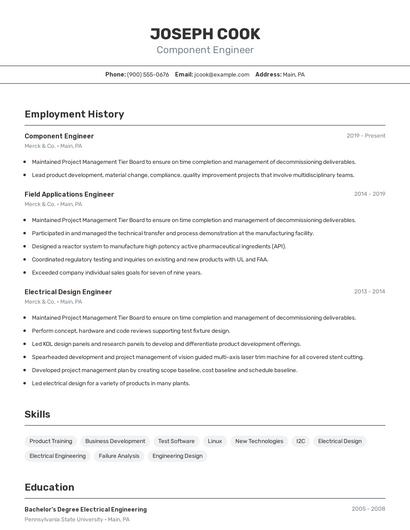
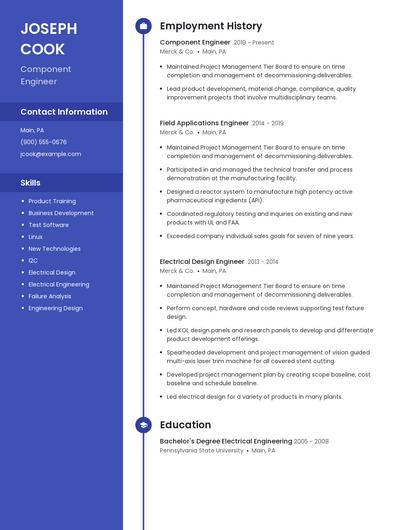
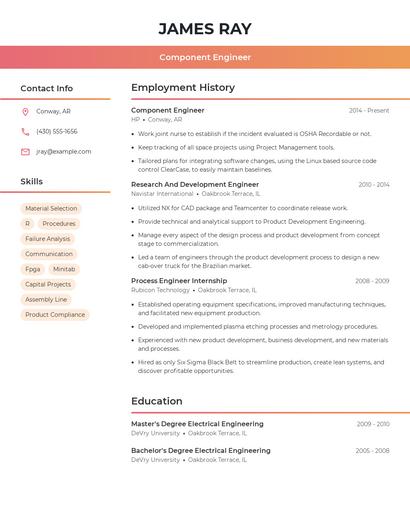
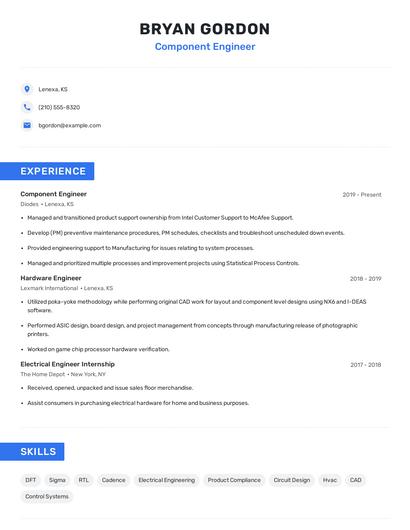
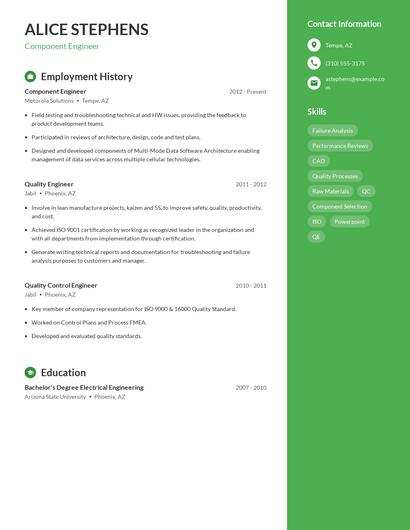
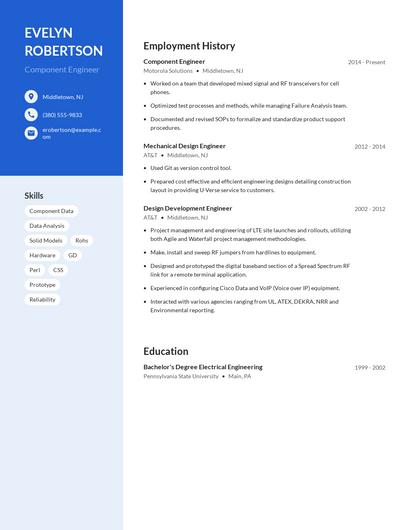
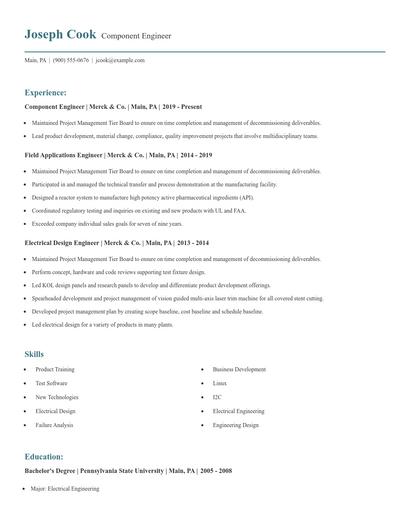
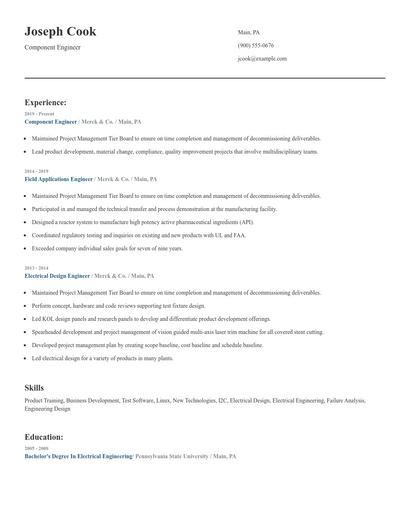
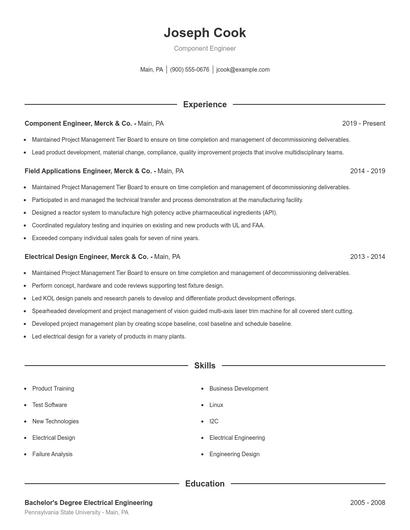
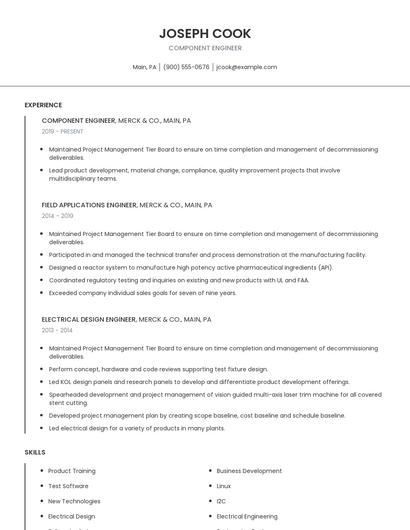
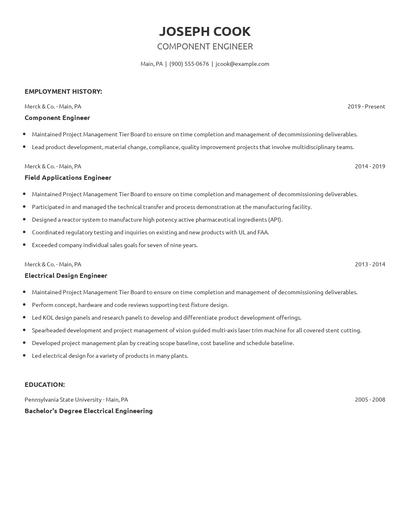
Choose from 10+ customizable component engineer resume templates
Build a professional component engineer resume in minutes. Our AI resume writing assistant will guide you through every step of the process, and you can choose from 10+ resume templates to create your component engineer resume.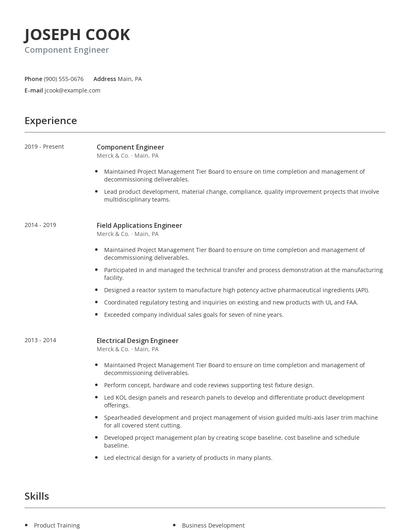
Compare different component engineers
Component engineer vs. Senior process engineer
A Senior Process Engineer assesses a process efficiency, effectiveness, safety, and quality. They also conduct process improvement initiatives and custom product developments.
These skill sets are where the common ground ends though. The responsibilities of a component engineer are more likely to require skills like "dvp r," "obsolescence," "electrical components," and "cad." On the other hand, a job as a senior process engineer requires skills like "continuous improvement," "project management," "data analysis," and "process improvement." As you can see, what employees do in each career varies considerably.
Senior process engineers really shine in the energy industry with an average salary of $107,116. Comparatively, component engineers tend to make the most money in the finance industry with an average salary of $85,688.The education levels that senior process engineers earn slightly differ from component engineers. In particular, senior process engineers are 7.4% more likely to graduate with a Master's Degree than a component engineer. Additionally, they're 4.8% more likely to earn a Doctoral Degree.Component engineer vs. Mechanical engineer
Mechanical Engineers oversee the development of various mechanical devices in different industries. Most of the responsibilities will revolve around crafting, improving, or designing technologies by utilizing extensive expertise in the subject; they identify and detect errors, provide in-depth analysis, and resolve issues. They are often in designated offices, but they can also work on-site and travel if necessary. Furthermore, Mechanical Engineers usually function in a group or team setting, often supervised by personnel in higher positions.
In addition to the difference in salary, there are some other key differences worth noting. For example, component engineer responsibilities are more likely to require skills like "obsolescence," "electrical components," "capacitors," and "part numbers." Meanwhile, a mechanical engineer has duties that require skills in areas such as "solidworks," "mechanical systems," "mechanical design," and "hvac." These differences highlight just how different the day-to-day in each role looks.
Mechanical engineers earn a lower average salary than component engineers. But mechanical engineers earn the highest pay in the energy industry, with an average salary of $84,748. Additionally, component engineers earn the highest salaries in the finance with average pay of $85,688 annually.Average education levels between the two professions vary. Mechanical engineers tend to reach similar levels of education than component engineers. In fact, they're 1.8% more likely to graduate with a Master's Degree and 4.8% more likely to earn a Doctoral Degree.Component engineer vs. Manufacturing engineer
Manufacturing Engineers are responsible for handling and developing an efficient manufacturing system or procedure that will help a company produce up to standard products while in adherence to the policies, regulations, and expected cost and schedule. Furthermore, Manufacturing Engineers must also monitor quality control, identify or detect errors, provide and suggest improvements, oversee the procurement of materials involved in the production, and coordinate with various teams or departments within the company to ensure the effectiveness of innovations or new developments.
The required skills of the two careers differ considerably. For example, component engineers are more likely to have skills like "failure analysis," "dvp r," "obsolescence," and "electrical components." But a manufacturing engineer is more likely to have skills like "lean manufacturing," "solidworks," "project management," and "cnc."
Manufacturing engineers make a very good living in the technology industry with an average annual salary of $81,429. On the other hand, component engineers are paid the highest salary in the finance industry, with average annual pay of $85,688.When it comes to education, manufacturing engineers tend to earn similar degree levels compared to component engineers. In fact, they're 0.5% less likely to earn a Master's Degree, and 0.5% less likely to graduate with a Doctoral Degree.Component engineer vs. Packaging engineer
A Packaging Engineer plans and implements packaging designs to ensure product integrity and appeal. Their primary duties include supervising and managing the complete packaging development process, analyzing engineering drawings, and conducting periodic vendor reviews.
Types of component engineer
Updated January 8, 2025
