What does a computer system specialist do?
Computer system specialists are responsible for providing technical guidance in developing and troubleshooting a company's computer systems. They adjust the software to provide the database needs of every department in the company. These specialists manage the intranet and internet websites the network users can access and test for system issues to resolve. They serve as lead workers that provide supervision and training over clerical and technical staff on how the system functions. Their duties also include gathering feedback from users to update the system to provide for their needs.
Computer system specialist responsibilities
Here are examples of responsibilities from real computer system specialist resumes:
- Implement administrator manage OS patch installation to entire domain.
- Lead effort to develop and maintain client's database by customizing existing computer information systems to support operating objectives.
- Design and implement TCP/IP networks to support multiple workstations and servers.
- Perform UNIX administration duties as required and troubleshoot server relate issues; securing and patching servers in compliance with DoD guidelines.
- Install updates and OS patches.
- Web design using HTML coding.
- Implement Linux on routers for cost effective VPN access for remote employees.
- Create and design internal web pages using HTML, JavaScript and SharePoint.
- Configure wide area networks, which utilize TCP/IP and connect via frame relay.
- Set standards for UNIX base software development, use of subroutine libraries, and version control systems.
- Review student timesheets, submit to accounts payable, distribute payroll and provide support to participating personnel.
- Develop a means to convert storage architecture (optical disc to native UNIX) for minimal impact to application code.
- Work with network technicians to troubleshoot connectivity issues.
- Install, configure and upgrade workstations and peripherals.
- Design, purchase and implement various system upgrades including high-end workstations and servers.
Computer system specialist skills and personality traits
We calculated that 18% of Computer System Specialists are proficient in Computer System, Troubleshoot, and CSV. They’re also known for soft skills such as Customer-service skills, Listening skills, and Speaking skills.
We break down the percentage of Computer System Specialists that have these skills listed on their resume here:
- Computer System, 18%
Performed daily operational support functions for the Laboratory computer systems, including as archiving data and tape back up administration.
- Troubleshoot, 6%
Worked with network technicians to troubleshoot connectivity issues.
- CSV, 5%
Managed collaborative CSV documentation efforts using Microsoft SharePoint.
- System Validation, 5%
Author and edit process and procedural documentation as the conformance component of a regulated system validation and implementation initiative.
- Database, 5%
Led effort to develop and maintain client's database by customizing existing computer information systems to support operating objectives.
- Technical Support, 4%
Provided Garrison hardware technical support and served as LAN administrator for Regiment headquarters.
Common skills that a computer system specialist uses to do their job include "computer system," "troubleshoot," and "csv." You can find details on the most important computer system specialist responsibilities below.
Customer-service skills. To carry out their duties, the most important skill for a computer system specialist to have is customer-service skills. Their role and responsibilities require that "computer support specialists must be patient and sympathetic." Computer system specialists often use customer-service skills in their day-to-day job, as shown by this real resume: "restructured organization to increase customer support and improve performance and accountability. "
Listening skills. Another soft skill that's essential for fulfilling computer system specialist duties is listening skills. The role rewards competence in this skill because "support workers must be able to understand the problems that their customers are describing and know when to ask questions to clarify the situation." According to a computer system specialist resume, here's how computer system specialists can utilize listening skills in their job responsibilities: "worked directly with information services and communicated cad implementation requirements to create deployment images for testing and final distribution. "
Speaking skills. This is an important skill for computer system specialists to perform their duties. For an example of how computer system specialist responsibilities depend on this skill, consider that "support workers must describe the solutions to computer problems in a way that a nontechnical person can understand." This excerpt from a resume also shows how vital it is to everyday roles and responsibilities of a computer system specialist: "developed and presented powerpoint training to large groups concerning information security. ".
Writing skills. computer system specialist responsibilities often require "writing skills." The duties that rely on this skill are shown by the fact that "strong writing skills are useful for preparing instructions and email responses for employees and customers, as well as for real-time web chat interactions." This resume example shows what computer system specialists do with writing skills on a typical day: "united network for organ sharing: technical support, report writing, programming, and end-user support. "
Problem-solving skills. Another common skill required for computer system specialist responsibilities is "problem-solving skills." This skill comes up in the duties of computer system specialists all the time, as "support workers must identify both simple and complex computer problems, analyze them, and solve them." An excerpt from a real computer system specialist resume shows how this skill is central to what a computer system specialist does: "conducted research to support the planning and enhancement of the distributed computer systems and system configuration solutions. "
The three companies that hire the most computer system specialists are:
- My Florida Regional Mls9 computer system specialists jobs
- Florida Department of Transportation7 computer system specialists jobs
- Laboratory Corporation of America Holdings3 computer system specialists jobs
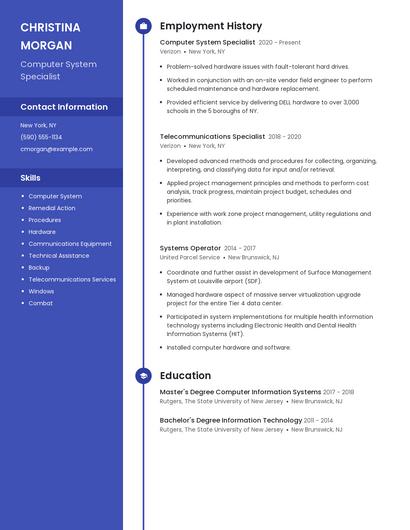
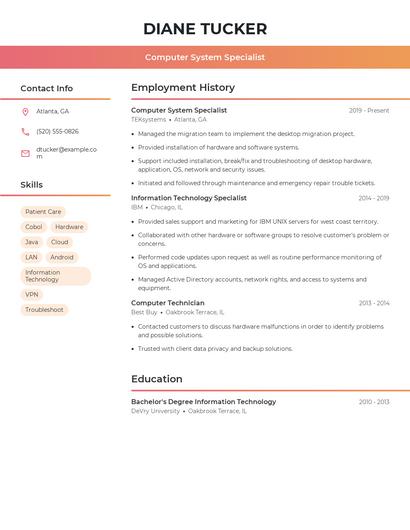
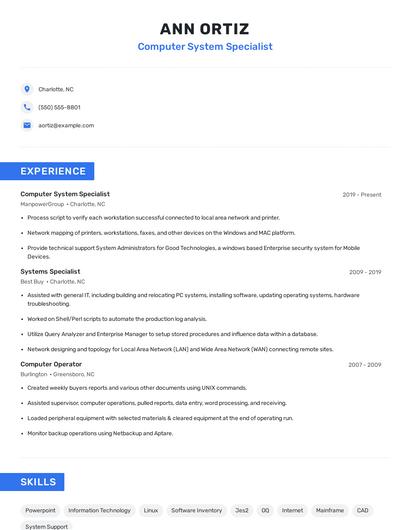
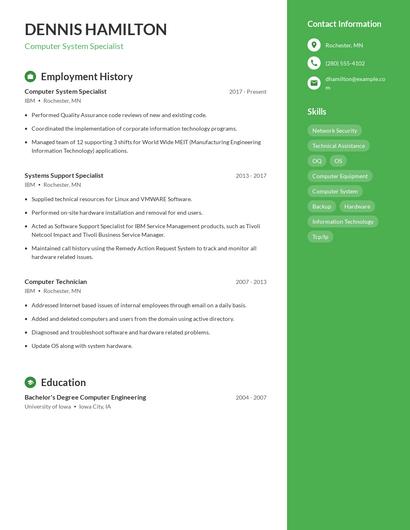
Choose from 10+ customizable computer system specialist resume templates
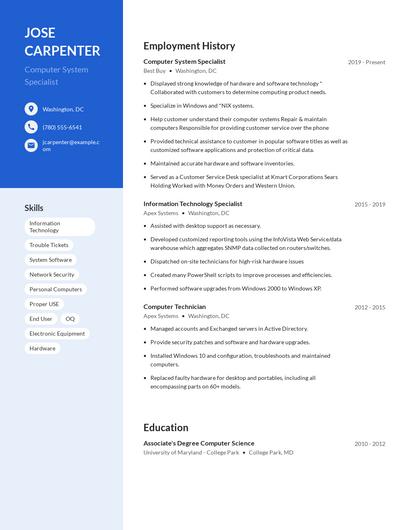
Build a professional computer system specialist resume in minutes. Our AI resume writing assistant will guide you through every step of the process, and you can choose from 10+ resume templates to create your computer system specialist resume.



Compare different computer system specialists
Computer system specialist vs. Application specialist
An application specialist is responsible for maintaining the optimal performance of system applications, ensuring smooth navigation by upgrading the features of existing applications, and performing multiple diagnostic tests before releasing the applications to the digital marketplace. Application specialists work closely with the design engineers to improve system codes, verify the efficiency of network infrastructure, and adjusting application functions based on the clients' specifications and business' needs. They should always consider the budget goals, target end-users, and current market trends to design applications, meeting users' demands and public interests.
These skill sets are where the common ground ends though. The responsibilities of a computer system specialist are more likely to require skills like "computer system," "csv," "system validation," and "database." On the other hand, a job as an application specialist requires skills like "customer service," "customer satisfaction," "project management," and "excellent organizational." As you can see, what employees do in each career varies considerably.
Application specialists tend to make the most money working in the manufacturing industry, where they earn an average salary of $92,542. In contrast, computer system specialists make the biggest average salary, $83,520, in the technology industry.The education levels that application specialists earn slightly differ from computer system specialists. In particular, application specialists are 1.2% more likely to graduate with a Master's Degree than a computer system specialist. Additionally, they're 0.7% more likely to earn a Doctoral Degree.Computer system specialist vs. Computer engineer
A computer engineer is someone who examines, designs, and manages computer hardware and software systems. He/She or she helps in solving issues or any concerns that may occur with the computer's hardware and software as well as assists in the innovation of computer technology. Computer engineers are responsible for computer hardware design, development, research, and test computer systems. They examine components like circuit boards, processors, memory devices, routers, and networks. While, those working with the computer software are in charge of the development, design, and administration of software programs.
Each career also uses different skills, according to real computer system specialist resumes. While computer system specialist responsibilities can utilize skills like "csv," "system validation," "fda," and "oq," computer engineers use skills like "c #," "python," "software development," and "java."
Computer engineers earn a higher average salary than computer system specialists. But computer engineers earn the highest pay in the finance industry, with an average salary of $117,704. Additionally, computer system specialists earn the highest salaries in the technology with average pay of $83,520 annually.Average education levels between the two professions vary. Computer engineers tend to reach higher levels of education than computer system specialists. In fact, they're 6.6% more likely to graduate with a Master's Degree and 0.7% more likely to earn a Doctoral Degree.What technology do you think will become more important and prevalent for computer system specialists in the next 3-5 years?
Ming Chow
Associate Teaching Professor, Tufts University
References:
1. cybersecurity
2. cybersecurity
Computer system specialist vs. Technical specialist
The role of technical specialists is to provide technical support for applications and programs to staff members and customers within an organization. They train staff and customers on products and apps and offer advice on the best practices for utilizing technical programs and applications. They also design training materials to teach other staff members the most effective methods of using its technology. It is also their job to reduce company costs by looking for ways to improve productivity and lessen expenses.
There are many key differences between these two careers, including some of the skills required to perform responsibilities within each role. For example, a computer system specialist is likely to be skilled in "troubleshoot," "csv," "system validation," and "database," while a typical technical specialist is skilled in "customer service," "patients," "project management," and "customer satisfaction."
Technical specialists earn the highest salary when working in the technology industry, where they receive an average salary of $92,419. Comparatively, computer system specialists have the highest earning potential in the technology industry, with an average salary of $83,520.When it comes to education, technical specialists tend to earn similar degree levels compared to computer system specialists. In fact, they're 2.6% more likely to earn a Master's Degree, and 0.9% more likely to graduate with a Doctoral Degree.Computer system specialist vs. Installation specialist
Installation specialists are skilled employees who are responsible for installing various equipment, machinery, and computer systems for a company or clients. These specialists must work with HVAC contractors to install air-conditioning ductwork and materials in business establishments and homes. They should recommend corrective action when identifying electrical and environmental deficiencies to ensure optimized performance and reliability of equipment. Installation specialists must also test hardware and software to determine its efficiency and reliability as well as its compatibility with the existing system.
Types of computer system specialist
Updated January 8, 2025
