
Automatically apply for jobs with Zippia
Upload your resume to get started.
Contract recruiter/sourcer skills for your resume and career
15 contract recruiter/sourcer skills for your resume and career
1. Applicant Tracking Systems
- Involved with applicant tracking systems, compensation and benefits issues, immigration, complaint investigations and conciliation on key employer-manager grievances
- Utilized online recruiting resources and in-house Applicant Tracking Systems to identify and help candidates fully understand the opportunity.
2. ICIMS
- Provided daily reports of recruiting metrics through ICIMS and maintained performance database for recruiting.
- Use of the ICIMS applicant tracking system for recruiting and screening candidates.
3. DOD
Definition of Done (DoD) is a set of deliverables that are needed to devise software. These deliverables are valuable to the system and can be exemplified by writing code, coding comments, unit testing, integration testing, design documents, release notes, and so on.
- Full life cycle recruiting of candidates throughout the U.S. for DOD contracts supporting four business groups.
- Lead recruiter for hard-to-fill positions within the Department of Defense (DOD) Recruiting Team.
4. Phone Screens
A phone screen refers to the stage of the recruiting process that occurs after narrowing the applicant pool through candidate's resumes and before they are asked for a face-to-face interview. Phone screenings are typically conducted over a call from a recruiter or talent acquisition team coordinator at a company to assess the applicant's suitability for a specific position and discuss basic qualifications and information about a job. This is usually a short call that lasts between 15 and 30 minutes. Phone screens can also be useful for employers to get a picture of realistic market expectations from applicants for a specific job.
- Conduct full phone screens of candidates, compile preliminary salary data and compile interview availability.
- Conduct candidate phone screens/assessments against qualifications and present to Hiring Managers.
5. Taleo
Taleo is a talent recruitment and management software owned by the famous software company Oracle. Large companies mainly use the software to find the best talent at reasonable prices. It also allows the management of the human resources conveniently through a rich user interface. Taleo uses a cloud-based Applications Tracking System to find people with relevant skill sets or education degrees instantly. It also provides testing and interviewing options right through the software, ridding you of any external processes.
- Coached hiring managers on using Taleo
- Build candidate acquisition plans using Taleo ATS, LinkedIn, Boolean searches, and networking and referrals.
6. Open Positions
Open positions may refer to a potential investment trade, where the trade has been established and recognized but has not yet closed. This is common for many investors holding a great deal of stock but have not yet sold those shares; however, there is considerable risk in holding multiple open positions given the market fluctuation.
- Worked with a variety of industries to fill and develop candidate pipelines for open positions.
- Worked with hiring Managers to determine hiring needs and perimeters for open positions.
Choose from 10+ customizable contract recruiter/sourcer resume templates
Build a professional contract recruiter/sourcer resume in minutes. Our AI resume writing assistant will guide you through every step of the process, and you can choose from 10+ resume templates to create your contract recruiter/sourcer resume.7. Candidate Interviews
- Conduct consensus meetings with hiring teams after candidate interviews.
- Coordinate all scheduling of candidate interviews with hiring managers.
8. TS/SCI
- Recruited for cleared positions ranging from secret to TS/SCI clearances supporting FAA, DHS and NRO.
- Contract Recruiting consultant recruiting for Software Engineers and Developers with TS/SCI w Poly supporting opportunities at the Maryland Procurement Office.
9. Strategic Sourcing
- Collaborated with hiring mangers to determine recruiting priorities and ensure strategic sourcing practices were effectively met or exceeded.
- Coordinate with management at all levels to define requirements and conduct necessary strategic sourcing and recruiting activities.
10. Candidate Pipeline
- Source on LinkedIn, job boards, and the Internet, using Boolean searches to generate healthy candidate pipelines.
- Partner and attend various job fairs educational community and government organizations to increase and ensure a strong and diverse candidate pipeline
11. ATS
- Sourced candidates for a wide range of positions utilizing job boards, associations, and RecruitMax (ATS).
- Utilized ATS, LinkedIn Recruiter, and various websites for sourcing.
12. Source Candidates
- Source candidates using networking, social media, events, competitive intelligence/research, and sourcing tools.
- Source candidates using LinkedIn, job boards, social media and networking.
13. Ofccp
- Manage applicant tracking requirements and related documentation to ensure compliance with OFCCP regulations and reduce risk to the company
- Provided documentation and actively participated in OFCCP audits.
14. Reference Checks
- Sourced, recruited, credentialed candidates, performed background and reference checks, negotiated rates and fees with client and candidates.
- Conduct reference checks, negotiate fees, salaries & Job offers.
15. Healthcare
Healthcare is the maintenance or improvement of a person's health by the diagnosis and treatment of a person's injury, illness, or any other disease. Healthcare is a basic necessity of human life and is the responsibility of the country's government to ensure that each person gets healthcare. Providing healthcare is the job of certified health professionals that includes doctors, surgeons, nurses, and other physicians. Pharmaceutical companies, hospitals, dentistry, therapy, and health training all come under healthcare. Healthcare plays a vital role in the country's economy and its development.
- Sourced, screened and recruited in sales, accounting, healthcare and information technology.
- Led logistics recruitment for client s subcontracted healthcare logistics providers throughout SoCal Counties.
5 Contract Recruiter/Sourcer resume examples
Build a professional contract recruiter/sourcer resume in minutes. Browse through our resume examples to identify the best way to word your resume. Then choose from 5+ resume templates to create your contract recruiter/sourcer resume.

What skills help Contract Recruiter/Sourcers find jobs?
Tell us what job you are looking for, we’ll show you what skills employers want.
What skills stand out on contract recruiter/sourcer resumes?
Elaine Farndale Ph.D.
Professor of Human Resource Management and Associate Director of the School of Labor and Employment Relations, The Pennsylvania State University
What contract recruiter/sourcer skills would you recommend for someone trying to advance their career?
Dr. James Lampley
Professor, East Tennessee State University
What technical skills for a contract recruiter/sourcer stand out to employers?
Ryan Smolko
Associate Director, Career Center, Muhlenberg College
The technical skills everyone should be continually working on are Excel/Tableau and Canva/PowerPoint. Working with large amounts of data is almost universal in today's economy regardless of industry or position. You can also have the best data in the world but if you can't present it in a dynamic way it won't be seen which is why being well versed in presentation and design tools can be a big advantage.
List of contract recruiter/sourcer skills to add to your resume
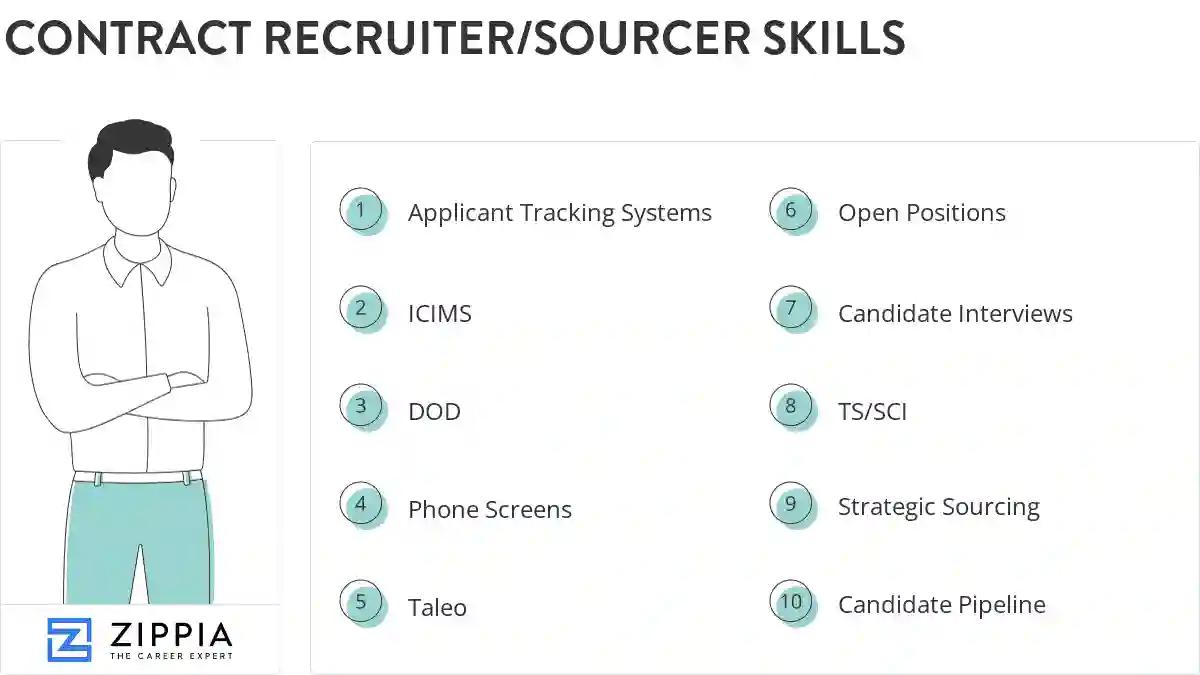
The most important skills for a contract recruiter/sourcer resume and required skills for a contract recruiter/sourcer to have include:
- Applicant Tracking Systems
- ICIMS
- DOD
- Phone Screens
- Taleo
- Open Positions
- Candidate Interviews
- TS/SCI
- Strategic Sourcing
- Candidate Pipeline
- ATS
- Source Candidates
- Ofccp
- Reference Checks
- Healthcare
- Java
- Monster
- Quality Candidates
- HR
- Dice
- Phone Interviews
- External Candidates
- Professional Networks
- Candidate Flow
- Qualifying Candidates
- Business Development
- SR
- Candidate Tracking
- Logistics
- Linux
- Identify Candidates
- SharePoint
- Enterprise Sales
- C++
- QA
- Cold Calls
- Social Media Sites
- Candidate Database
- PeopleSoft
- FTE
- Internal Database
- EMC
- Real Estate
- Career Fairs
Updated January 8, 2025
