What does a control inspector do?
Control inspector responsibilities
Here are examples of responsibilities from real control inspector resumes:
- Design and implementation of a continuous PID controllers using control theory to achieve a desire temperature on an aluminum rod.
- See para.2.1 per AS9100) / general and flight safety FAI, verify that the DQR has complete requirements.
- Verify that all process and material certifications meet P.O.
- Move parts into MRB if fail tests or do not match blueprint.
- Develop human interface to TI545 PLC and industrial wastewater treatment plant using LabVIEW s/w.
- Measure the temperature using the temperature sensor and display it on the LCD screen.
- Prepare reports on the status/progress of NCR's, RMA's, and calibration for the weekly MRB meeting ..
- Create a LabVIEW program to improve on the capabilities, precision, and user-friendliness of the previous LabVIEW program.
- Verify equipment calibration and records comply with GMP requirements.
- Review certifications and applicable inspection data prior to release.
- Participate in a wide array of radioactive tank closure activities providing radiological coverage.
- Verify radiological instrumentation calibration as well as source check on a daily basis.
- Examine customer-purchased product to ensure product integrity and conformance to specify FDA requirements.
- Witness, verify and document specify manufacturing process steps; perform conformity/first article inspections to ensure compliance with FAA approve procedures.
- Maintain regulated testing logs for FDA audits.
Control inspector skills and personality traits
We calculated that 17% of Control Inspectors are proficient in Pressure Vessels, Safety Standards, and Regulatory Compliance. They’re also known for soft skills such as Dexterity, Math skills, and Mechanical skills.
We break down the percentage of Control Inspectors that have these skills listed on their resume here:
- Pressure Vessels, 17%
Conducted regulatory and risk assessment inspections on insured boilers and pressure vessels.
- Safety Standards, 15%
Discussed concerns with contractor representatives to ensure labor and safety standards were maintained.
- Regulatory Compliance, 12%
Inspected Medicare providers of durable medical equipment for regulatory compliance issues.
- Construction Projects, 11%
Worked with right-of-way agents to obtain temporary and permanent easements for construction projects.
- Ladders, 11%
Test and inspect ground and aerial ladders for fire departments in Michigan, Indiana, Pennsylvania and Ohio.
- Pest Control, 8%
Performed wood repairs as needed and termite/pest control elimination as needed.
Common skills that a control inspector uses to do their job include "pressure vessels," "safety standards," and "regulatory compliance." You can find details on the most important control inspector responsibilities below.
Math skills. Many control inspector duties rely on math skills. "knowledge of basic math is important for measuring, calibrating, and calculating specifications in quality control testing.," so a control inspector will need this skill often in their role. This resume example is just one of many ways control inspector responsibilities rely on math skills: "perform visual inspections, mathematical calculations, and quantity verification of products to meet customer requirements and specifications. "
Mechanical skills. control inspectors are also known for mechanical skills, which are critical to their duties. You can see how this skill relates to control inspector responsibilities, because "quality control inspectors use tools and machinery when testing products." A control inspector resume example shows how mechanical skills is used in the workplace: "recognized by the american society for quality as a certified mechanical inspector (cmm). "
Physical strength. control inspector responsibilities often require "physical strength." The duties that rely on this skill are shown by the fact that "quality control inspectors may be required to lift or maneuver heavy production materials or finished products." This resume example shows what control inspectors do with physical strength on a typical day: "reviewed in-process inspection which included monitoring, packaging and manufacturing by inspecting, weight testing and analyzing physical parameters in order. "
Technical skills. Another common skill required for control inspector responsibilities is "technical skills." This skill comes up in the duties of control inspectors all the time, as "to ensure that products and parts meet quality standards, inspectors must understand the relevant blueprints, technical documents, and manuals." An excerpt from a real control inspector resume shows how this skill is central to what a control inspector does: "utilize calipers, micrometers and other technical measuring devices to determine product conformance to specifications and end product requirements. "
The three companies that hire the most control inspectors are:
- Arrow Exterminators38 control inspectors jobs
- American Family Insurance7 control inspectors jobs
- Munich Reinsurance America, Inc.6 control inspectors jobs
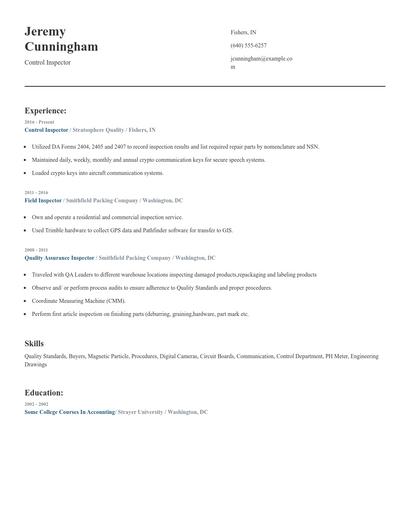
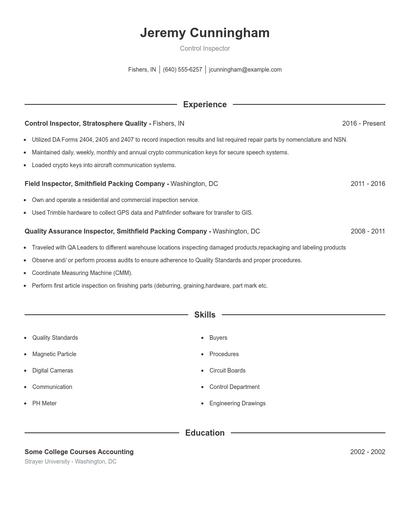
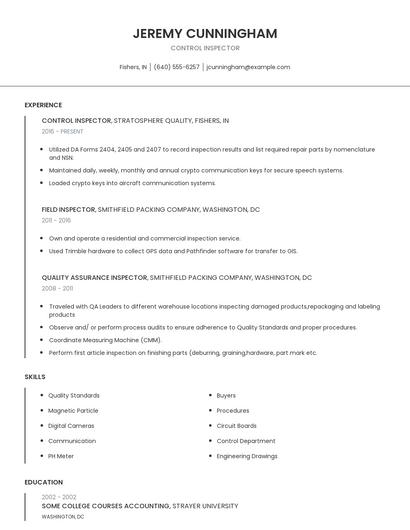
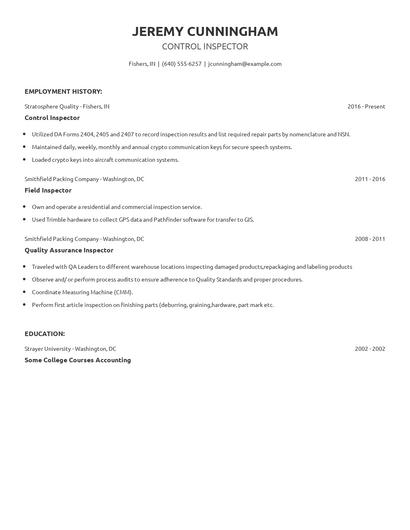
Choose from 10+ customizable control inspector resume templates
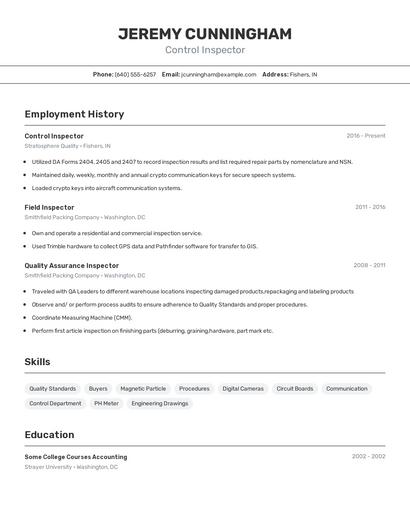
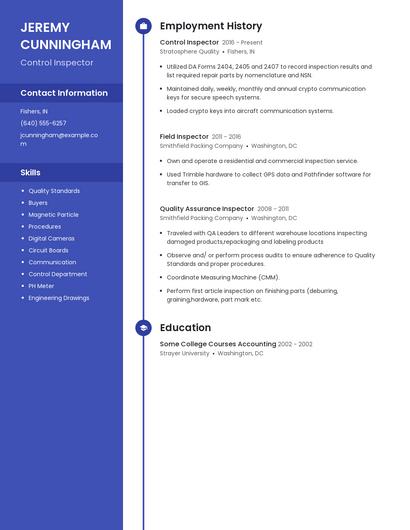
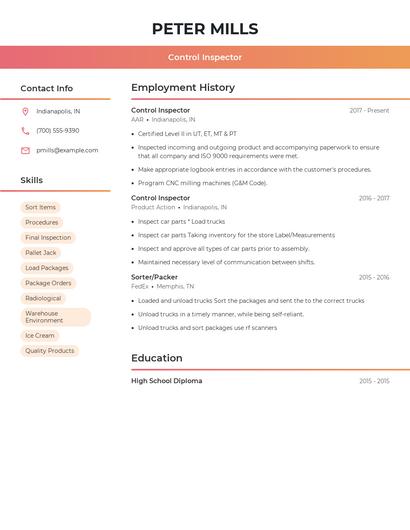
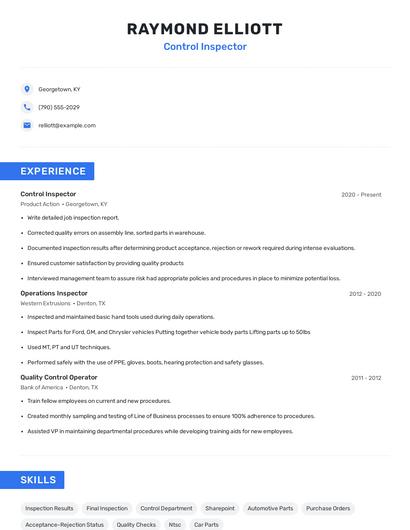
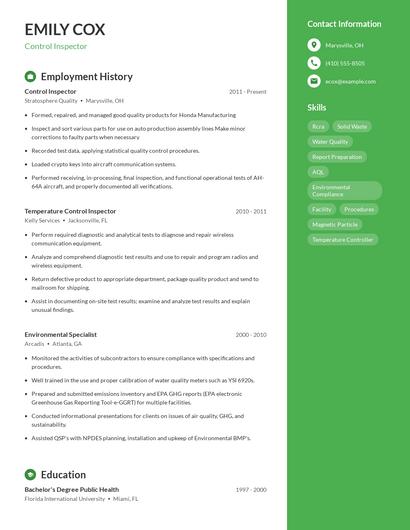
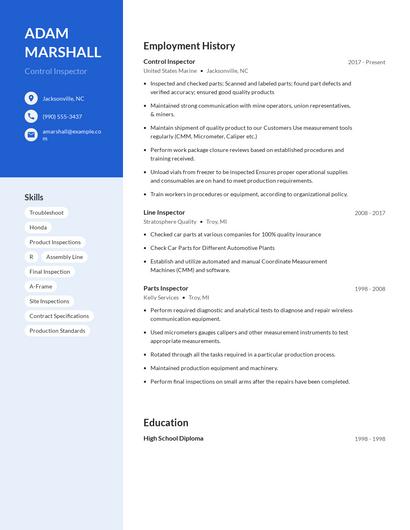
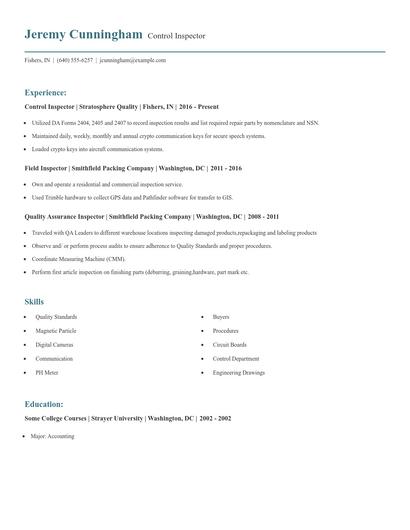
Build a professional control inspector resume in minutes. Our AI resume writing assistant will guide you through every step of the process, and you can choose from 10+ resume templates to create your control inspector resume.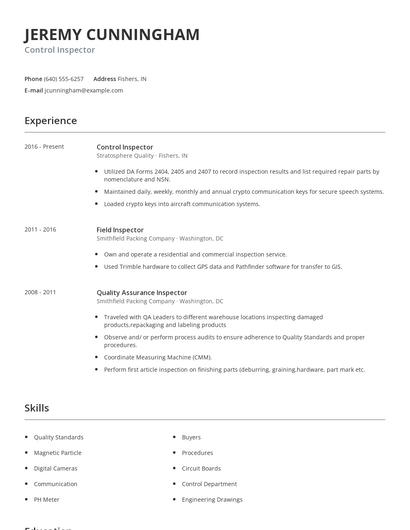
Compare different control inspectors
Control inspector vs. Catcher
The job of a test operator is to test the functionality of electronic components, assemblies, units, parts, and systems in a manner consistent with standard procedures. As a test operator, you will perform a variety of duties that include working with engineers to ensure accurate procedures are being followed, perform different mechanical assembly operations, and inspecting products for the correct orientation and placement. Additionally, you will assemble electronics in their boxes and notify the quality/test engineer if the test yields below the acceptable levels.
While similarities exist, there are also some differences between control inspectors and catcher. For instance, control inspector responsibilities require skills such as "pressure vessels," "safety standards," "regulatory compliance," and "construction projects." Whereas a catcher is skilled in "quality checks," "assembly line," "ppe," and "tape measure." This is part of what separates the two careers.
Catchers really shine in the automotive industry with an average salary of $34,416. Comparatively, control inspectors tend to make the most money in the government industry with an average salary of $37,388.On average, catchers reach lower levels of education than control inspectors. Catchers are 5.3% less likely to earn a Master's Degree and 0.8% less likely to graduate with a Doctoral Degree.Control inspector vs. Test operator
Quality Assurance Auditors are employees who ensure the adherence of other employees to company processes and guidelines. They are expected to be experts on quality assurance processes and procedures. They also have in-depth knowledge of the expected outcomes of such processes to ensure that the company only provides quality products and services. Quality assurance auditors are also familiar with regulatory laws and policies of governing bodies that oversee companies in their particular industry. They ensure that their companies are compliant and may conduct random quality checks every now and then.
While some skills are similar in these professions, other skills aren't so similar. For example, resumes show us that control inspector responsibilities requires skills like "pressure vessels," "safety standards," "regulatory compliance," and "construction projects." But a test operator might use other skills in their typical duties, such as, "test equipment," "hand tools," "test procedures," and "safety rules."
On average, test operators earn a higher salary than control inspectors. Some industries support higher salaries in each profession. Interestingly enough, test operators earn the most pay in the technology industry with an average salary of $44,634. Whereas control inspectors have higher pay in the government industry, with an average salary of $37,388.Average education levels between the two professions vary. Test operators tend to reach similar levels of education than control inspectors. In fact, they're 4.0% less likely to graduate with a Master's Degree and 0.8% less likely to earn a Doctoral Degree.Control inspector vs. Quality assurance inspector
An inspector general is responsible for doing audit reports and inspections to ensure that no possible fraud, misconduct, corruption, or power abuse in the government or private sector occurs. Their role is to monitor and inspect the agencies' effectiveness, assess possible mismanagement of a company, and improve the economy. Also, they usually conduct and review audit reports or investigations to ensure an agency's compliance to the policies and guidelines.
The required skills of the two careers differ considerably. For example, control inspectors are more likely to have skills like "pressure vessels," "regulatory compliance," "construction projects," and "construction control." But a quality assurance inspector is more likely to have skills like "calipers," "micrometers," "corrective action," and "basic math."
Quality assurance inspectors earn the best pay in the government industry, where they command an average salary of $48,138. Control inspectors earn the highest pay from the government industry, with an average salary of $37,388.Most quality assurance inspectors achieve a similar degree level compared to control inspectors. For example, they're 2.2% less likely to graduate with a Master's Degree, and 0.8% less likely to earn a Doctoral Degree.Control inspector vs. Inspector general
Even though a few skill sets overlap between control inspectors and inspectors general, there are some differences that are important to note. For one, a control inspector might have more use for skills like "pressure vessels," "safety standards," "construction projects," and "construction control." Meanwhile, some responsibilities of inspectors general require skills like "ig," "oig," "dod," and "corrective action. "
Inspectors general enjoy the best pay in the government industry, with an average salary of $59,592. For comparison, control inspectors earn the highest salary in the government industry.In general, inspectors general hold higher degree levels compared to control inspectors. Inspectors general are 10.3% more likely to earn their Master's Degree and 2.5% more likely to graduate with a Doctoral Degree.Types of control inspector
Updated January 8, 2025
