
Automatically apply for jobs with Zippia
Upload your resume to get started.
Credit/collection supervisor skills for your resume and career
15 credit/collection supervisor skills for your resume and career
1. Collections
- Contributed to the workplace administratively from new employee training to billing disputes and collections, authorizing balance adjustments and negotiated settlements.
- Supervised staff of collections representatives responsible for reducing bad debt while also upholding company policies, and following strict legal regulations.
2. Customer Accounts
- Established and maintained collaborative relationships with customers; initiated adjustments and credits to customer accounts.
- Report to Management all customer accounts receivable and collection standing.
3. Customer Service
Customer service is the process of offering assistance to all the current and potential customers -- answering questions, fixing problems, and providing excellent service. The main goal of customer service is to build a strong relationship with the customers so that they keep coming back for more business.
- Collaborated with Customer Service, Customer Account Processing and Billing Departments to successfully obtain outstanding payments and resolve customer disputes/complaints.
- Analyzed and reported trends and made recommendations to management for opportunities to improve customer service and department success.
4. Financial Statements
A financial statement is a report of an individual or a company that includes all the information about the declared assets, the use of money, income, and also the contribution of shareholders over a certain period.
- Credit Verification effectively assessed credit risk and (current and potential) client viability, analyzing financial statements and credit reports.
- Reviewed and analyzed personal and business financial statements including corporate balance sheets and tax returns to make sound credit decisions.
5. Delinquent Accounts
A delinquent account is an account wherein there are many past-due funds.
- Negotiate payment options for delinquent accounts and provide regular updates and resolution of receivables to management.
- Forwarded delinquent accounts for processing and advised management of payments received from agencies.
6. Collection Agencies
- Performed collection activities on problem accounts including filing lawsuits and working with outside collection agencies.
- Worked closely with outside collection agencies and legal representatives.
Choose from 10+ customizable credit/collection supervisor resume templates
Build a professional credit/collection supervisor resume in minutes. Our AI resume writing assistant will guide you through every step of the process, and you can choose from 10+ resume templates to create your credit/collection supervisor resume.7. Collection Efforts
In general, collection efforts referr to the process of collecting specific objects. The object can be tangible such as clothes, money, any physical product, or intangible such as data and information. However, the term is mostly used to indicate the collection of money or funds.
- Improved collection efforts and debt retention ratio by identifying, analyzing, and recommending loss litigation opportunities.
- Coordinate and drive territory receivable calls and generate monthly receivable reports to facilitate collection efforts.
8. Past Due Accounts
A credit card account in a bank or any other financial association that is past due in payment is called a past due account. Past due account holders are required to recompense their scheduled payments to the bank or their creditor. The more credit account holders are due, the more they are compelled by their lender to make the payment.
- Organized collection portfolios, monitored and authorized disconnection of past due accounts.
- Established accounts receivable tracking and decreased past-due accounts receivable.
9. Strong Analytical
- Key Achievement: Consistently met deadlines while demonstrating strong analytical and problem-solving skills to achieve corporate objectives.
10. Credit Analysis
Credit analysis is the process of evaluating a person's or company's ability to repay their debts.
- Trained and led a staff of Credit Analysts, Auditors and a Support Clerk in loss management and credit analysis functions.
- Performed credit analysis for 3,000 active customers; utilized Dun and Bradstreet commercial credit reports.
11. Process Improvement
- Participated in long-range departmental planning and provided input to operational decisions and process improvements.
- Provide effective workforce management, quality assurance, and process improvement for department.
12. DSO
- Managed/Supervised a team of 10 commercial collectors to ensure a reduction of monthly goals to maintain a DSO below 30 days.
- Maintain and report monthly DSO and send comparison charts to Credit Manager, CFO, CEO, Controller and AAP.
13. Collection Process
- Assisted in the training field personnel in all aspects of the collection process.
- Interfaced with superiors on variations and changes in collection processing.
14. Credit Risk
Credit risk entails the risk experienced by a lender from the possibility of losing money due to a borrower failing to repay or meet their obligations set out in a loan contract. Credit risk manifests in many forms including loans (the most popular), letters of credit, foreign exchange and lines of credit.
- Implemented checks and balances ensuring the credit risk team s compliance with internal and external regulations including SOX controls.
- Created processes and controls that effectively managed and mitigated credit risk to less than a 1% default rate.
15. Accounts Receivables
- Turned Accounts Receivables around from 75% of accounts over 100 days down to 45% in a six-month period.
- Managed Accounts Receivables for a 56 property region with a value of $113 million dollars.
5 Credit/Collection Supervisor resume examples
Build a professional credit/collection supervisor resume in minutes. Browse through our resume examples to identify the best way to word your resume. Then choose from 5+ resume templates to create your credit/collection supervisor resume.

What skills help Credit/Collection Supervisors find jobs?
Tell us what job you are looking for, we’ll show you what skills employers want.
List of credit/collection supervisor skills to add to your resume
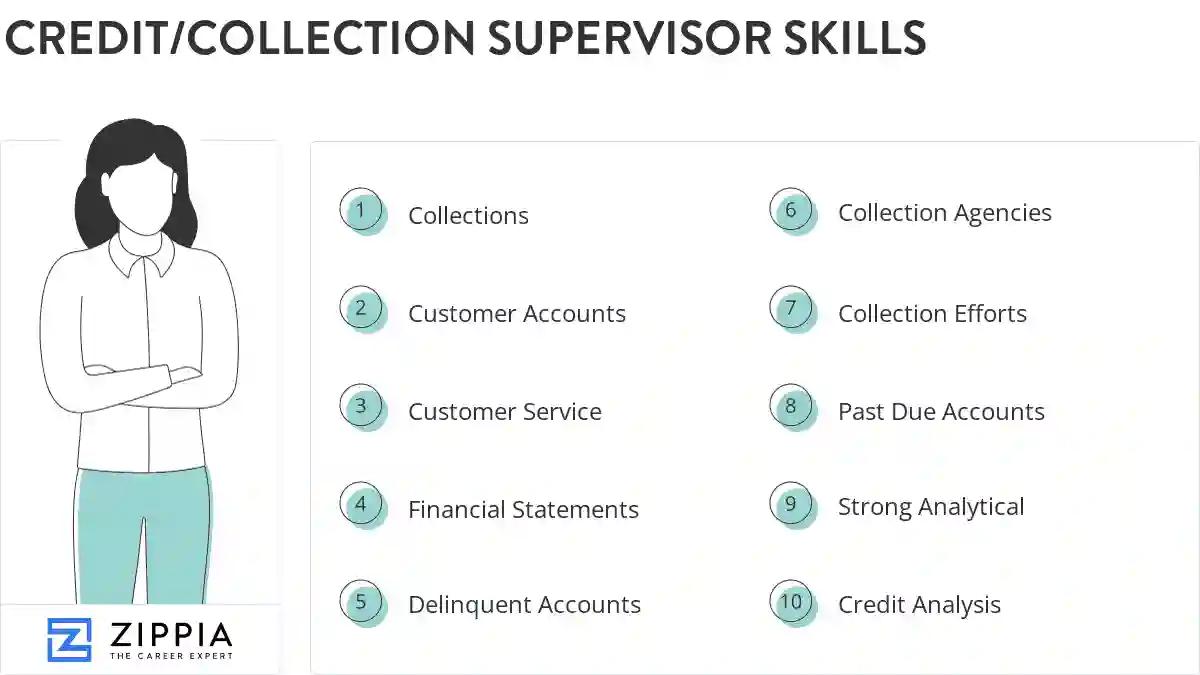
The most important skills for a credit/collection supervisor resume and required skills for a credit/collection supervisor to have include:
- Collections
- Customer Accounts
- Customer Service
- Financial Statements
- Delinquent Accounts
- Collection Agencies
- Collection Efforts
- Past Due Accounts
- Strong Analytical
- Credit Analysis
- Process Improvement
- DSO
- Collection Process
- Credit Risk
- Accounts Receivables
- Credit Policies
- Credit Card
- Direct Reports
- Credit Worthiness
- Collection Policies
- Payment Arrangements
- Cash Application
- Collection Calls
- Credit Lines
- Credit Reports
- Credit Applications
- Journal Entries
- Bank Deposits
- SOX
- Customer Issues
- Collection Issues
- FDCPA
- Payment Terms
- Due Balances
- Credit Terms
- Overdue Accounts
- Bradstreet
- Experian
- Call Monitoring
- Problem Accounts
- Customer Credit Limits
- Credit Hold
- Collection Reports
- Customer Disputes
- Bad Debts
- Trade References
- Reconciliations
- HR
- ACH
Updated January 8, 2025
