What does a database architect do?
A database architect is an individual who helps organizations or corporations increase and expand into various marketplaces. Database architects establish a vision in order to meet their strategic goals. The architects manage electronic databases for data storage and organization. They should be familiar with various software, such as application server software. The skills necessary for this job include data modeling, knowledge in programming languages, and data management.
Database architect responsibilities
Here are examples of responsibilities from real database architect resumes:
- Develop and manage SSRS projects for financial and informational reporting, along with accompanying store procedures.
- Tune many custom SQL queries and PL/SQL code for complicate business processes to achieve sub-second response time.
- Work with all technical leads in the organization to understand the existing system and work on the new ETL extract.
- Create PHP page for loan officers to add to their contact list for leads which interact with the MySQL database.
- Migrate data from RDBMS to Hadoop infrastructure using Sqoop.
- Create and edit SSIS packages for movement of data to reporting servers and ETL of client files from other systems.
- Implement Debian Linux web server and email server.
- Develop the corporate UNIX kernel parameter standard for data base servers.
- Experience with setting up Linux servers for various functionality or purpose.
- Involve in up gradation and migration of database in staging environment and production environment in UNIX platform.
- Work involve reading data from flat files and writing PL/SQL packages to transform data in the new database.
- Design and develop the SSIS packages and a command line application used to load data from the various state agencies.
- Recommend hardware and software requirements, assign performance problems and handles prevention of database outage, server crashes within DBA scope.
- Monitor Hadoop cluster connectivity and security.
- Implement central monitoring and alerting system-using OEM.
Database architect skills and personality traits
We calculated that 9% of Database Architects are proficient in Cloud, Infrastructure, and Java. They’re also known for soft skills such as Analytical skills, Communication skills, and Detail oriented.
We break down the percentage of Database Architects that have these skills listed on their resume here:
- Cloud, 9%
Led several high profile customer engagements in the on premise and Cloud environments for install, cloning, migration and upgrades.
- Infrastructure, 8%
Designed and implemented the database infrastructure of e-commerce and portal applications.
- Java, 7%
Modified java code to redirect portal application to another database with different schema design.
- Database Design, 5%
Work closely with Application team engineers to translate specific product requirements into database design and implementation.
- Database Administration, 4%
Provided database administration support for development and production database environments, including backup, recovery, and performance tuning.
- ETL, 4%
Developed ETL packages to migrate data between various data platforms, using SSIS, Hive, and Microsoft SQL Server.
Common skills that a database architect uses to do their job include "cloud," "infrastructure," and "java." You can find details on the most important database architect responsibilities below.
Analytical skills. To carry out their duties, the most important skill for a database architect to have is analytical skills. Their role and responsibilities require that "dbas must monitor a database system’s performance to determine when action is needed." Database architects often use analytical skills in their day-to-day job, as shown by this real resume: "created workbooks, dashboards and reports using tableau, business objects and excel for data visualization. "
Communication skills. Another essential skill to perform database architect duties is communication skills. Database architects responsibilities require that "most database administrators work on teams and need to communicate effectively with developers, managers, and other workers." Database architects also use communication skills in their role according to a real resume snippet: "support multiple tibco production environments, hereby ensuring cross-application and cross-vendor communication. "
Detail oriented. Another skill that relates to the job responsibilities of database architects is detail oriented. This skill is critical to many everyday database architect duties, as "working with databases requires an understanding of complex systems, in which a minor error can cause major problems." This example from a resume shows how this skill is used: "utilized data modeling tools and developed detailed system capacity planning estimates. "
Problem-solving skills. database architect responsibilities often require "problem-solving skills." The duties that rely on this skill are shown by the fact that "when database problems arise, administrators must troubleshoot and correct the problems." This resume example shows what database architects do with problem-solving skills on a typical day: "developed companywide reporting solution to improve data usage and visualization. "
The three companies that hire the most database architects are:
- Oracle174 database architects jobs
- Leidos12 database architects jobs
- Bank of America6 database architects jobs
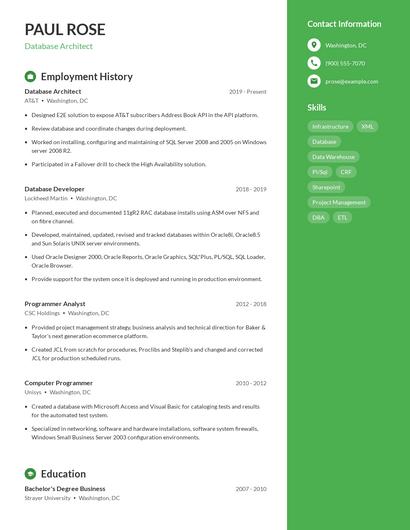
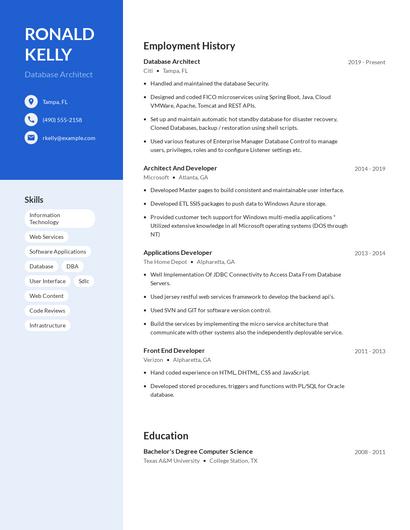
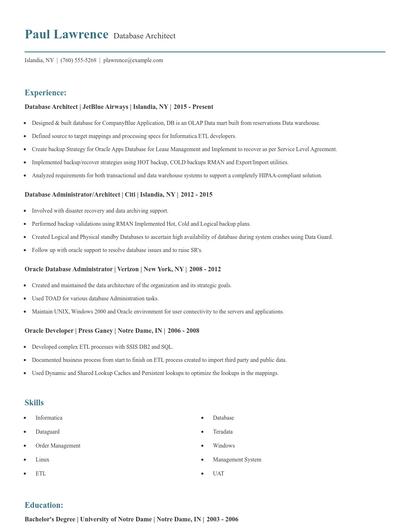
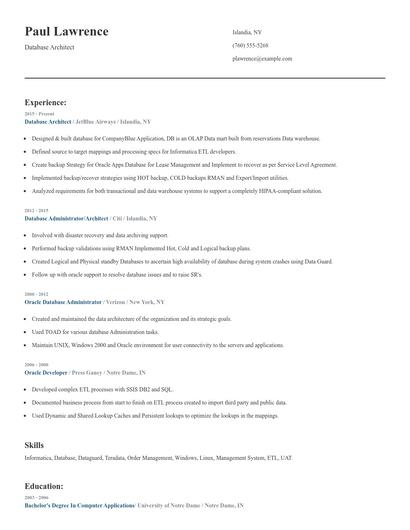
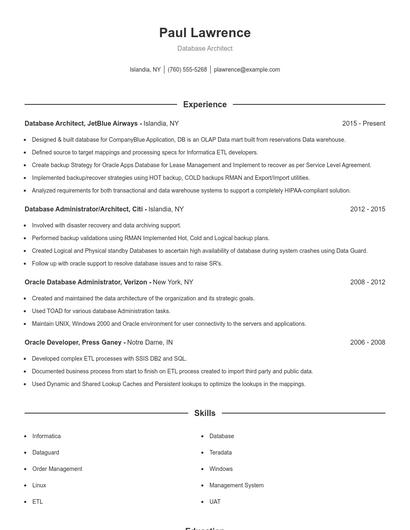
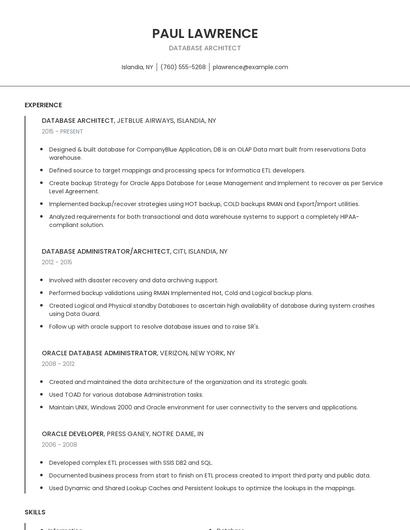
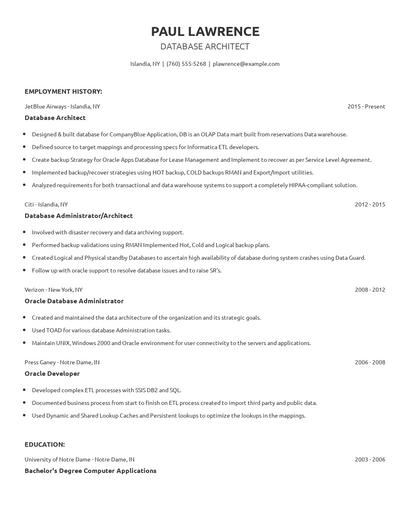
Choose from 10+ customizable database architect resume templates
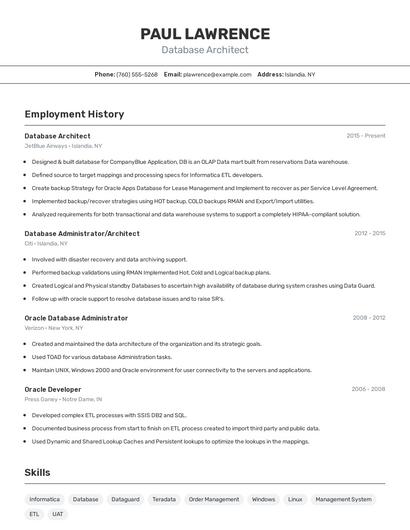
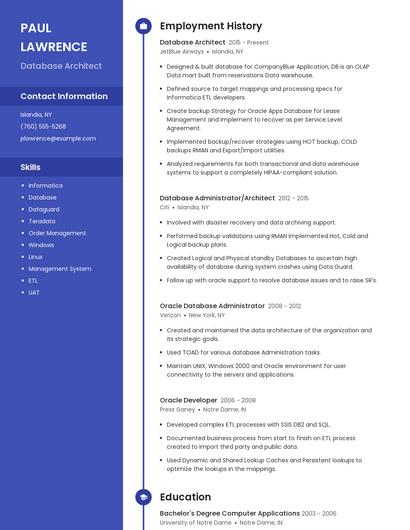
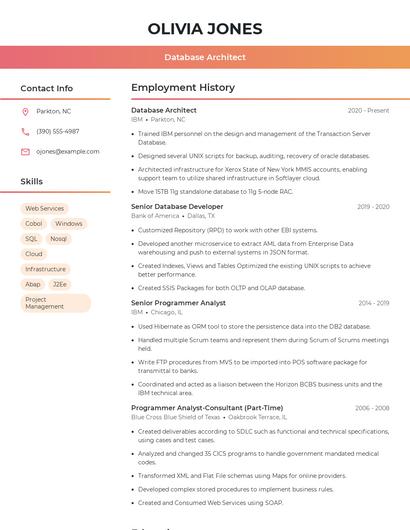
Build a professional database architect resume in minutes. Our AI resume writing assistant will guide you through every step of the process, and you can choose from 10+ resume templates to create your database architect resume.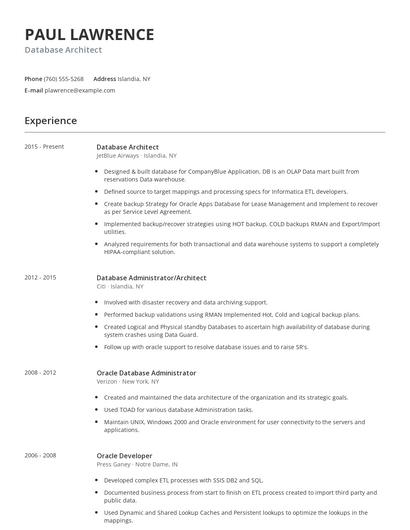

Compare different database architects
Database architect vs. Database developer/database administrator
A database developer/database administrator specializes in designing and developing database programs and systems, maintaining and updating them regularly. They are in charge of understanding project needs and guidelines, establishing and implementing test systems to identify potential risks and issues, fixing and upgrading components, and storing data according to protocols. They may also produce and present reports to managers and participate in creating security and recovery plans to protect company data. Moreover, as a database developer/database administrator, it is vital to be proactive at dealing with issues while adhering to company standards.
There are some key differences in the responsibilities of each position. For example, database architect responsibilities require skills like "cloud," "infrastructure," "provisioning," and "data architecture." Meanwhile a typical database developer/database administrator has skills in areas such as "ssis packages," "application development," "database backup," and "management system." This difference in skills reveals the differences in what each career does.
Database developer/database administrators really shine in the finance industry with an average salary of $109,613. Comparatively, database architects tend to make the most money in the finance industry with an average salary of $114,088.On average, database developer/database administrators reach similar levels of education than database architects. Database developer/database administrators are 4.3% less likely to earn a Master's Degree and 0.6% less likely to graduate with a Doctoral Degree.Database architect vs. Architect and developer
An Architect And Developer is focused on the technical design, architecture, and development of products. They generally work as a part of the development team.
While some skills are similar in these professions, other skills aren't so similar. For example, resumes show us that database architect responsibilities requires skills like "cloud," "infrastructure," "database design," and "database administration." But an architect and developer might use other skills in their typical duties, such as, "application development," "api," "c++," and "web services."
On average, architects and developer earn a higher salary than database architects. Some industries support higher salaries in each profession. Interestingly enough, architects and developer earn the most pay in the finance industry with an average salary of $125,314. Whereas database architects have higher pay in the finance industry, with an average salary of $114,088.Average education levels between the two professions vary. Architects and developer tend to reach similar levels of education than database architects. In fact, they're 1.0% less likely to graduate with a Master's Degree and 0.6% more likely to earn a Doctoral Degree.What technology do you think will become more important and prevalent for database architects in the next 3-5 years?
Dak Kopec Ph.D.
Associate Professor, Coordinator, BA Interior Architecture and Design and Master of Design Program, University Of Nevada, Las Vegas
Database architect vs. Senior oracle database administrator
A senior Oracle Database administrator is responsible for designing network systems and improve existing databases and software programs for optimal performance. Senior Oracle Database administrators maintain the safety and security of the computer systems and application to prevent unauthorized access and activities by upgrading network infrastructures. They also perform multiple diagnostic tests on the system to ensure stability and smooth navigations and assist the end-users on troubleshooting issues. A senior Oracle Database administrator must have excellent knowledge of the technology industry, as well as operating communication systems, programming languages, and system codes.
The required skills of the two careers differ considerably. For example, database architects are more likely to have skills like "infrastructure," "data architecture," "microsoft sql server," and "data lake." But a senior oracle database administrator is more likely to have skills like "troubleshoot," "disaster recovery," "database backup," and "windows."
Senior oracle database administrators earn the best pay in the finance industry, where they command an average salary of $122,380. Database architects earn the highest pay from the finance industry, with an average salary of $114,088.senior oracle database administrators typically earn similar educational levels compared to database architects. Specifically, they're 0.5% more likely to graduate with a Master's Degree, and 0.2% more likely to earn a Doctoral Degree.Database architect vs. Consultant database administrator
Consultant database administrators maintain and monitor the health and security of the database systems used in different applications utilized by international offices. They create database management procedures including, backup programs, server maintenance, and program updates. These administrators also provide technical support for programs and design a disaster recovery protocol in case of a security breach. They are also in charge of creating accounts and assigning the security level of access for all the users in their network.
Types of database architect
Updated January 8, 2025
