What does a database consultant do?
A database consultant is an information technology professional who specializes in database development and management. Part of their job is to establish and implement databases according to the company's needs, provide technical and analytical support, perform research and analyses, evaluate databases and systems to identify their strengths and weaknesses, and suggest solutions to optimize operations. Moreover, as a database consultant, it is essential to produce progress reports along with recommendations to improve database maintenance and resolve any potential issues or risks.
Database consultant responsibilities
Here are examples of responsibilities from real database consultant resumes:
- Deploy and manage VMware horizon view on CISCO UCS for VDI deployemet.
- Create encrypted passwords in UNIX and Linux servers by using SQL crypt utilities.
- Develop Java wrapper to eliminate database passwords from UNIX shell scripts to enhance security.
- Analyze and change SQL code heavily embed inside Java code.
- Perform tuning and optimization of SQL queries for faster SSRS reports running.
- Provide Linux server and workstation installation, configuration, maintenance and support services.
- Used PERL CGI scripts for execution of SAS programs from a web interface.
- Create multiple SQL, Perl, and UNIX shell scripts for database application maintenance.
- Perform regression, acceptance, and user interface testing on applications running on UNIX servers.
- Develop stored procedures, advance queries, trigger, views, indexes by using T-SQL.
- Create MDX queries to retrieve data from the cube and also to display SSRS reports.
- Redefine data mart with more complex star schemas to support OLAP functions to meet new business intelligence requirements.
- Assess schema design and develop t-SQL to extract data maintaining appropriate key relationships for bulk load into SalesForce.
- Develop data model, design front-end application and database, document the entire system and train end-users and DBA.
- Tune parameters and registry variables on development and test databases to perform stress test on BMC's DB2 products.
Database consultant skills and personality traits
We calculated that 20% of Database Consultants are proficient in Oracle Sql, DB, and Data Warehouse. They’re also known for soft skills such as Analytical skills, Communication skills, and Detail oriented.
We break down the percentage of Database Consultants that have these skills listed on their resume here:
- Oracle Sql, 20%
Implemented various customized Oracle reports using different techniques in Oracle sql/pl-sql.
- DB, 7%
Supported six go-lives during my tenure at USPS and performed the role of DB mentor to new employees.
- Data Warehouse, 6%
Developed and documented a data verification process for data input into DB2 data warehouse to enforce business requirements.
- PL/SQL, 6%
Authored PL/SQL stored procedures to auto-finalize postage statements, that are marked for auto finalization or that satisfy certain business rules.
- Microsoft SQL Server, 5%
Designed and assisted with implementation of daily backup routines and monitoring routines on corporate portal hosted on Microsoft SQL Server instances.
- OLTP, 4%
Separated workloads and consistently archived data which resulted in greatly reduced report production times and provided significantly more responsive OLTP queries.
"oracle sql," "db," and "data warehouse" are among the most common skills that database consultants use at work. You can find even more database consultant responsibilities below, including:
Analytical skills. The most essential soft skill for a database consultant to carry out their responsibilities is analytical skills. This skill is important for the role because "dbas must monitor a database system’s performance to determine when action is needed." Additionally, a database consultant resume shows how their duties depend on analytical skills: "hired to develop reporting tools in access (vba) and sql for frequency marketing analysis and database management. "
Communication skills. Another soft skill that's essential for fulfilling database consultant duties is communication skills. The role rewards competence in this skill because "most database administrators work on teams and need to communicate effectively with developers, managers, and other workers." According to a database consultant resume, here's how database consultants can utilize communication skills in their job responsibilities: "provide advanced level data analysis using sql server and oracle current duties are focused on communications with wholesale customers. "
Detail oriented. This is an important skill for database consultants to perform their duties. For an example of how database consultant responsibilities depend on this skill, consider that "working with databases requires an understanding of complex systems, in which a minor error can cause major problems." This excerpt from a resume also shows how vital it is to everyday roles and responsibilities of a database consultant: "develop detailed technical specifications and etl documentation in collaboration with database developer. ".
Problem-solving skills. database consultant responsibilities often require "problem-solving skills." The duties that rely on this skill are shown by the fact that "when database problems arise, administrators must troubleshoot and correct the problems." This resume example shows what database consultants do with problem-solving skills on a typical day: "gap analysis for various microsoft sql server and storage based ha/dr solutions. "
The three companies that hire the most database consultants are:
- Amazon75 database consultants jobs
- JPMorgan Chase & Co.2 database consultants jobs
- TWO95 International2 database consultants jobs
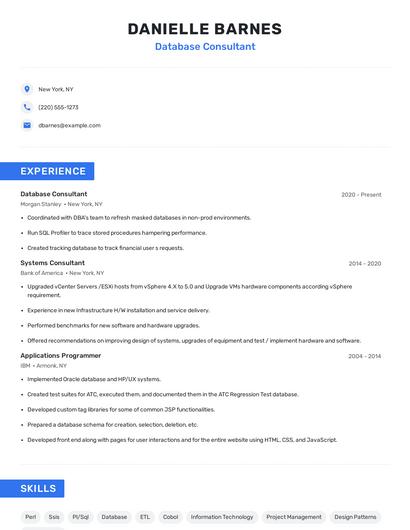
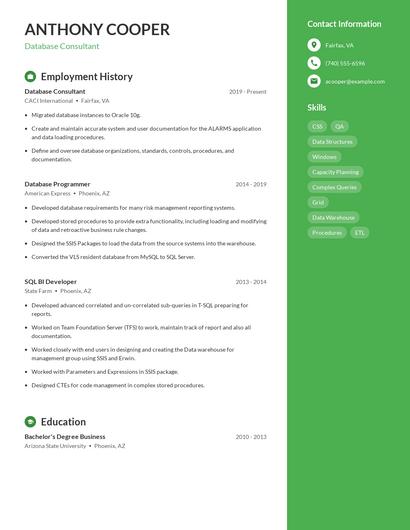
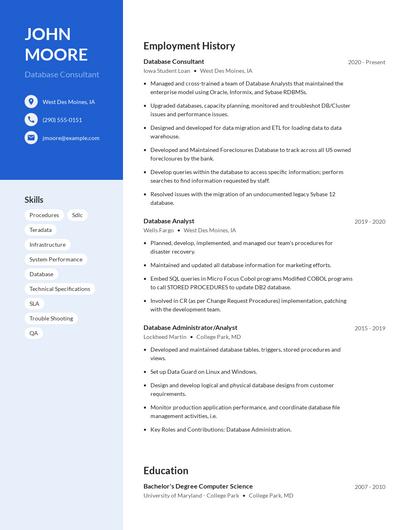
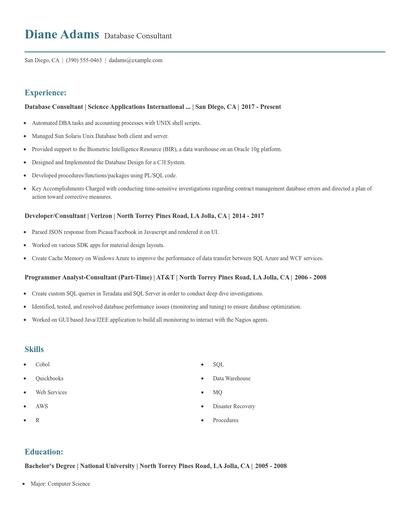
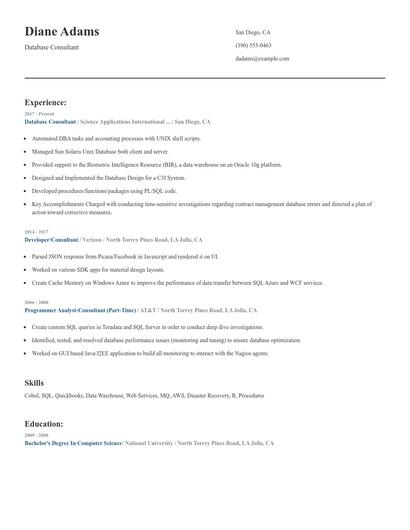
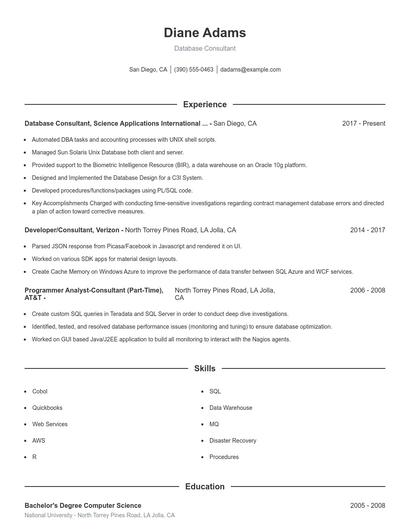
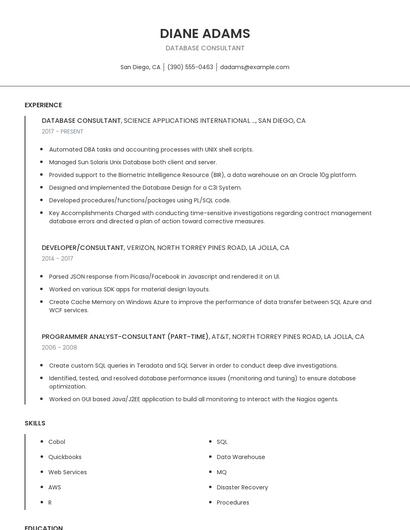
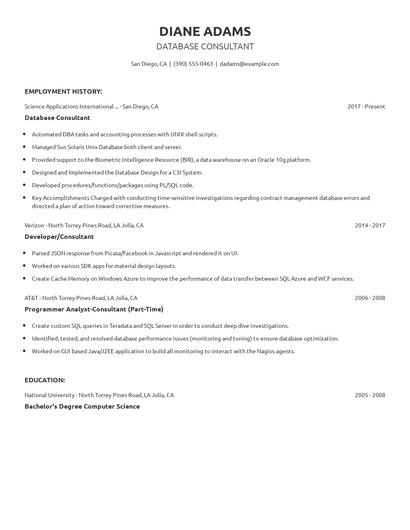
Choose from 10+ customizable database consultant resume templates
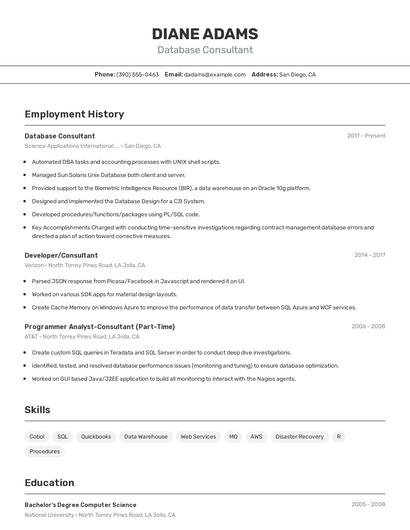
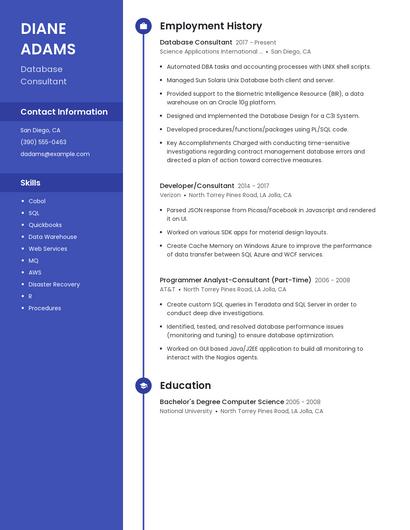
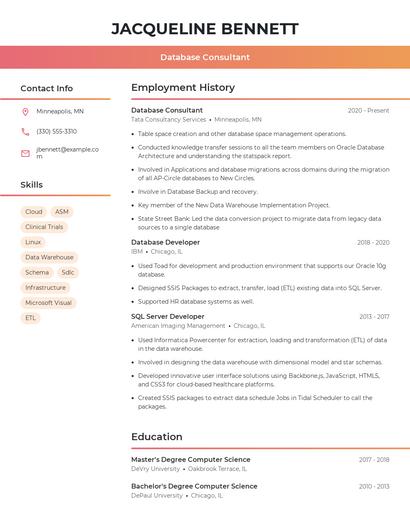
Build a professional database consultant resume in minutes. Our AI resume writing assistant will guide you through every step of the process, and you can choose from 10+ resume templates to create your database consultant resume.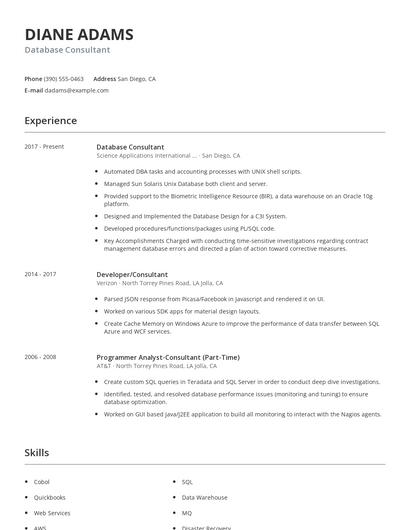
Compare different database consultants
Database consultant vs. Sql server developer
A structured query language (SQL) server developer is a specialist who is tasked to develop and maintain systems to store, organize, and access databases. With their experience in data architect and management, SQL server developers can develop and scale SQL databases based on the needs of their organization. They conduct troubleshooting in databases which involve data validation and extensive testing to ensure that the end user's specifications are met. They are also involved in the maintenance of the organization's server.
There are some key differences in the responsibilities of each position. For example, database consultant responsibilities require skills like "tcp ip," "db," "database design," and "management system." Meanwhile a typical sql server developer has skills in areas such as "sql server analysis," "ssis packages," "sql server profiler," and "windows server." This difference in skills reveals the differences in what each career does.
Sql server developers tend to make the most money working in the health care industry, where they earn an average salary of $95,274. In contrast, database consultants make the biggest average salary, $136,510, in the utilities industry.On average, sql server developers reach similar levels of education than database consultants. Sql server developers are 0.1% less likely to earn a Master's Degree and 1.1% less likely to graduate with a Doctoral Degree.Database consultant vs. Sql developer
An SQL developer is responsible for designing database systems for storing and accessing business information. SQL developers incorporate a high-level of data management and technical knowledge to ensure the safety and security of the systems, preventing unauthorized access that may put the company's reputation in jeopardy. They evaluate the network infrastructure, run multiple diagnostic tests, and update the information security systems for optimal performance and efficient navigation. An SQL developer must have excellent skills in programming languages, data engineering, and software management to handle the complexities of system commands and data validation.
While some skills are similar in these professions, other skills aren't so similar. For example, resumes show us that database consultant responsibilities requires skills like "tcp ip," "db," "management system," and "ssis." But an sql developer might use other skills in their typical duties, such as, "sql server analysis," "java," "ssis packages," and "c # .net."
Sql developers may earn a lower salary than database consultants, but sql developers earn the most pay in the health care industry with an average salary of $93,938. On the other hand, database consultants receive higher pay in the utilities industry, where they earn an average salary of $136,510.Average education levels between the two professions vary. Sql developers tend to reach similar levels of education than database consultants. In fact, they're 2.3% less likely to graduate with a Master's Degree and 1.1% less likely to earn a Doctoral Degree.Database consultant vs. Informatica developer
Informatica Developers are responsible for assisting in the process of maintaining all of the relevant sources of data and ensuring that all of the data is stored properly. This job involves coding, testing, and documentation of complex programs.
The required skills of the two careers differ considerably. For example, database consultants are more likely to have skills like "tcp ip," "db," "microsoft sql server," and "olap." But a informatica developer is more likely to have skills like "informatica workflow," "sql server," "informatica etl," and "repository."
Informatica developers earn the highest salary when working in the pharmaceutical industry, where they receive an average salary of $104,573. Comparatively, database consultants have the highest earning potential in the utilities industry, with an average salary of $136,510.When it comes to education, informatica developers tend to earn similar degree levels compared to database consultants. In fact, they're 4.0% less likely to earn a Master's Degree, and 1.4% less likely to graduate with a Doctoral Degree.Database consultant vs. Tableau developer
A tableau developer is responsible for creating data visualization solutions to enhance business processes. You will perform varied duties and responsibilities that may include preparing Tableau dashboard reports, creating business intelligence reports, and working closely with developers. Other tasks that you will likely perform are creating tools to effectively store data within the organization, conducting unit tests and developing database queries, and developing technical documentation. As a tableau developer, you will also conduct testing and troubleshooting systems and assisting non-technical staff in interpreting data.
Even though a few skill sets overlap between database consultants and tableau developers, there are some differences that are important to note. For one, a database consultant might have more use for skills like "tcp ip," "db," "oltp," and "database design." Meanwhile, some responsibilities of tableau developers require skills like "tableau dashboards," "visualization," "tableau server," and "tableau desktop. "
In general, tableau developers earn the most working in the pharmaceutical industry, with an average salary of $101,413. The highest-paying industry for a database consultant is the utilities industry.In general, tableau developers hold similar degree levels compared to database consultants. Tableau developers are 1.0% more likely to earn their Master's Degree and 1.1% less likely to graduate with a Doctoral Degree.Types of database consultant
Updated January 8, 2025
