What does a deployment engineer do?
A deployment engineer specializes in designing and developing deployment systems, ensuring quality and efficiency. Typically, it is their duty to conduct research and analysis to identify the company's needs, assess existing systems to identify areas needing improvement, implementing solutions against problem areas, and developing strategies to optimize operations. They may also provide technical support to employees, spearhead training programs as required. Furthermore, as a deployment engineer, it is essential to lead and encourage the staff to reach goals while implementing the company's policies and regulations.
Deployment engineer responsibilities
Here are examples of responsibilities from real deployment engineer resumes:
- Create service requests in CRM application to reflect report issues and manage customer expectations throughout escalation and/or resolution.
- Complete core/handler Java programming, JSP development, and QA testing responsibilities.
- Research and adopt optimal Linux OS configurations to provide better server performance.
- Work on TWS migration for entire ETL jobs
- Help to design and deploy a VMWare base private cloud.
- Maintain UNIX share library and windows DLL code for product lines.
- Standardize the Linux environment to provide a familiar shell across all the servers.
- Play a key role in different POCs including Datacenter virtualization and network security.
- Perform all logical work require such as server imaging, port provisioning and Msasset updates.
- Utilize SecureCRT and PowerMTA software mix with Perl scripts on Unix systems to deploy email campaigns.
- Create daily build status report and post in website to inform developers, QA testers, and managers.
- Provide mechanism that eliminate repetitive tasks of moving or copying files from source system to the ETL server.
- Provide ongoing support for Cisco VOIP at the facility including review of all configuration changes to the VOIP system.
- Configure profiles, server groups, servers, data sources, and security domains on JBoss and WebLogic servers.
- Streamline the delivery of code from development teams to QA teams through auditing of the build process and version control.
Deployment engineer skills and personality traits
We calculated that 8% of Deployment Engineers are proficient in Python, Troubleshoot, and Linux. They’re also known for soft skills such as Creativity, Detail oriented, and Interpersonal skills.
We break down the percentage of Deployment Engineers that have these skills listed on their resume here:
- Python, 8%
Developed scripts in Python to package log files and send them to a remote server.
- Troubleshoot, 7%
Execute WAN activation ticket and Troubleshoot WAN, T1, T3 and DS3 lines in upgrading WAN links for sites.
- Linux, 6%
Researched and adopted optimal Linux OS configurations to provide better server performance.
- Java, 5%
Configured and Administered the Java application with WebLogic Server.
- Windows Server, 4%
Implemented Technical requirements for the State Department by Supporting Windows Server 2003 account administration and Patch Management.
- Desktop, 4%
Designed a controlled desktop implementation to reduce desktop TCO while maintaining full end-user business functionality.
"python," "troubleshoot," and "linux" are among the most common skills that deployment engineers use at work. You can find even more deployment engineer responsibilities below, including:
Creativity. To carry out their duties, the most important skill for a deployment engineer to have is creativity. Their role and responsibilities require that "developers are the creative minds behind new computer software." Deployment engineers often use creativity in their day-to-day job, as shown by this real resume: "maintained inventory database in the in house ticketing system, listing ownership, location and warranty details. "
Detail oriented. Another soft skill that's essential for fulfilling deployment engineer duties is detail oriented. The role rewards competence in this skill because "developers often work on many parts of an application or system at the same time and must therefore be able to concentrate and pay attention to detail." According to a deployment engineer resume, here's how deployment engineers can utilize detail oriented in their job responsibilities: "tracked all pc requests including new/replacement pc s, software installations, and other request details. "
Interpersonal skills. deployment engineers are also known for interpersonal skills, which are critical to their duties. You can see how this skill relates to deployment engineer responsibilities, because "software developers must be able to work well with others who contribute to designing, developing, and programming successful software." A deployment engineer resume example shows how interpersonal skills is used in the workplace: "used superior technical, interpersonal, time management, and organizational skills to provide excellent customer service. "
Analytical skills. deployment engineer responsibilities often require "analytical skills." The duties that rely on this skill are shown by the fact that "developers must analyze users’ needs and then design software to meet those needs." This resume example shows what deployment engineers do with analytical skills on a typical day: "build out java production training environment, upgrade data model, packages, and data reference scripts. "
Communication skills. A commonly-found skill in deployment engineer job descriptions, "communication skills" is essential to what deployment engineers do. Deployment engineer responsibilities rely on this skill because "developers must be able to give clear instructions to others working on a project." You can also see how deployment engineer duties rely on communication skills in this resume example: "managed tcp/ip setup network communications, network cabling and troubleshooting all network connectivity issues. "
Problem-solving skills. Lastly, "problem-solving skills" is an important element of what a deployment engineer does. Deployment engineer responsibilities require this skill because "because developers are in charge of software from beginning to end, they must be able to solve problems that arise throughout the design process." This resume example highlights how deployment engineer duties rely on this skill: "implemented continuous integration solutions for java applications using ucm clearcase, maven, jenkins. "
The three companies that hire the most deployment engineers are:
- Oracle49 deployment engineers jobs
- Amazon24 deployment engineers jobs
- Tyler Technologies13 deployment engineers jobs
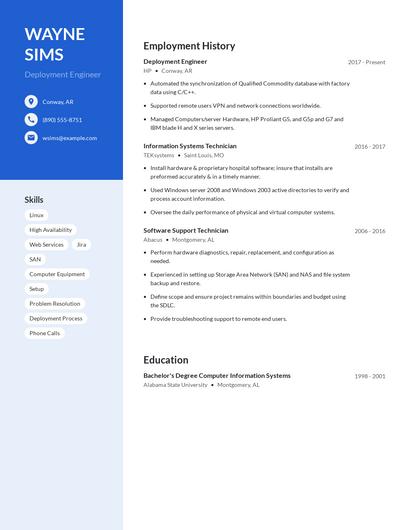
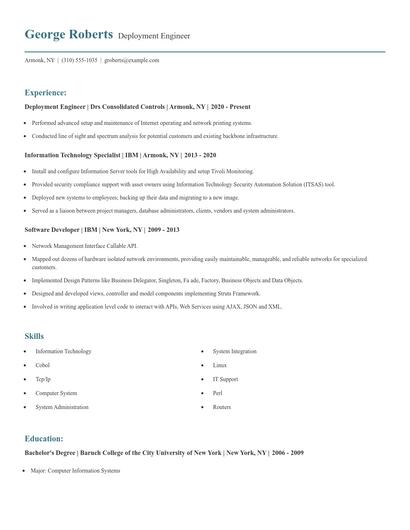
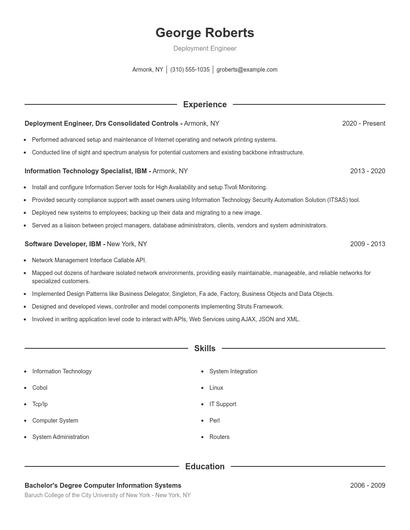
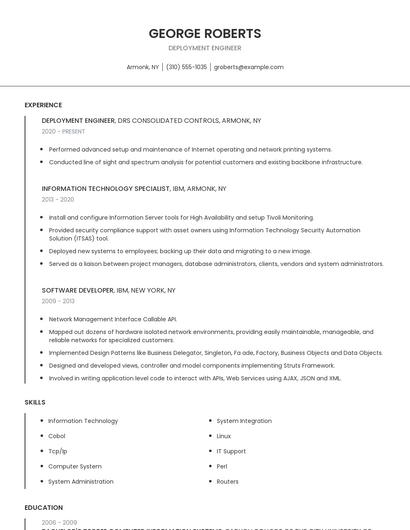
Choose from 10+ customizable deployment engineer resume templates
Build a professional deployment engineer resume in minutes. Our AI resume writing assistant will guide you through every step of the process, and you can choose from 10+ resume templates to create your deployment engineer resume.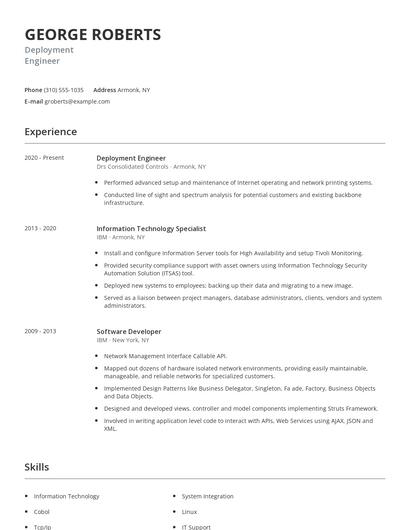
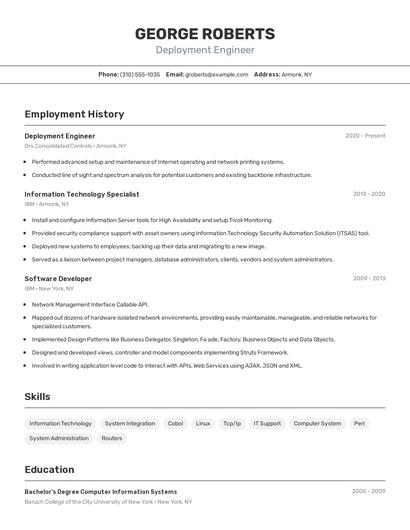
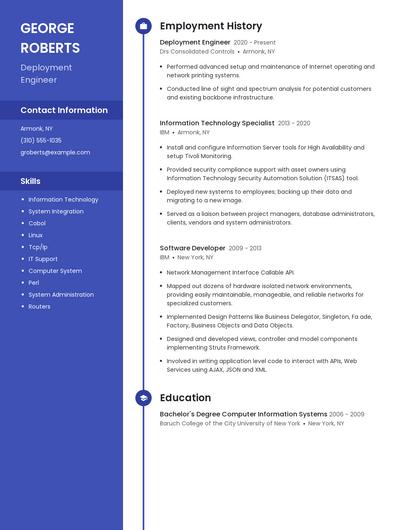

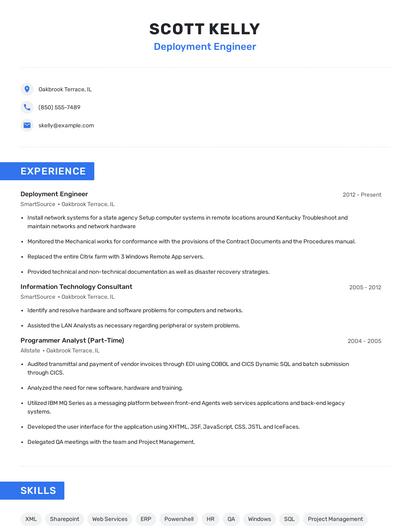



Compare different deployment engineers
Deployment engineer vs. Computer engineer
A computer engineer is someone who examines, designs, and manages computer hardware and software systems. He/She or she helps in solving issues or any concerns that may occur with the computer's hardware and software as well as assists in the innovation of computer technology. Computer engineers are responsible for computer hardware design, development, research, and test computer systems. They examine components like circuit boards, processors, memory devices, routers, and networks. While, those working with the computer software are in charge of the development, design, and administration of software programs.
There are some key differences in the responsibilities of each position. For example, deployment engineer responsibilities require skills like "desktop," "git," "sccm," and "powershell." Meanwhile a typical computer engineer has skills in areas such as "c #," "software development," "c," and "c++." This difference in skills reveals the differences in what each career does.
Computer engineers tend to make the most money working in the finance industry, where they earn an average salary of $117,704. In contrast, deployment engineers make the biggest average salary, $98,757, in the technology industry.On average, computer engineers reach similar levels of education than deployment engineers. Computer engineers are 2.7% more likely to earn a Master's Degree and 1.9% more likely to graduate with a Doctoral Degree.Deployment engineer vs. Software engineer
A software engineer is a computer science professional who is responsible for the development of information systems, designing and building computer systems software and applications software. They often prefer to call themselves as a software developer or computer programmer. They have substantial knowledge of programming languages, software development, and computer operating systems, and other technologies. They use these to turn a plan into a final output. They can create a design, test, and develop software based on the needs of their clients.
While some skills are similar in these professions, other skills aren't so similar. For example, resumes show us that deployment engineer responsibilities requires skills like "troubleshoot," "windows server," "desktop," and "vmware." But a software engineer might use other skills in their typical duties, such as, "software development," "object oriented programming," "c," and "c++."
Software engineers may earn a lower salary than deployment engineers, but software engineers earn the most pay in the start-up industry with an average salary of $122,617. On the other hand, deployment engineers receive higher pay in the technology industry, where they earn an average salary of $98,757.In general, software engineers achieve higher levels of education than deployment engineers. They're 8.5% more likely to obtain a Master's Degree while being 1.9% more likely to earn a Doctoral Degree.What technology do you think will become more important and prevalent for deployment engineers in the next 3-5 years?
Andrea Welker Ph.D.
Associate Dean for Academic Affairs, College of Engineering Professor, Civil and Environmental Engineering, Villanova University
Deployment engineer vs. Senior systems engineer
A senior systems engineer specializes in overseeing network systems, management tools, software, and hardware within a company or an organization. Their primary responsibility is to install, maintain, and resolve complex system issues using their years of extensive knowledge and expertise. They can also provide insights, troubleshooting, and technical support should it be needed. Furthermore, as a senior systems engineer, it is also their responsibility to lead, supervise, and coordinate with a team of skilled system engineers while in adherence to company policies and regulations.
There are many key differences between these two careers, including some of the skills required to perform responsibilities within each role. For example, a deployment engineer is likely to be skilled in "python," "desktop," "vmware," and "git," while a typical senior systems engineer is skilled in "architecture," "c++," "c #," and "dod."
Senior systems engineers earn the highest salary when working in the retail industry, where they receive an average salary of $116,608. Comparatively, deployment engineers have the highest earning potential in the technology industry, with an average salary of $98,757.Most senior systems engineers achieve a similar degree level compared to deployment engineers. For example, they're 4.4% more likely to graduate with a Master's Degree, and 1.3% more likely to earn a Doctoral Degree.Deployment engineer vs. Technical systems engineer
Technical Systems Engineers are responsible for maintaining the integrity of the infrastructure or systems network. They build, maintain, and repair all the systems and network infrastructure of the organization. They troubleshoot problems and find the best possible solution to address such problems. They also ensure that those problems will be resolved and would never be encountered again. Technical Systems Engineers also help out in information technology or network infrastructure projects of other departments. They provide expertise on the systems-related aspects of the project. They help guide project teams on the feasibility and the success factors of the project.
Types of deployment engineer
Updated January 8, 2025
