
Automatically apply for jobs with Zippia
Upload your resume to get started.
Deputy juvenile officer skills for your resume and career
15 deputy juvenile officer skills for your resume and career
1. Juvenile Offenders
- Provided general supervision performed a variety of duties relating to juvenile offenders.
- Provide supervision to approximately 65 juvenile offenders through formal and informal supervision.
2. Direct Supervision
Direct supervision is a term used to indicate that a person is supervising a certain task or a certain person while being physically present or in close proximity. It refers to the presence of a person and the availability of their supervision in something if it is needed.
- Direct Supervision of 8 staff members including annual evaluations.
- Direct supervision of Inmates, maintaining safety security and accountability at detention center and courthouse.
3. Law Enforcement Agencies
- Assisted and coordinated with fellow officers and other law enforcement agencies during the large-scale investigations involving multiple jurisdictions.
- Analyze reports and extract essential information received from the intelligence community and other law enforcement agencies.
4. Crisis Intervention
- Develop and implement plans of supervision, group and individual counseling, crisis intervention, and physically restrain offenders when required.
- Provided crisis intervention and coordinated services for children and families and ensured compliance of court orders.
5. Court Hearings
- Prepare documentation for court hearings, provide oral and written recommendations to the court and testify when required.
- Attended and testified in court hearings to pretrial/probationary clients that were assigned to my caseload.
6. Mental Health
Mental health is the state of wellbeing in which an individual can cope with the regular stresses and tensions of life, and can work productively without having any emotional or psychological breakdown. Mental health is essential for a person of any age and helps them make the right decisions in their life.
- Complete all necessary documents and paperwork including disciplinary reports, informational reports, inspection reports, and mental health screenings.
- Completed motivational interviewing training, completed proper screening for mental health issues, maintained proper documentation.
Choose from 10+ customizable deputy juvenile officer resume templates
Build a professional deputy juvenile officer resume in minutes. Our AI resume writing assistant will guide you through every step of the process, and you can choose from 10+ resume templates to create your deputy juvenile officer resume.7. Court Orders
- Helped start a unit for sexual perpetrators and facilitated groups for youth that were court ordered to participate through MOCSA.
- Supervised a caseload of juveniles and monitored compliance with Court ordered sanctions and services.
9. Court Reports
- Compiled court reports, home studies, social history reports and affidavits which provided recommendations as to the custody of juveniles.
- Review court reports submitted by staff and providing training and professional development for staff.
10. Protective Custody
- Perform on-call duties such as emergency protective custody and juvenile detention situations.
- Conducted interviews, background investigations, and authorized protective custody or detention.
11. Community Agencies
Community agencies stand for the organizations operated to provide human service in the community.
- Worked in conjunction with the community agencies for the betterment of families and children.
- Collaborated with law enforcement, treatment providers, schools and other community agencies.
12. JIS
- Input information, description, and charges on juveniles in the Missouri JIS (Juvenile Information System).
- Perform data entry of all juvenile case information utilizing the Justice Information System (JIS) program.
13. Sexual Abuse
- Collaborate with the Children's Division to investigate physical/sexual abuse and neglect.
- Assist the Division of Family Services in the investigation of severe physical or sexual abuse and neglect.
14. Law Violations
- Provided service for juveniles who had committed felony and misdemeanor law violations.
- Prepared written reports and testified in court with recommendations in cases involving child/abuse neglect cases, and felony law violations.
15. CPR
Cardiopulmonary resuscitation or CPR is a medical procedure that involves chest compression to help a patient breathe. This artificial ventilation helps in keeping the brain function in place and regulates blood throughout the body. CPR is a lifesaving procedure that is used in emergencies.
- Gained several certifications including CPR.
- Frisk Searches*Perimeter Checks*Contraband Searches*CPR certified*P.A.R.
5 Deputy Juvenile Officer resume examples
Build a professional deputy juvenile officer resume in minutes. Browse through our resume examples to identify the best way to word your resume. Then choose from 5+ resume templates to create your deputy juvenile officer resume.

What skills help Deputy Juvenile Officers find jobs?
Tell us what job you are looking for, we’ll show you what skills employers want.
List of deputy juvenile officer skills to add to your resume
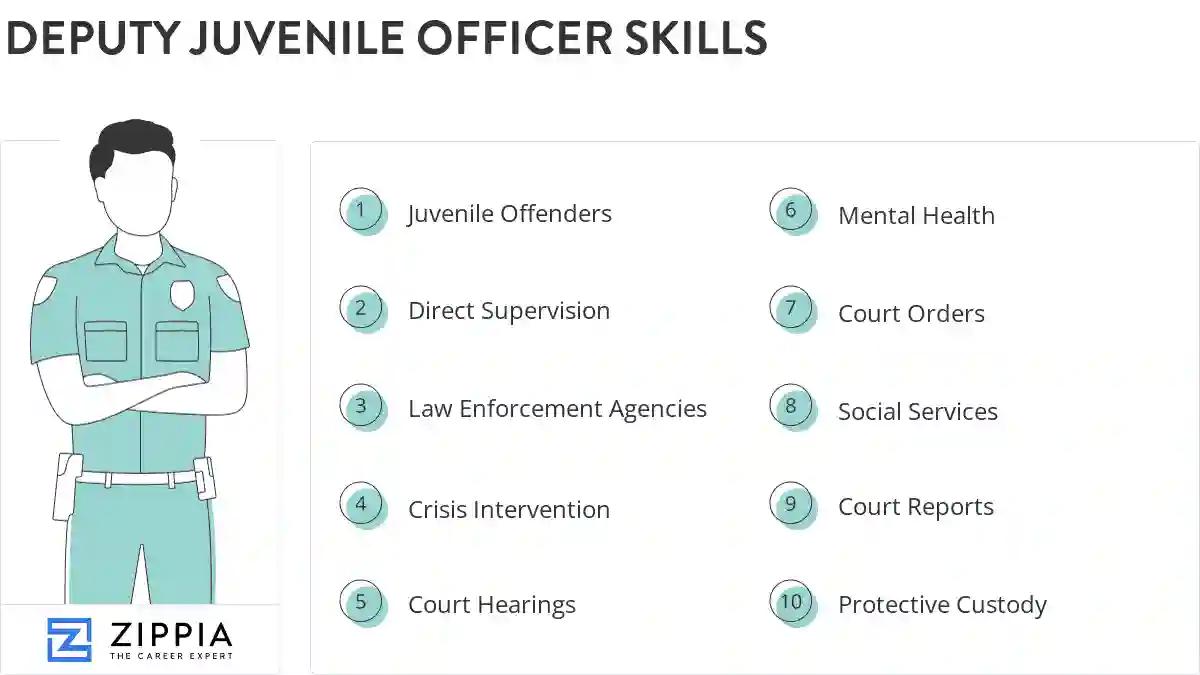
The most important skills for a deputy juvenile officer resume and required skills for a deputy juvenile officer to have include:
- Juvenile Offenders
- Direct Supervision
- Law Enforcement Agencies
- Crisis Intervention
- Court Hearings
- Mental Health
- Court Orders
- Social Services
- Court Reports
- Protective Custody
- Community Agencies
- JIS
- Sexual Abuse
- Law Violations
- CPR
- Community Resources
- Alcohol Tests
Updated January 8, 2025

8. Social Services