Explore jobs
Find specific jobs
Explore careers
Explore professions
Best companies
Explore companies
Job outlook for directors, learning and development in the United States
Are director, learning and development jobs in demand?
Director, learning and development job and salary trends over time
Director, learning and development jobs over time
Director, learning and development job growth rate over time
| Year | # of jobs | % of population |
|---|---|---|
| 2021 | 2,684 | 0.00% |
| 2020 | 2,897 | 0.00% |
| 2019 | 2,883 | 0.00% |
| 2018 | 2,673 | 0.00% |
| 2017 | 2,588 | 0.00% |
Average director, learning and development salary over time
Director, learning and development salary by year
| Year | Avg. salary | Hourly rate | % Change |
|---|---|---|---|
| 2026 | $92,733 | $44.58 | +2.0% |
| 2025 | $90,897 | $43.70 | +1.8% |
| 2024 | $89,285 | $42.93 | +2.9% |
| 2023 | $86,807 | $41.73 | +2.3% |
| 2022 | $84,866 | $40.80 | +3.1% |
Director, learning and development jobs by state
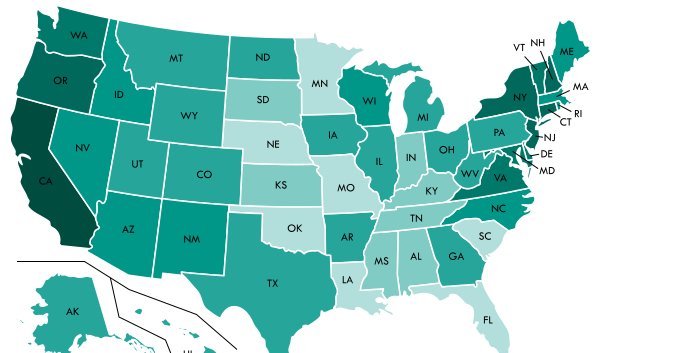
Most common states for directors, learning and development
| Rank | State | Population | # of jobs | Employment/ 1000ppl |
|---|---|---|---|---|
| 1 | South Dakota | 869,666 | 306 | 35% |
| 2 | District of Columbia | 693,972 | 200 | 29% |
| 3 | West Virginia | 1,815,857 | 418 | 23% |
| 4 | South Carolina | 5,024,369 | 1,032 | 21% |
| 5 | Alabama | 4,874,747 | 1,012 | 21% |
| 6 | New Hampshire | 1,342,795 | 283 | 21% |
| 7 | Montana | 1,050,493 | 205 | 20% |
| 8 | Alaska | 739,795 | 148 | 20% |
| 9 | Maine | 1,335,907 | 255 | 19% |
| 10 | Louisiana | 4,684,333 | 835 | 18% |
| 11 | Oklahoma | 3,930,864 | 700 | 18% |
| 12 | Mississippi | 2,984,100 | 512 | 17% |
| 13 | North Dakota | 755,393 | 132 | 17% |
| 14 | Minnesota | 5,576,606 | 916 | 16% |
| 15 | Maryland | 6,052,177 | 914 | 15% |
| 16 | Georgia | 10,429,379 | 1,435 | 14% |
| 17 | Arkansas | 3,004,279 | 410 | 14% |
| 18 | Kansas | 2,913,123 | 396 | 14% |
| 19 | New Mexico | 2,088,070 | 294 | 14% |
| 20 | Nebraska | 1,920,076 | 275 | 14% |
Most common cities for directors, learning and development
| Rank | City | # of jobs | Employment/ 1000ppl | Avg. salary |
|---|---|---|---|---|
| 1 | Duluth | 1 | 3% | $84,438 |
| 2 | South Bend | 2 | 2% | $81,454 |
| 3 | Bentonville | 1 | 2% | $91,293 |
| 4 | Eden Prairie | 1 | 2% | $71,788 |
| 5 | Boulder | 1 | 1% | $93,025 |
| 6 | Flagstaff | 1 | 1% | $98,742 |
| 7 | Chicago | 2 | 0% | $89,066 |
| 8 | Washington | 2 | 0% | $95,605 |
| 9 | Atlanta | 1 | 0% | $84,094 |
| 10 | Baltimore | 1 | 0% | $107,418 |
| 11 | Baton Rouge | 1 | 0% | $74,470 |
| 12 | Birmingham | 1 | 0% | $77,322 |
| 13 | Boston | 1 | 0% | $97,043 |
| 14 | Denver | 1 | 0% | $92,805 |
| 15 | Des Moines | 1 | 0% | $90,549 |
| 16 | Detroit | 1 | 0% | $85,011 |
Director, Learning And Development job outlook: Expert opinions
Our panel of director, learning and development experts

Holy Family University

Ohio University

m3 Development
Dr. Geraldine Fitzpatrick-Doria
Assistant ProfessorHoly Family University
School of Education
What Director, Learning And Development skills would you recommend for someone trying to advance their career?
Dr. Geraldine Fitzpatrick-Doria: If a graduate needs to take a gap year, I would recommend that they spend this time learning about themselves and learning about what is going on out in the field. As I coach aspiring educators I share with them that the teacher and the organization must be a match. It's almost like a marriage with intentional alignment of core values, principles, vision, educational philosophy and community. During a gap year I would encourage aspiring educators to spend some time focusing on themselves and thinking about where they would like to work and what they would like to do within an organization. Are they interested in public, private or charter school structures? Are they interested in urban or suburban? Are they interested in virtual or brick and mortar? Are they interested in progressive or traditional? During this time the pre-service educators can think about what would work best for them and begin to explore schools, districts, and organizations to see which one would match who they are as a personal and a professional educator.
I would encourage them to network and talk to as many educators and leaders as possible. Golden nuggets of wisdom can be found in every interaction and every conversation. Volunteering is also an excellent strategy. They can immerse themselves directly into schools and feel and breath the climate and culture. They can also review curriculum and teaching and engagement strategies. There's nothing better than being in the thick of it and observing everything. Through these experiences they can see what resonates with them and what they want to ensure they do not choose.
Finally as an advocate for self-care, I am passionate about sharing self-care strategies and plans with all pre-service educators that I meet and teach. Let's prepare our future educators so that they don't leave within the first five years of their teaching career.
Will there be an enduring impact of the coronavirus pandemic on Directors, Learning And Development?
Marcquis Parham: Absolutely, this generation of graduates has experienced an event that has no comparison to one from the past. Generation Z was inclined to use technology for communication, but never has the world articulated that as mandatory until recent times. Changing industry trends as well as the impact on socialization of the workplace will allow this new generation to have a new perspective on work, leisure, and life in general.
What type of skills will young Directors, Learning And Development need?
Marcquis Parham: Resiliency, Adaptability, and Innovation are key in today's workforce. Past generations have shown that the average graduate needs to be ready to change careers on average 3-5 times prior to retirement, and current trends can only continue to expand this phenomenon. The current workforce are inclined to the upcoming generations for ideas and solutions. Creativity and innovation are coveted in today's workplace.
What experience really stands out on Director, Learning And Development resumes?
Michael Baker: For graduates entering the job market, we look at any prior employment (part-time or full-time); what internships they have had, both paid and unpaid; their volunteer activities; accomplishments (i.e., GPA, Cum Laude, Gold Award, Eagle Scout, ROTC, leadership roles, etc.); and extracurricular activities candidates have had (clubs, intramural sports, NCAA student-athletes, study abroad experiences, sororities and fraternities, etc.). It is a better gauge for interest in working in the non-profit sector when candidates have had an internship with a non-profit organization and an internship outside the non-profit sector. Having experience as an intern at both a for-profit business and non-profit business (yes, non-profits are a business) is a great indicator that the candidate has had different experiences in both sectors helping to shape interests, views, ideas, skills, and the impact they want to make on the world.
I cannot highlight enough that ethics is the number one quality candidates must have; resumes should be clear, briefly descriptive, and accurate.
What Director, Learning And Development skills would you recommend for someone trying to advance their career?
Michael Baker: I am a big fan of graduate's taking a gap year to help get themselves set-up for success in their career. I recommend finding what you're passionate about that is employable. For example, if you want to work in the non-profit sector and have a specific area that has impacted you in your life, find an organization you can volunteer with that aligns with your specific area of interest. Some organizations will offer internships to recent graduates; if you have an interest in the cause, go for it. Those internships will help you determine if this is the direction you want to go, or not, for your career. Also, take advantage of career counseling services offered by the institution you just graduated from. They can help you by providing guidance and assessment tools to help you identify your skills, interests, and areas you need to develop. Good assessment tests are the Myers-Briggs Type Indicator, DISC Assessment, and others.
I also think those taking a gap year use the time wisely to develop relationships with fellow graduates, alumni, potential employers, friends, and family. Have an introductory networking conversation with someone in an interesting field you might want to work in. Taking the initiative shows you are resourceful and seeking others' advice. All should be on LinkedIn and take advantage of networking. Look for, and join, professional association young professional groups in your area of interest. When able to participate in webinars, Zooms, online conferences, professional development seminars, graduate test preparation courses, training, networking events, and other opportunities to learn and build your network. Gap year graduates should be focused on acquiring the skills you need for your next step, whether it is going to work or graduate school. For everyone, the skills needed are different. I always recommend graduates enhance their interpersonal communication abilities, learn to listen to others, develop writing skills, focus on developing task-oriented habits to actually get things done (For example: Making a to-do list for every day and sticking to it; repetition will build this habit and needed skill set), take the time to learn what the dress-code looks like in the professional environment you want to be in, be aware and knowledgeable of the latest in technology, and continue to ask questions. This is a great time in your life; take advantage of it.
What technology do you think will become more important and prevalent for Directors, Learning And Development in the next 3-5 years?
Michael Baker: The non-profit sector, like every sector, has been impacted greatly by technology. I believe innovation and disruption from technology is a key tool for making non-profits more efficient and effective. AI is already being used by the big non-profits and will become more common throughout our sector in mid-sized and small non-profit organizations when it is more cost-effective. The current, future and recent graduates are mostly Generation Z. This is the generation that was born into and has grown up with the internet and technology. The most important technology is and will continue to be online and mobile. Non-profits need to continue developing and investing in technology, tools, and support systems to meet the needs of their mission. Technology has brought us the internet, social media, the cloud, cashless forms of payments, automating work, evaluation tools creating dashboards that automatically monitor performance, electronic health records, and will continue to evolve. I believe machine-based learning and artificial intelligence are technology now and for the future. Technology that supports transparency, engagement, impact, and data analytics will be what is important in the next 3 to 5 years for non-profit organizations.