What does an electrical test engineer do?
An electrical test engineer specializes in developing test structures to ensure the quality and efficiency of electrical systems and equipment. Among their responsibilities include understanding and identifying the needs of electrical projects, troubleshooting errors, gathering and analyzing materials to find defects and inconsistencies, conducting tests and examinations, and analyzing test results. Moreover, an electrical test engineer must also study and identify the root of problems, recommending and implementing solutions while adhering to the company's policies and regulations.
Electrical test engineer responsibilities
Here are examples of responsibilities from real electrical test engineer resumes:
- Manage drafting and software group, write equipment specifications, BOMS, test, and installation procedures.
- Coordinate with senior electrical engineers and achieve hands-on experience on coal fire plant power generation and power transformers, circuit breakers.
- Work with management in obtaining UL approval.
- Used MATLAB to analyze data for clients.
- Perform the burn-in test battery on all displays.
- Modele PZT ceramic and piezo film parameters using MATLAB.
- Leverage ATS development for regression testing executing LabVIEW, LabWindows/CVI in TestStand.
- Help develop a group of 6 competent LabVIEW programming test engineers 10.
- Train test technicians, compile test reports, and troubleshoot technical issues.
- Configure, debug and instal cyberswitches, procurve switches and ethernet wiring.
- Implement new work procedures for mechanical & electrical build to ISO standards.
- Assist in the training of lab technicians on how to test and examine RF modules.
- Maintain CGI scripts interface to SQL databases that track and report system and processor performance.
- Train production employees as well as engineers to test and troubleshoot electronic switching equipment as introduced.
- Assist and advise the client company on UL, CSA, IEC and EU regulatory requirements.
Electrical test engineer skills and personality traits
We calculated that 7% of Electrical Test Engineers are proficient in Data Analysis, LabVIEW, and C++. They’re also known for soft skills such as Initiative, Speaking skills, and Math skills.
We break down the percentage of Electrical Test Engineers that have these skills listed on their resume here:
- Data Analysis, 7%
Simplify data analysis using software to automate data processing on repeated tests.
- LabVIEW, 7%
Delivered remarkable improvement by replacing a manual test system with personally designed automated test software using National Instruments LabView.
- C++, 6%
Created interrupt driven C++ test software and serial/parallel communication software to control instrumentation.
- Data Acquisition, 6%
Perform troubleshooting, repair/replacement of telemetry and instrumentation and data acquisition systems.
- Test Procedures, 5%
Develop and implement test procedures for the electrical characterization of High Density Interconnect Systems.
- Test Results, 4%
Maintain organized and well-documented test results in database for future reference.
Common skills that an electrical test engineer uses to do their job include "data analysis," "labview," and "c++." You can find details on the most important electrical test engineer responsibilities below.
Initiative. To carry out their duties, the most important skill for an electrical test engineer to have is initiative. Their role and responsibilities require that "electrical and electronics engineers must apply their knowledge to new tasks in every project they undertake." Electrical test engineers often use initiative in their day-to-day job, as shown by this real resume: "performed daily troubleshooting and led failure analysis and process improve initiatives in the long run. "
Speaking skills. Another soft skill that's essential for fulfilling electrical test engineer duties is speaking skills. The role rewards competence in this skill because "electrical and electronics engineers work closely with other engineers and technicians." According to an electrical test engineer resume, here's how electrical test engineers can utilize speaking skills in their job responsibilities: "worked closely with the senior engineer and electrical designers to develop new approaches to problems presented by the client. "
Math skills. electrical test engineers are also known for math skills, which are critical to their duties. You can see how this skill relates to electrical test engineer responsibilities, because "electrical and electronics engineers must use the principles of calculus and other advanced math in order to analyze, design, and troubleshoot equipment." An electrical test engineer resume example shows how math skills is used in the workplace: "completed mathematical calculations to accurately calibrate new/old equipment while also responsible for providing monthly evaluations of power management equipment. "
Writing skills. electrical test engineer responsibilities often require "writing skills." The duties that rely on this skill are shown by the fact that "electrical and electronics engineers develop technical publications related to equipment they develop, including maintenance manuals, operation manuals, parts lists, product proposals, and design methods documents." This resume example shows what electrical test engineers do with writing skills on a typical day: "conducted data analysis using microsoft excel, writing script in lua, a c based language for testing purposes. "
The three companies that hire the most electrical test engineers are:
- Raytheon Technologies10 electrical test engineers jobs
- Tesla10 electrical test engineers jobs
- Carrier8 electrical test engineers jobs
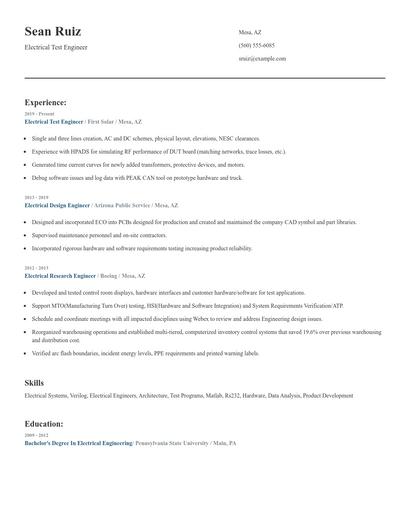
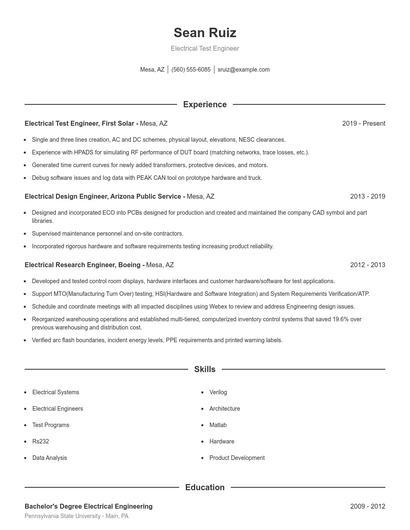
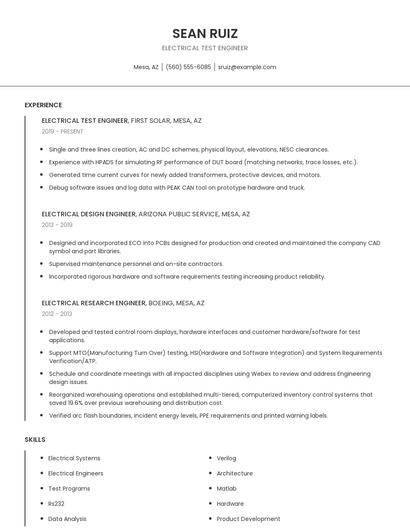
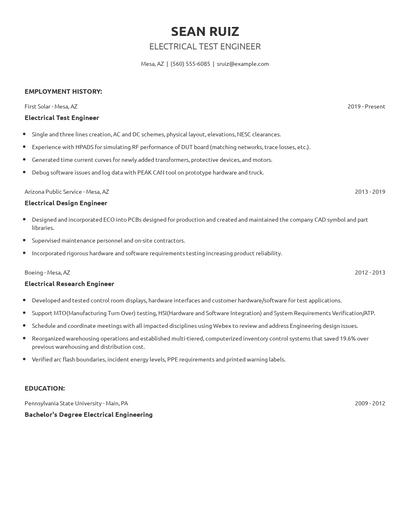
Choose from 10+ customizable electrical test engineer resume templates
Build a professional electrical test engineer resume in minutes. Our AI resume writing assistant will guide you through every step of the process, and you can choose from 10+ resume templates to create your electrical test engineer resume.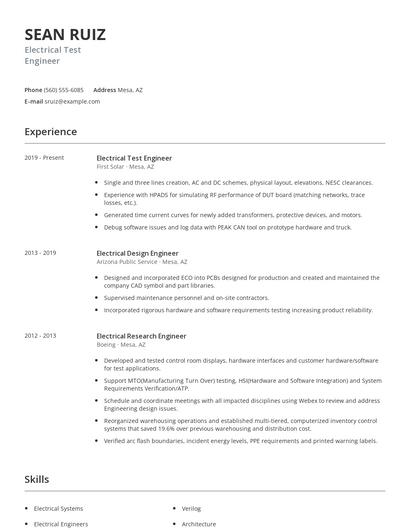


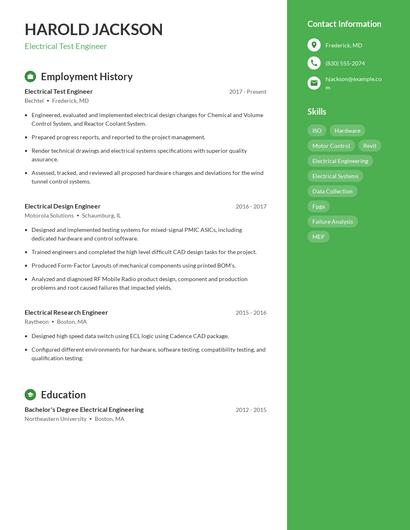
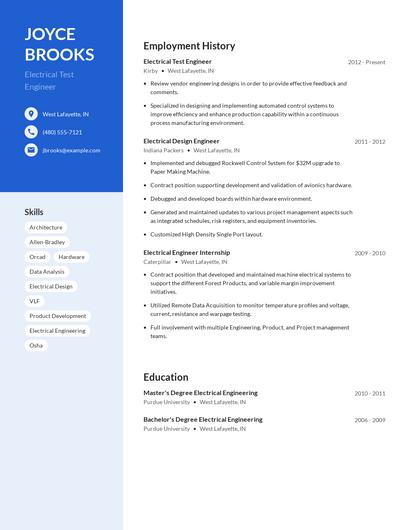
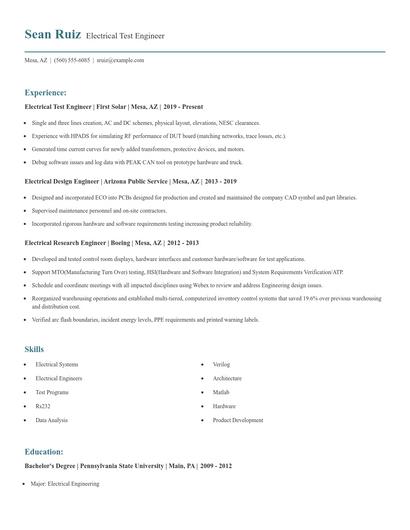
Compare different electrical test engineers
Electrical test engineer vs. Test technician
A test technician is responsible for running multiple diagnostic tests on various tools and equipment to boost optimization and ensure its efficient performance on operations. Test technicians inspect system components and manage calibration, following clients' specifications or the business' needs. A test technician also analyzes the system's design processes and features to understand its complexities and identify necessary upgrades. Test technicians keep a record of system issues and resolutions for reference. A test technician must have excellent knowledge of the technical and mechanical industry to perform tasks and achieve the highest customer satisfaction.
While similarities exist, there are also some differences between electrical test engineers and test technician. For instance, electrical test engineer responsibilities require skills such as "labview," "c++," "c #," and "electrical systems." Whereas a test technician is skilled in "hand tools," "engineering drawings," "oscilloscopes," and "windows." This is part of what separates the two careers.
Test technicians tend to make the most money working in the technology industry, where they earn an average salary of $48,786. In contrast, electrical test engineers make the biggest average salary, $86,752, in the automotive industry.The education levels that test technicians earn slightly differ from electrical test engineers. In particular, test technicians are 7.3% less likely to graduate with a Master's Degree than an electrical test engineer. Additionally, they're 0.8% less likely to earn a Doctoral Degree.Electrical test engineer vs. Senior field engineer
A senior field engineer is in charge of overseeing and providing technical support on-site, helping operations run smoothly and efficiently. Among their responsibilities include performing installations and upgrades, performing research and analysis, managing staff, producing progress reports, and conducting inspections, ensuring compliance with state laws and regulations. They must also perform regular maintenance checks on equipment, performing corrective repairs and adjustments when necessary. Furthermore, as a senior field engineer, it is essential to lead and serve as a mentor to junior engineers while implementing the site's safety policies and regulations.
Each career also uses different skills, according to real electrical test engineer resumes. While electrical test engineer responsibilities can utilize skills like "data analysis," "labview," "c++," and "c #," senior field engineers use skills like "excellent interpersonal," "technical problems," "test equipment," and "linux."
Senior field engineers earn a higher average salary than electrical test engineers. But senior field engineers earn the highest pay in the energy industry, with an average salary of $107,400. Additionally, electrical test engineers earn the highest salaries in the automotive with average pay of $86,752 annually.senior field engineers earn similar levels of education than electrical test engineers in general. They're 2.6% less likely to graduate with a Master's Degree and 0.8% less likely to earn a Doctoral Degree.Electrical test engineer vs. Radio frequency engineer
A radio frequency engineer, also known as RF engineer, specializes in designing and developing communication systems using radio waves. One of their primary responsibilities revolves around creating networks and systems and testing equipment. They make sure that equipment is up to high standards by traveling to different areas as needed, troubleshooting issues to identify the root of problems and performing corrective measures required. Furthermore, a radio frequency engineer must continuously optimize equipment quality and ensure efficiency while adhering to the laws and regulations.
The required skills of the two careers differ considerably. For example, electrical test engineers are more likely to have skills like "data analysis," "c++," "c #," and "data acquisition." But a radio frequency engineer is more likely to have skills like "test equipment," "antenna," "system performance," and "system design."
Radio frequency engineers earn the highest salary when working in the technology industry, where they receive an average salary of $94,522. Comparatively, electrical test engineers have the highest earning potential in the automotive industry, with an average salary of $86,752.When it comes to education, radio frequency engineers tend to earn higher degree levels compared to electrical test engineers. In fact, they're 9.4% more likely to earn a Master's Degree, and 0.3% more likely to graduate with a Doctoral Degree.Electrical test engineer vs. Engineer
Engineers are highly trained professionals who determine the feasibility of various projects, usually related to the construction industry. They are considered experts in mathematics and science, two disciplines that they need to use in designing and coming up with plans for projects. They should also be well-versed in different construction or industrial materials, and they ensure that appropriate materials are used for the project. They also ensure that the projects meet the requirements of the groups that hired them. They create spaces that would both address the needs of the end-users and the industry standards. They also ensure that the projects they make would stand the test of time.
Types of electrical test engineer
Updated January 8, 2025
