Explore jobs
Find specific jobs
Explore careers
Explore professions
Best companies
Explore companies
Job outlook for energy auditors in the United States
Are energy auditor jobs in demand?
Energy auditor job and salary trends over time
Energy auditor jobs over time
Energy auditor job growth rate over time
| Year | # of jobs | % of population |
|---|---|---|
| 2021 | 3,227 | 0.00% |
| 2020 | 4,639 | 0.00% |
| 2019 | 4,942 | 0.00% |
| 2018 | 3,322 | 0.00% |
| 2017 | 3,136 | 0.00% |
Average energy auditor salary over time
Energy auditor salary by year
| Year | Avg. salary | Hourly rate | % Change |
|---|---|---|---|
| 2026 | $62,723 | $30.16 | +4.0% |
| 2025 | $60,336 | $29.01 | +2.4% |
| 2024 | $58,922 | $28.33 | +0.7% |
| 2023 | $58,488 | $28.12 | +1.4% |
| 2022 | $57,677 | $27.73 | +1.3% |
Energy auditor jobs by state
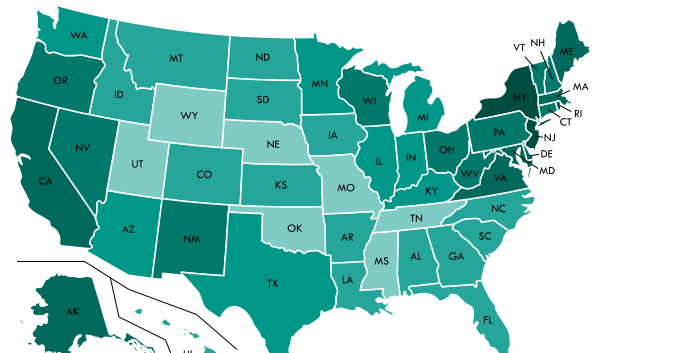
Most common states for energy auditors
| Rank | State | Population | # of jobs | Employment/ 1000ppl |
|---|---|---|---|---|
| 1 | District of Columbia | 693,972 | 103 | 15% |
| 2 | Massachusetts | 6,859,819 | 243 | 4% |
| 3 | Colorado | 5,607,154 | 206 | 4% |
| 4 | Connecticut | 3,588,184 | 128 | 4% |
| 5 | Montana | 1,050,493 | 41 | 4% |
| 6 | Delaware | 961,939 | 34 | 4% |
| 7 | Wyoming | 579,315 | 24 | 4% |
| 8 | Vermont | 623,657 | 23 | 4% |
| 9 | Illinois | 12,802,023 | 432 | 3% |
| 10 | Georgia | 10,429,379 | 304 | 3% |
| 11 | Virginia | 8,470,020 | 281 | 3% |
| 12 | Arizona | 7,016,270 | 213 | 3% |
| 13 | Minnesota | 5,576,606 | 178 | 3% |
| 14 | Maryland | 6,052,177 | 152 | 3% |
| 15 | Wisconsin | 5,795,483 | 148 | 3% |
| 16 | Iowa | 3,145,711 | 110 | 3% |
| 17 | Oregon | 4,142,776 | 106 | 3% |
| 18 | Maine | 1,335,907 | 45 | 3% |
| 19 | New Hampshire | 1,342,795 | 40 | 3% |
| 20 | Rhode Island | 1,059,639 | 30 | 3% |
Most common cities for energy auditors
| Rank | City | # of jobs | Employment/ 1000ppl | Avg. salary |
|---|---|---|---|---|
| 1 | Bangor | 1 | 3% | $73,905 |
| 2 | Saint Paul | 3 | 1% | $69,817 |
| 3 | Lansing | 1 | 1% | $66,422 |
Energy Auditor job outlook: Expert opinions
Our panel of energy auditor experts
Metropolitan State University
University of South Florida
University of South Florida
What Energy Auditor skills would you recommend for someone trying to advance their career?
Dr. Xiaolong Shao: If you want to maximize your salary potential as a new graduate, I believe it's important to first understand the job market well. Look for positions with less competition, and don't hesitate to put your personal interests aside for the time being. Do some research about what special skills are highly valued in the industry, such as revenue management, event planning, or culinary arts. Then, enhance your credibility by obtaining different certifications or attending relevant training programs. Many higher education institutions offer excellent training and certification programs. Also, keep an eye on industry trends, build your network, and consider the economy, or political environment when choosing where to work. This is a continuous process, but the key to maximizing your salary is to spend time understanding what unique values that make you irreplaceable.
What will help Energy Auditors increase their earning potential?
Dr. Xiaolong Shao: I believe there are many important skills that play important roles in succeeding in the hospitality industry. As a researcher who focuses on sustainable products and consumer behaviors, I can see that the hospitality industry evolves with a growing focus on sustainability and Environmental, Social, and Governance (ESG) principles. I believe that graduates must cultivate a diverse skill set to thrive in the field over the next 3-5 years. For example, proficiency in sustainability skills/practices, including resource management and eco-friendly technologies, is important, as well as analytical skills for assessing environmental impact and progress towards sustainability goals. Also, effective communication and stakeholder engagement are very important for garnering support for these ESG initiatives.
Thomas Culhane
University of South Florida
Sustainability Studies
What will help Energy Auditors increase their earning potential?
Thomas Culhane: I would (and do) give graduates the same advice my journalist father gave to my graduating class when I was young: 'Only Connect'. Dad was certain, and I am now too, that the most important career skill in general and specifically for the sustainability field is to develop and constantly strengthen your ability to connect different ideas and fields. Our PCGS program is unabashedly interdisciplinary. I teach the 'Navigating the Food Energy Water Nexus' and 'Waste Not Want Not: Reconsidering Refuse as Resource' courses, as well as being the director of our Climate Mitigation and Adaptation program and teaching science communication and technical skills through our 'Envisioning Sustainability' and 'Sustainable Design Laboratory' Courses and they ALL overlap and they all demand 'Nexus Thinking' – the ability to see the rhizomal/neuronal connections between each area of study.
What will help Energy Auditors increase their earning potential?
Joseph Dorsey Ph.D.: There are many positions out there in the public, private and non-profit sectors for Sustainability Officers, Sustainability Managers, Sustainability Coordinators, Sustainability Planners, and Sustainability Consultants. But not all sustainability related jobs have “sustainability” in the title. Jobs that focus on environment, resiliency, green technology, renewable energy, water management, food systems, climate, biodiversity, tourism, transportation, public health, and policy implementation, among others, could have sustainability components that can assure a long-term career in the field. I often tell my students that the jobs in sustainability that they seek may not exist yet, but once they have the appropriate education, training, and skills to address certain problems in the future, they’ll either create the position themselves or the position will appear in the job market due to timeliness and relevant necessity.