What does an engine installer do?
Engine installer responsibilities
Here are examples of responsibilities from real engine installer resumes:
- Perform installation of subsea control modules, hydraulic flying leads and electric flying leads.
- Manage and perform the onsite installation, configuration and setup of all PLC and network monitoring software.
- Manage relationships through CRM documentation and complete post-sale customer follow ups.
- Install, monitor and updating network equipment (switches, routers, access points).
- Install routers, switches, hubs, and wiring into public schools over the state of Arizona.
- Include desktop and laptop PC's, monitors, cabling, printers, check scanners, switches and routers.
- Configure, test, and troubleshoot various routing protocols, including OSPF, RIPv2, BGP, and EIGRP.
- Configure, update and troubleshoot BGP.
- Make minor, common changes in plc logic.
- Install and test VOIP, at customer location.
- Create designs of equipment and architectural solid models and drawings in AutoCAD.
- Create, modify, and update AutoCAD drawings when in home office.
- Board level troubleshooting for digital and RF devices and occasional component level.
- Assist implementation of first broadband DSL service for AmericasMart, Atlanta GA.
- Locate and move user's vital data from old PC to new PC.
Engine installer skills and personality traits
We calculated that 14% of Engine Installers are proficient in Technical Support, Autocad, and Equipment Installation. They’re also known for soft skills such as Creativity, Mechanical skills, and Listening skills.
We break down the percentage of Engine Installers that have these skills listed on their resume here:
- Technical Support, 14%
Provided technical support to resolve post-installation issues.
- Autocad, 7%
Complete Network/Security Drawings and Blueprints via AutoCAD.
- Equipment Installation, 7%
Perform equipment installation activities including cabling, assembly, running safety checks and initial set-up.
- PC, 6%
Included desktop and laptop PC's, monitors, cabling, printers, check scanners, switches and routers.
- Installation Procedures, 6%
Developed installation procedures for pipeline and in-line structure installation.
- Technical Issues, 6%
Interact with IE coordinator, Network Design, Civil Work and Implementation regarding SE technical issues.
"technical support," "autocad," and "equipment installation" are among the most common skills that engine installers use at work. You can find even more engine installer responsibilities below, including:
Creativity. One of the key soft skills for an engine installer to have is creativity. You can see how this relates to what engine installers do because "mechanical engineers design and build complex pieces of equipment and machinery." Additionally, an engine installer resume shows how engine installers use creativity: "performed and documented inventory on routers, switches, switch panel, hubs and lab computers. "
Mechanical skills. Many engine installer duties rely on mechanical skills. "mechanical skills allow engineers to apply basic engineering concepts and mechanical processes to the design of new devices and systems.," so an engine installer will need this skill often in their role. This resume example is just one of many ways engine installer responsibilities rely on mechanical skills: "performed the mechanical installation of computer systems at the factory and at customer sites. "
Listening skills. This is an important skill for engine installers to perform their duties. For an example of how engine installer responsibilities depend on this skill, consider that "mechanical engineers often work on projects with others, such as architects and computer scientists." This excerpt from a resume also shows how vital it is to everyday roles and responsibilities of an engine installer: "communicated regularly with the telecommunication service center and others to ensure priority changes can be met. ".
Math skills. A big part of what engine installers do relies on "math skills." You can see how essential it is to engine installer responsibilities because "mechanical engineers use the principles of calculus, statistics, and other advanced subjects in math for analysis, design, and troubleshooting in their work." Here's an example of how this skill is used from a resume that represents typical engine installer tasks: "developed a demo rest web service for meap statistics with java/j2ee. "
Problem-solving skills. A commonly-found skill in engine installer job descriptions, "problem-solving skills" is essential to what engine installers do. Engine installer responsibilities rely on this skill because "mechanical engineers need good problem-solving skills to take scientific principles and discoveries and use them to design and build useful products." You can also see how engine installer duties rely on problem-solving skills in this resume example: "analyzed and resolved pc related problems. "
The three companies that hire the most engine installers are:
- Applied Materials64 engine installers jobs
- Amazon20 engine installers jobs
- iHeartMedia19 engine installers jobs
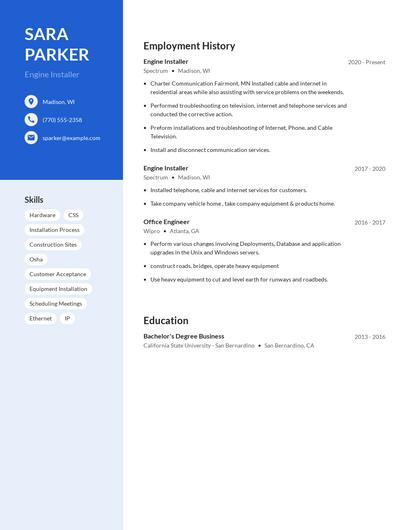
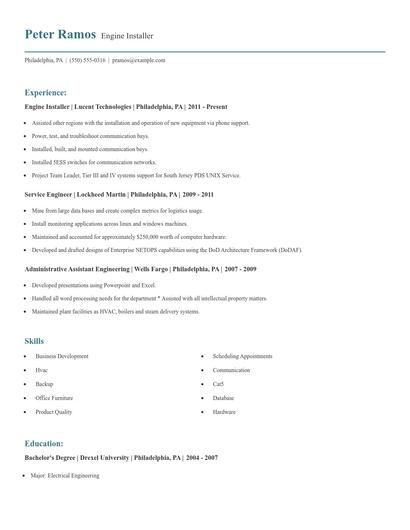
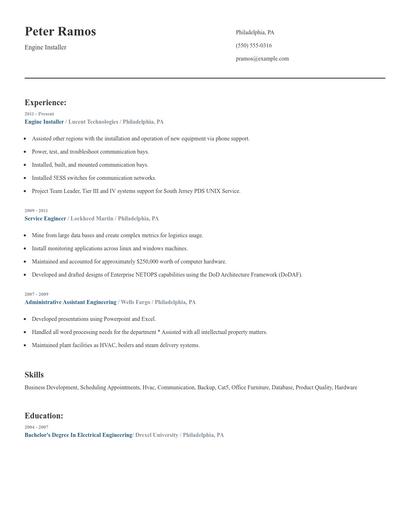
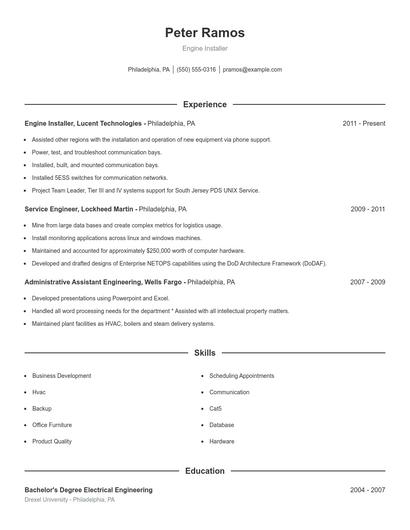
Choose from 10+ customizable engine installer resume templates
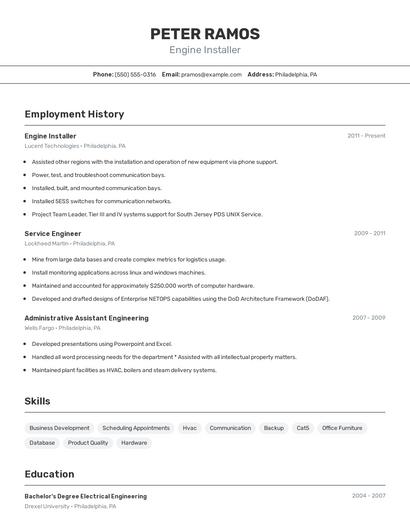
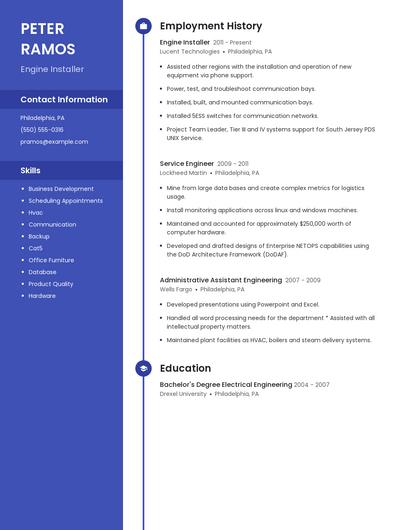
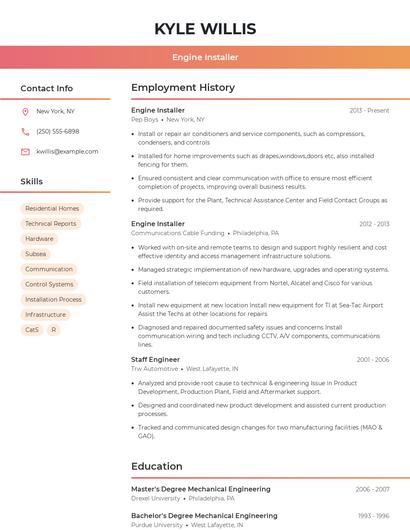
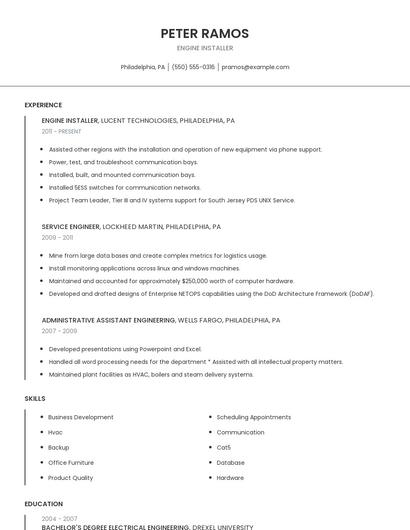
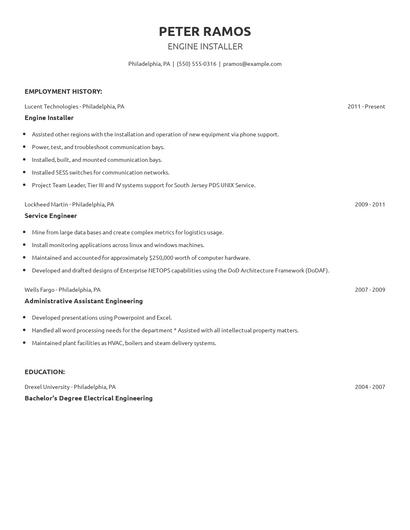
Build a professional engine installer resume in minutes. Our AI resume writing assistant will guide you through every step of the process, and you can choose from 10+ resume templates to create your engine installer resume.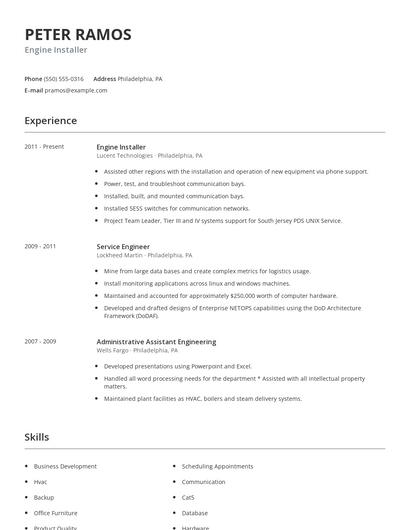


Compare different engine installers
Engine installer vs. Systems designer
In the information technology industry, a systems designer specializes in creating systems in adherence to the client or company's needs. Their responsibilities include performing research and analysis, gathering and analyzing operational data and client feedback, subjecting designs in a variety of tests, coordinating with engineers, troubleshooting problems, and developing strategies to optimize operations. They may also assess existing systems and design enhancements as needed. Moreover, a systems designer may provide technical support and guidance to staff while adhering to the company's policies and regulations.
There are some key differences in the responsibilities of each position. For example, engine installer responsibilities require skills like "technical support," "system troubleshooting," "autocad," and "equipment installation." Meanwhile a typical systems designer has skills in areas such as "system design," "crm," "sales proposals," and "customer satisfaction." This difference in skills reveals the differences in what each career does.
Systems designers earn the highest salaries when working in the health care industry, with an average yearly salary of $105,218. On the other hand, engine installers are paid more in the energy industry with an average salary of $83,177.The education levels that systems designers earn slightly differ from engine installers. In particular, systems designers are 5.4% more likely to graduate with a Master's Degree than an engine installer. Additionally, they're 0.2% less likely to earn a Doctoral Degree.Engine installer vs. Mechanical designer
A mechanical designer is responsible for designing mechanical equipment and devices, together with the engineers and other technology professionals. Mechanical designers create layouts following the clients' specifications, perform structural analysis, and analyze dimensions to ensure quality. They also inspect overall equipment performance and recommend adjustments as needed to improve its quality and boost optimization. Mechanical designers assist with installation and system upgrades, respond with the clients' inquiries and concerns, and escalate it to the appropriate personnel for resolution. A mechanical designer must have a strong knowledge of the mechanical and technology industry to build designs according to the highest standards.
In addition to the difference in salary, there are some other key differences worth noting. For example, engine installer responsibilities are more likely to require skills like "technical support," "system troubleshooting," "autocad," and "equipment installation." Meanwhile, a mechanical designer has duties that require skills in areas such as "mechanical design," "revit," "auto cad," and "engineering drawings." These differences highlight just how different the day-to-day in each role looks.
Mechanical designers earn a higher average salary than engine installers. But mechanical designers earn the highest pay in the energy industry, with an average salary of $66,900. Additionally, engine installers earn the highest salaries in the energy with average pay of $83,177 annually.Average education levels between the two professions vary. Mechanical designers tend to reach similar levels of education than engine installers. In fact, they're 4.0% less likely to graduate with a Master's Degree and 0.2% less likely to earn a Doctoral Degree.Engine installer vs. Mechanical design engineer
A mechanical design engineer specializes in designing various mechanical devices that will be vital in developing machinery or large structures. One of their primary responsibilities revolves around conducting thorough research and analysis, establishing layouts and prototypes, producing progress reports, and working alongside fellow engineers and skilled professionals. Typically assigned in an office setting, a mechanical design engineer must visit construction sites or factories to test and observe equipment qualities. Furthermore, during production, there are instances when a mechanical engineer must coordinate with suppliers, contractors, and clients.
There are many key differences between these two careers, including some of the skills required to perform responsibilities within each role. For example, an engine installer is likely to be skilled in "system troubleshooting," "autocad," "equipment installation," and "pc," while a typical mechanical design engineer is skilled in "cad," "mechanical design," "gd," and "creo."
Mechanical design engineers earn the highest salary when working in the automotive industry, where they receive an average salary of $87,483. Comparatively, engine installers have the highest earning potential in the energy industry, with an average salary of $83,177.Most mechanical design engineers achieve a similar degree level compared to engine installers. For example, they're 4.2% more likely to graduate with a Master's Degree, and 0.4% more likely to earn a Doctoral Degree.Engine installer vs. Senior principal engineer
A senior principal engineer is responsible for leading engineering tasks within an organization and reports project updates to senior management. Senior principal engineers develop strategic methods and principles to improve the technical stability and efficiency of the company's systems, creating business proposals according to clients' specifications, and negotiating contracts with suppliers and other service providers. They also train new staff and identify innovations and business opportunities that would generate more revenue resources for the company.
Types of engine installer
Updated January 8, 2025
