What does an engineering instructor do?
Teachers who live to help aspiring students be the top engineers of their generation are called engineering instructors. They teach the theoretical aspects and necessary engineering skills to their students while providing a suitable room for learning. They must investigate new technology and share them with students while assisting them in the application. They must be sensitive enough to feel empathy for students who are having difficulty. Also, they ought to have the skills necessary to understand the lessons well.
Engineering instructor responsibilities
Here are examples of responsibilities from real engineering instructor resumes:
- Achieve highest GPA for any class in the history of the program.
- Enrich student learning of robotics and computer programming with the LEGO Mindstorm robotic kits.
- Conduct labs on PLC operations, advance motor control, service installation, and raceways.
- Provide training on DC motor control systems and programmable logic controllers for surface mining equipment to employees and mining personnel worldwide.
- Instruct students on OSHA regulations and procedures.
- Conduct DC motor interface design seminar course.
- Certify to teach all engineering and math courses.
- Create new lecture materials including PowerPoint and other resources.
- Teach OSHA safety regulation, and best work practices.
- Well verse with transformers and using electrical testing equipment.
- Connect wires to circuit breakers, transformers, or other components
- Assist in the establishment of a review seminar for graduates.
- Prepare students to take the OSHA-10 and the NCCER certification exams.
- Develop courses and write course books on math, science and engineering.
- Encourage the students using Lego to build engineering projects like gear trains.
Engineering instructor skills and personality traits
We calculated that 25% of Engineering Instructors are proficient in Kids, Professional Development, and Engineering Principles. They’re also known for soft skills such as Interpersonal skills, Speaking skills, and Writing skills.
We break down the percentage of Engineering Instructors that have these skills listed on their resume here:
- Kids, 25%
Established reputation for creating a high-energy environment, keeping kids active and learning, both on and off the ice.
- Professional Development, 13%
Participated in several college efforts aimed at the recruitment of potential students, and the professional development of current students.
- Engineering Principles, 8%
Designed and deployed curriculum on engineering principles to high school students * Guided students in hands-on design projects.
- Engineering Courses, 4%
Developed engineering courses designed to align effectively with partner universities.
- Mathematics, 4%
Applied technical mathematics problem solving.
- Instructional Materials, 3%
Conceptualized lesson plans and utilized a variety of teaching methods and instructional materials to meet students' varying needs.
"kids," "professional development," and "engineering principles" are among the most common skills that engineering instructors use at work. You can find even more engineering instructor responsibilities below, including:
Interpersonal skills. The most essential soft skill for an engineering instructor to carry out their responsibilities is interpersonal skills. This skill is important for the role because "postsecondary teachers need to work well with others for tasks such as instructing students and serving on committees." Additionally, an engineering instructor resume shows how their duties depend on interpersonal skills: "help to provide service for adults with intellectual and developmental disabilities.the services assist adults with independence, employment and interpersonal relationships. "
Speaking skills. Another soft skill that's essential for fulfilling engineering instructor duties is speaking skills. The role rewards competence in this skill because "postsecondary teachers need good communication skills to present lectures and provide feedback to students." According to an engineering instructor resume, here's how engineering instructors can utilize speaking skills in their job responsibilities: "course presented concepts and skills required in mathematics for persons working in technical fields. "
Writing skills. This is an important skill for engineering instructors to perform their duties. For an example of how engineering instructor responsibilities depend on this skill, consider that "postsecondary teachers need strong writing ability to publish original research and analysis." This excerpt from a resume also shows how vital it is to everyday roles and responsibilities of an engineering instructor: "tutored students in grade level math, reading, and writing to meet california common core requirements. ".
The three companies that hire the most engineering instructors are:
- Guilford Technical Community College5 engineering instructors jobs
- Adecco4 engineering instructors jobs
- PSEA4 engineering instructors jobs
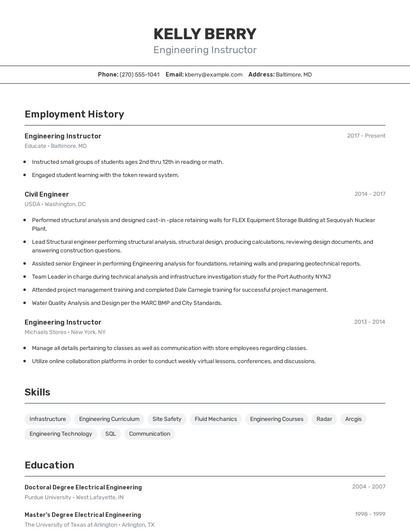
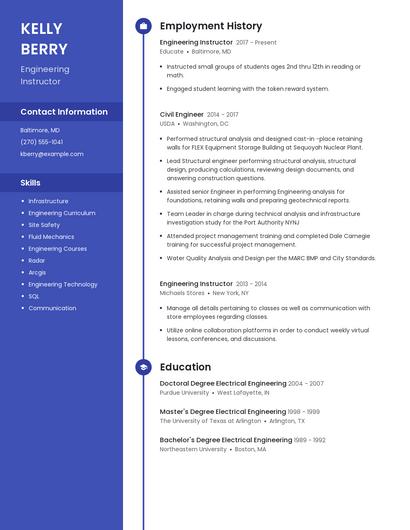
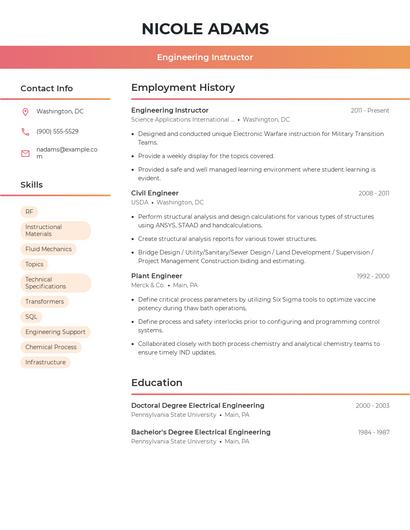
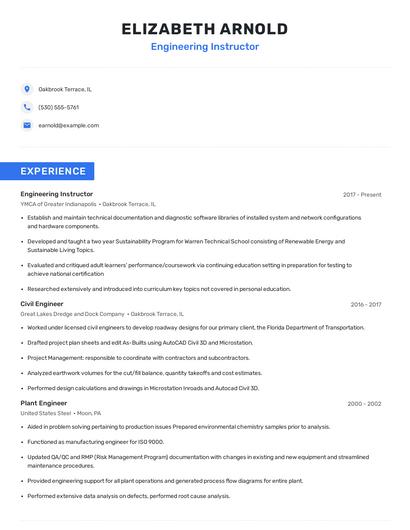
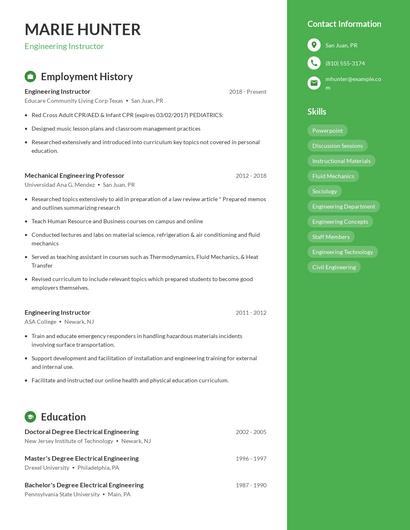
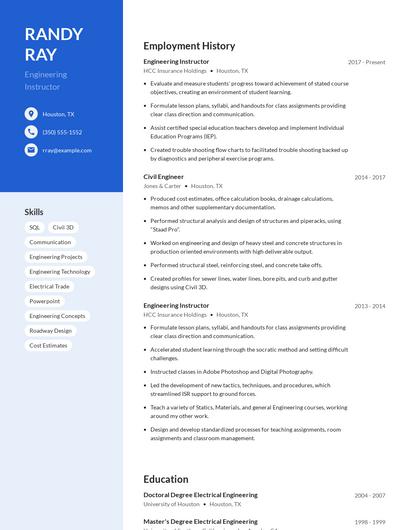
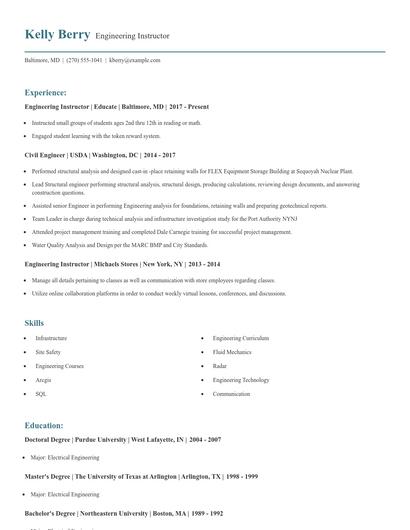
Choose from 10+ customizable engineering instructor resume templates
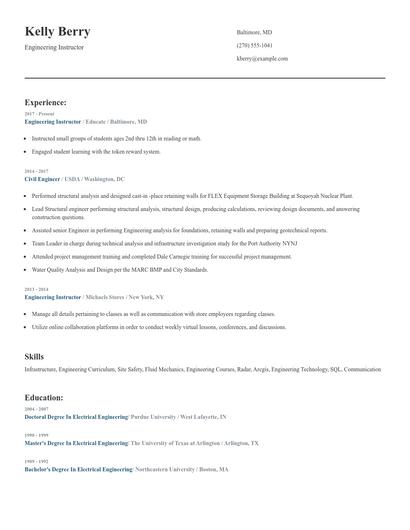
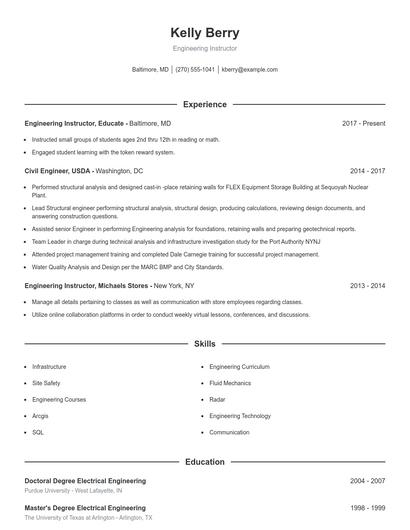
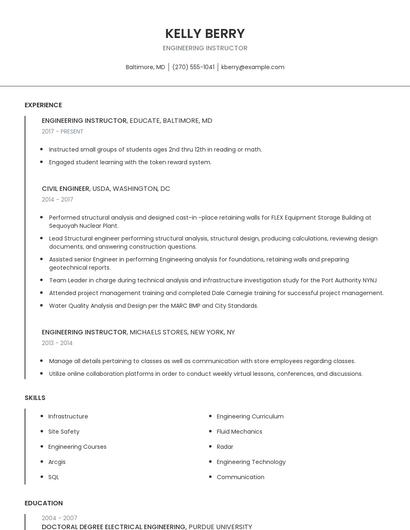
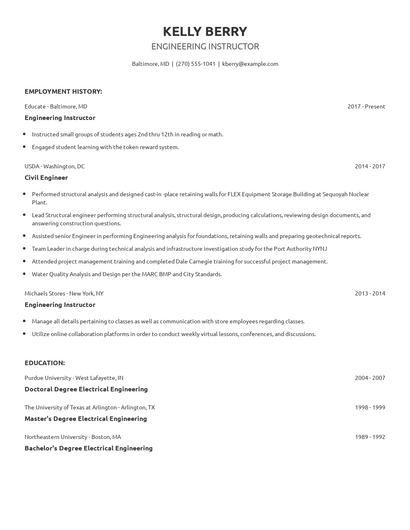
Build a professional engineering instructor resume in minutes. Our AI resume writing assistant will guide you through every step of the process, and you can choose from 10+ resume templates to create your engineering instructor resume.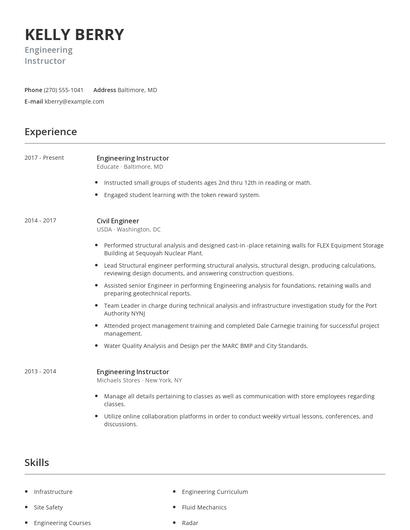
Compare different engineering instructors
Engineering instructor vs. Senior lecturer
As a senior lecturer, you need to have the skills of managing and implementing an online system for better learning. You also need to arrange the laboratory courses and conduct the research, which includes model-based testing. You have to incorporate theoretical exercises to improve the student's knowledge. Besides that, you need to conduct some practical classes to expand the scope of the students.
You can teach them some practical skills such as communication basics and creative thinking. You need to lecture the undergraduate students as well as the postgraduate students. From time to time, you need to teach reaction mechanisms to alternative students as well.
There are some key differences in the responsibilities of each position. For example, engineering instructor responsibilities require skills like "kids," "engineering principles," "engineering courses," and "instructional materials." Meanwhile a typical senior lecturer has skills in areas such as "philosophy," "undergraduate courses," "literature," and "research projects." This difference in skills reveals the differences in what each career does.
Senior lecturers earn the highest salaries when working in the education industry, with an average yearly salary of $82,871. On the other hand, engineering instructors are paid more in the education industry with an average salary of $52,512.The education levels that senior lecturers earn slightly differ from engineering instructors. In particular, senior lecturers are 12.6% more likely to graduate with a Master's Degree than an engineering instructor. Additionally, they're 17.7% more likely to earn a Doctoral Degree.Engineering instructor vs. Electronics teacher
In addition to the difference in salary, there are some other key differences worth noting. For example, engineering instructor responsibilities are more likely to require skills like "kids," "engineering principles," "engineering courses," and "mathematics." Meanwhile, an electronics teacher has duties that require skills in areas such as "basic mathematics," "circuit design," "lab equipment," and "computer repair." These differences highlight just how different the day-to-day in each role looks.
Average education levels between the two professions vary. Electronics teachers tend to reach similar levels of education than engineering instructors. In fact, they're 0.8% less likely to graduate with a Master's Degree and 17.7% less likely to earn a Doctoral Degree.Engineering instructor vs. Associate professor of mechanical engineering
The required skills of the two careers differ considerably. For example, engineering instructors are more likely to have skills like "kids," "professional development," "engineering principles," and "engineering courses." But a associate professor of mechanical engineering is more likely to have skills like "biomedical," "cad/cam," "undergraduate courses," and "mechanical engineering courses."
Associate professors of mechanical engineering typically earn higher educational levels compared to engineering instructors. Specifically, they're 5.2% more likely to graduate with a Master's Degree, and 29.6% more likely to earn a Doctoral Degree.Engineering instructor vs. Mechanical drawing teacher
Even though a few skill sets overlap between engineering instructors and mechanical drawing teachers, there are some differences that are important to note. For one, an engineering instructor might have more use for skills like "kids," "professional development," "engineering principles," and "engineering courses." Meanwhile, some responsibilities of mechanical drawing teachers require skills like "ages range," "k-12," "drawing classes," and "art classes. "
Mechanical drawing teachers reach similar levels of education compared to engineering instructors, in general. The difference is that they're 2.4% more likely to earn a Master's Degree, and 3.7% less likely to graduate with a Doctoral Degree.Types of engineering instructor
Updated January 8, 2025
